10/02/2026
Boston Dynamics Gives Atlas a 13-DOF Hand
Four fingers, direct drive, and a design built for sim-to-real work with tools.
Read full story →
Four fingers, direct drive, and a design built for sim-to-real work with tools.
Read full story →
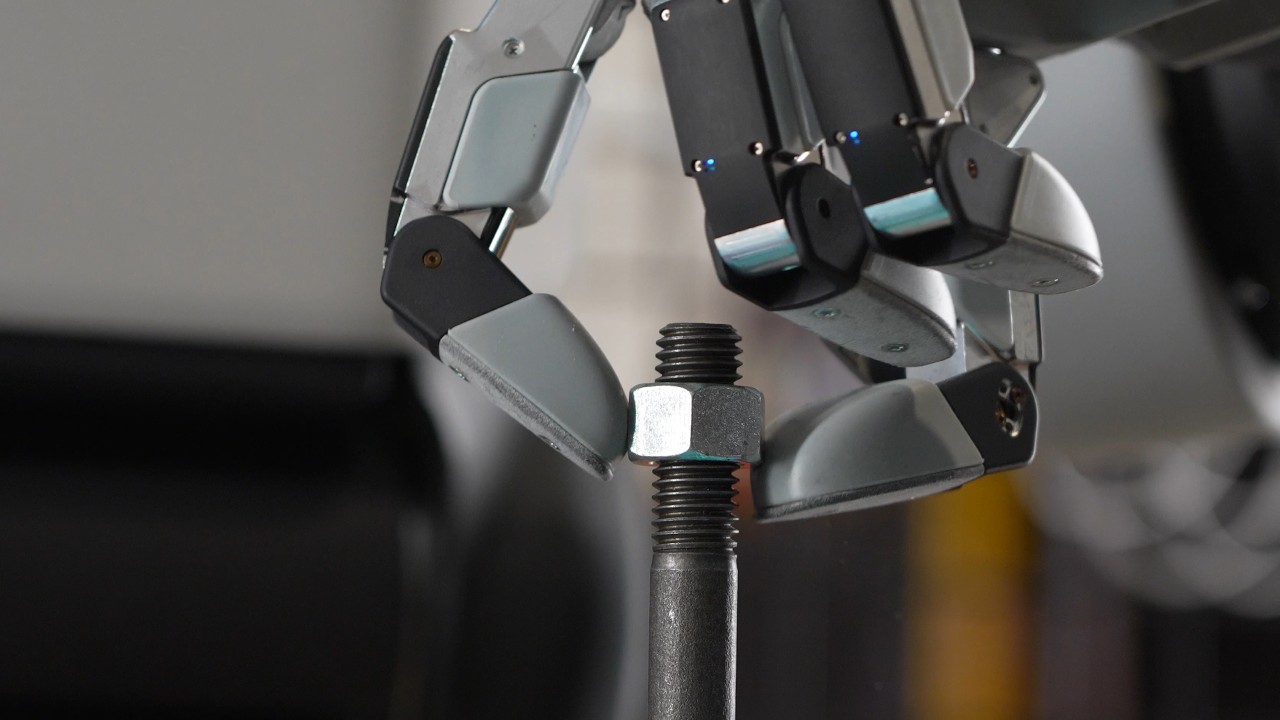
Boston Dynamics has shown a new generation of hands for Atlas. The company says the hand has 13 degrees of freedom, is directly actuated, and is built so it can be simulated cleanly enough for sim-to-real reinforcement learning. The previous hand had seven degrees of freedom. This one has four fingers, including a more dexterous thumb, and no pinky.
In a blog posted October 1, Boston Dynamics said the hand is meant for dexterous physical work, not only grasping. Direct-drive joints, encapsulated actuators, and tactile sensors on the fingertips and palm are part of the design. The company says the hand can pinch, hold a tripod grasp, and grip a tool while pressing its trigger.
A humanoid that cannot hold a tool and pull a trigger is still a carrier. Boston Dynamics is arguing that 13 well-chosen joints beat a five-finger replica if the hand has to be simulated, built, and repaired at factory scale.
Watch Boston Dynamics’ new Atlas hands.
Open the official video
REK’s ring bout puts a person in gear opposite a six-foot combat robot.
Read full story →
Frankie LaPenna faced a humanoid robot in a ring bout organized by REK on September 18. The clip, carried by Mecha Fight Arena, runs from the face-off to the final exchange. LaPenna wore protective gear. The robot is about six feet tall and has been compared in coverage to a Terminator-style chassis.
REK billed the night as a human-versus-machine event and tied it to a game in which people face remote-controlled humanoid robots. Coverage of the bout shows LaPenna trading strikes before a kick sends him across the ring. Viewers and reporters have questioned how much of the exchange was staged, and the robot is not presented as an autonomous fighter.
The useful fact is the format, not a claim that a robot won an autonomous fight. A company put a humanoid in a ring with a person to sell robot combat as entertainment. Treat the result as event footage.
Watch the REK human-versus-machine bout.
Open the video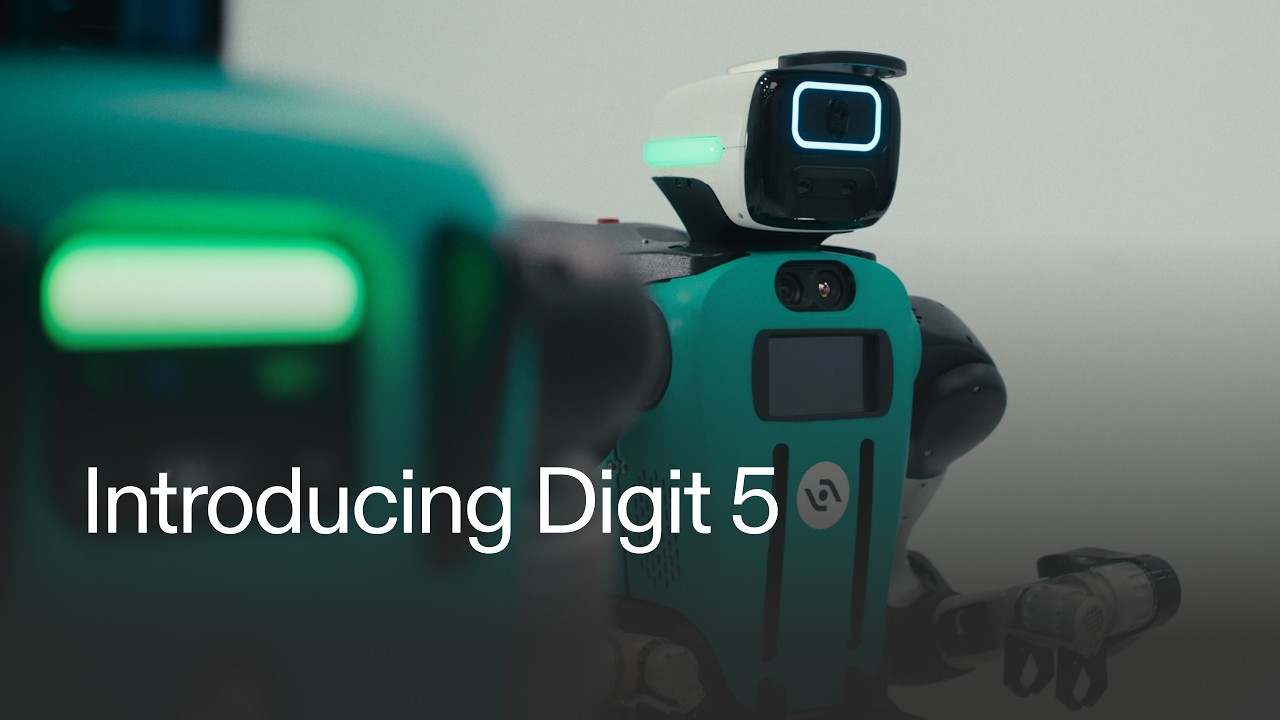
Cooperative safety is meant to drop the cages traditional automation still needs.
Read full story →
Agility Robotics unveiled Digit 5 on September 15 as its first humanoid engineered for cooperatively safe work at scale. The company says the robot can work in close proximity to people without the physical safety barriers traditional automation usually requires.
Digit 5 uses sensors and a separate safety controller to avoid a person, stop, or sit if someone gets too close. Visual and audio cues signal what it is about to do. Agility lists a 50-pound payload, 7.2-foot reach, and a battery that charges in about nine minutes so a unit can work more than 20 hours in a day. Early customer access is planned for the first half of 2027.
Humanoids stay stuck in demos if every aisle needs a fence. Digit 5 is Agility’s attempt to make shared floor space the product, not a later feature.
Watch Agility’s Digit 5 introduction.
Open the official video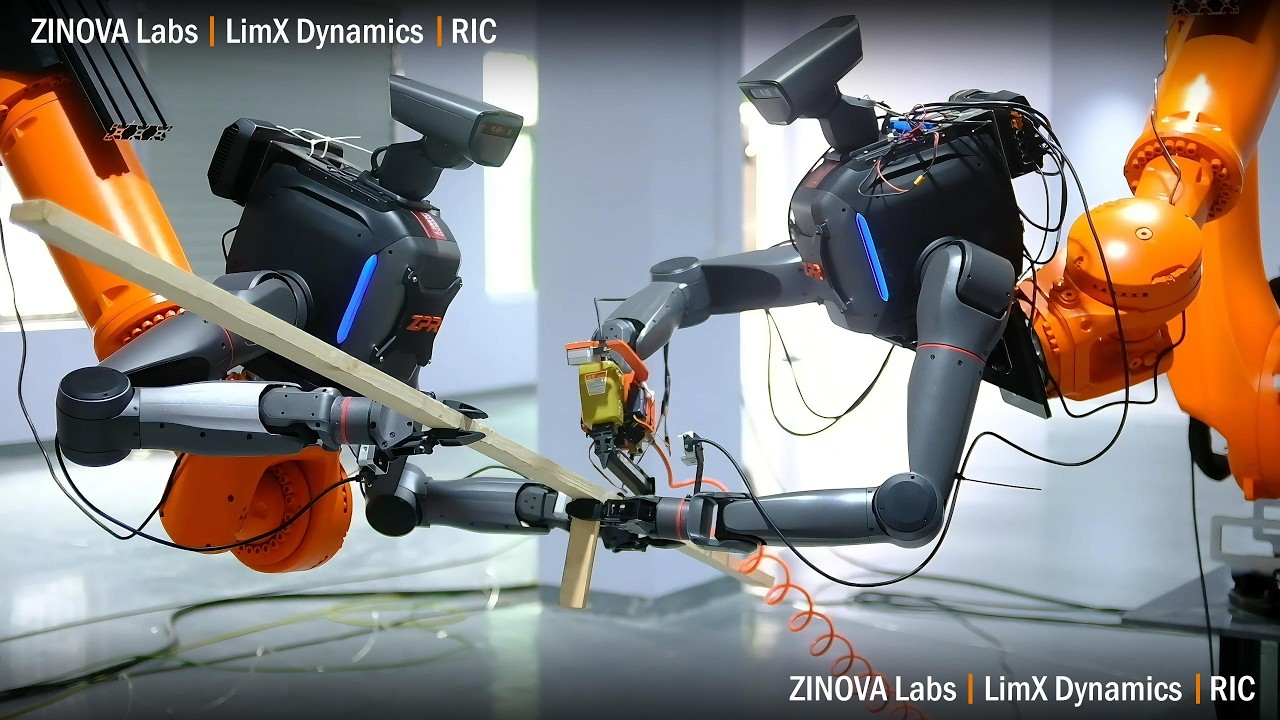
LimX and ZINOVA show formwork, rebar placement, and tying on a scaled site.
Read full story →
ZINOVA Labs used LimX Dynamics’ TRON 2 to explore a robotic setup for construction. The official video shows a scaled-down tilt-up workflow: formwork assembly, multi-layer rebar placement, and tying. TRON 2’s dual arms handle tools and materials at different heights and orientations.
The demo, posted in early September with RIC Robotics, mounts the modular upper body so it can cover a larger workspace than a desktop cell. LimX calls TRON 2 a platform for multi-tool, multi-step tasks. Neither company is claiming a live construction fleet. It is a proof of concept on a scaled site.
Construction fails robots on reach, tools, and sequence, not on a single grasp. This clip is about connecting those steps, even if the site is still a demonstration.
Watch the TRON 2 construction demo.
Open the official video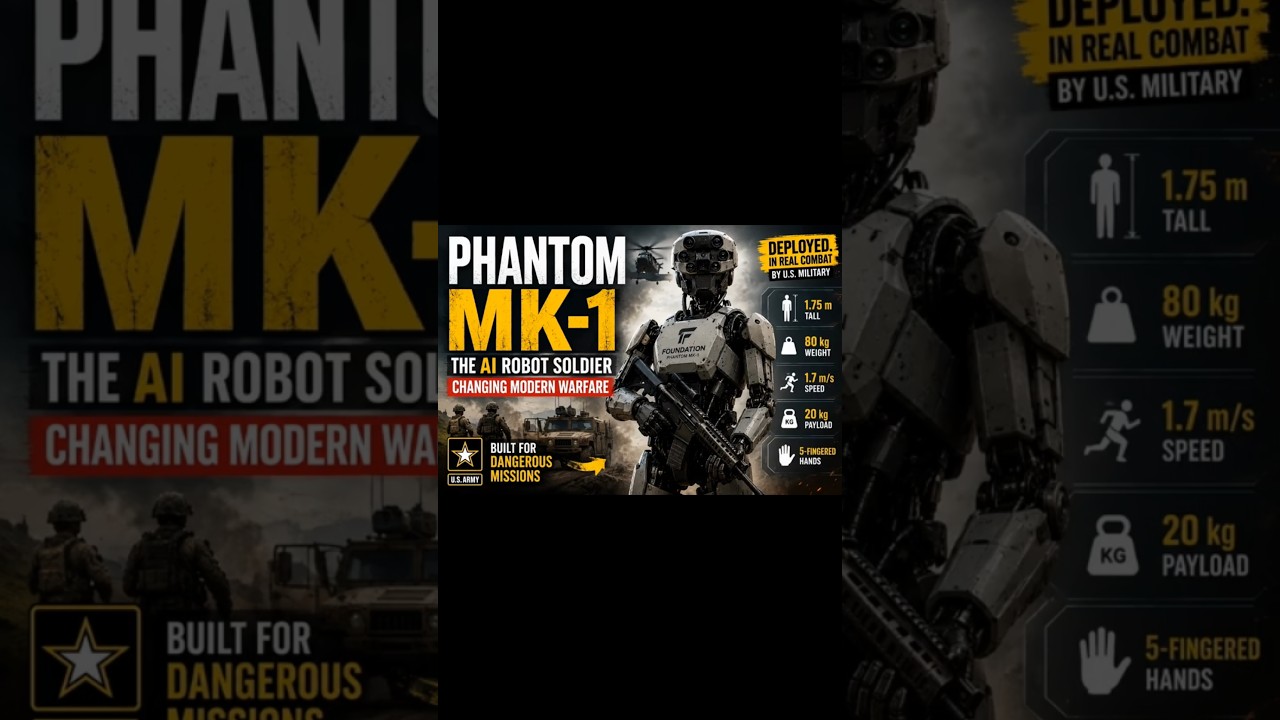
A humanoid pitched for carry, tools, and high-risk support roles.
Read full story →
A short on the Phantom MK-1 presents Foundation’s humanoid as a platform for military support, reconnaissance, bomb disposal, and other dangerous tasks. The company has described the robot as a body that can carry equipment, operate tools, and go into places it does not want a soldier to enter first.
Public specs put the MK-1 at about 5 feet 9 inches and roughly 175 to 180 pounds, with a payload around 44 pounds and cycloidal actuators. Foundation has been open about dual-use defense interest and a human-in-the-loop model for lethal decisions. The short is a product pitch, not an after-action report from a deployment.
Most humanoid companies avoid defense language. Foundation does not. The short is useful as a statement of intent, and only as that until independent deployment data exists.
Watch the Phantom MK-1 short.
Open the videoSeptember 27 through October 1 at the David L. Lawrence Convention Center. Thursday is reserved for workshops and tutorials.

IROS 2026 ends today in Pittsburgh. The IEEE/RSJ International Conference on Intelligent Robots and Systems opened September 27 and runs through October 1 at the David L. Lawrence Convention Center. Humanoid Press shot the footage above from an upper floor on September 29. From that height the hall reads as one field of booths, posters, and people, not as a list of names. The view is meant to show the scale of one of the field’s main annual meetings as the week reaches its last day.
The official program is the fact sheet behind that view. Program chair Ross L. Hatton’s note lists more than 1,900 contributed papers, each given as a talk and a poster. Add 19 keynotes under the theme “Open Problems and Perspective Shifts,” 86 workshops and tutorials on the Sunday and Thursday bookends, nine competitions, about 150 late-breaking posters, and more than 170 exhibitors. IEEE IROS also reported that the exhibit hall in Halls A and B opened Monday with 180 numbered booths plus industry talks, demonstrations, and competitions.
The week is split on purpose. Sunday and Thursday are workshops and tutorials. Monday through Wednesday carry the core papers, posters, paper demos, keynotes, and the three plenary panels: start-ups and entrepreneurship; space; and generalist versus specialist robotics. Forums covered U.S. government funding, experiential robotics education, and whether the field underinvests in its own foundations. Exhibit hours ran through Wednesday. Thursday, October 1, returns to workshops and tutorials rather than another full exhibit session.
Pittsburgh’s local claim on that agenda is Carnegie Mellon and a downtown hall that can hold a meeting this size. IROS is not a civic campaign. It is papers, sessions, and a floor. Labs use the week to show reviewed work. Companies use it to put hardware in front of people who write requirements. Students use it to find the next lab. The overhead footage is how that mix looks when the camera stops on the room instead of a single booth.
One high shot cannot stand in for an exhibitor list. The video does not identify companies on the floor, and this brief does not invent them. Digit 5 and the 1X interview published this month are separate product and manufacturing stories. They are not evidence those firms occupied a Pittsburgh stand unless a floor plan or a photograph from the hall says so. The lead remains the conference itself.
IROS 2026 ran in Pittsburgh from September 27 to October 1 at the David L. Lawrence Convention Center, with more than 1,900 papers, 19 keynotes, 86 workshops and tutorials, nine competitions, and more than 170 exhibitors. The footage shows the hall from above. The final day is given over to workshops and tutorials as the meeting closes.

Agility Robotics unveiled Digit 5 on September 15 as its first humanoid engineered for cooperatively safe work at scale. The company says the robot can work in close proximity to people without the physical safety barriers traditional automation still uses. The product film on this page is Agility’s official introduction. The firm frames Digit 5 as a warehouse and factory tool built on a decade of research and years of earlier Digit deployments, not as a show-floor mascot.
Cooperative safety, in Agility’s wording, means the robot watches for people and then avoids them, stops, or sits. Proprietary detection software and an independent safety controller are supposed to make those moves without a fence. Visual and audio cues tell nearby workers what the machine intends to do. IEEE Spectrum and Ars Technica both reported the sit-down behavior as the blunt answer to a falling biped: put the load down and become a stable seat before a person is close enough to be hit.
The published hardware numbers sit next to that claim. Agility lists a 23-kilogram, or 50-pound, payload and a reach of about 2.1 meters. A 90-minute battery with a nine-minute charge is how the company argues more than 20 hours of work in a day. Spectrum described a 1.8-meter, 129-kilogram machine trained, Agility says, on 65,000 hours of real-world operating data. Those figures are Agility’s. They are not a third-party shift log from a Digit 5 line that is already running without cages.
Spectrum also noted the hardware is real and that Digit 5 is not yet deployed in factories. That sentence matters more than the launch adjectives. Earlier Digits worked behind workcells. Digit 5 is the generation Agility says can leave the cell. Until a customer site publishes hours with people walking the same aisle and no fence, cooperative safety remains a designed behavior on a new body, not a finished industrial standard.
The film shows gait, reach, and the safety language Agility wants attached to the machine. A conference hall in Pittsburgh is not a Digit 5 factory floor. Agility’s own site is the source for the phrase “first humanoid engineered for cooperatively safe work at scale.” Independent coverage confirmed the launch. Factory-scale work beside people without barriers is still the claim being tested.
Digit 5 is Agility’s fifth-generation warehouse humanoid, announced in mid-September and built to detect people and then avoid, stop, or sit instead of living behind a cage. Payload, charge time, and the 65,000-hour data line are company figures. Work beside people without barriers is the promise still being proven in the field.

On Relentless, 1X founder and CEO Bernt Børnich sat with Ti Morse and said the company is preparing to manufacture and ship 50,000 NEO humanoids in 2027. That number is a target from the September 18 interview, not a completed order book. Børnich’s own caution came in the same opening stretch: the hard part is not only shipping 50,000 units, but making sure they do not come back.
The factory math he gave is also a plan. The Hayward, California line is built for about 10,000 units a year at full ramp. He said 1X will not hit 10,000 this year because the line reaches that rate late in 2026. A second site in San Carlos is being built for about 100,000 units a year, with most of that volume arriving late in 2027. Combined nameplate capacity is not the same as 50,000 robots walking out the door next calendar year.
Børnich treated production as harder than prototypes. Rare faults start to matter when output moves from hundreds of units into the thousands. He described quality gates, a roughly four-week path from a major CAD change to a walking robot, and a preference for small teams and fewer parts than a car. Those are manufacturing arguments from the founder. They are not third-party yield numbers from either plant.
The rest of the conversation is product philosophy, not a shipment report. Living with NEO, automating household tasks, warmth in the design, world models, teleoperation, and the line that 1X is “diversity-bound rather than data-bound” are how Børnich wants the home robot understood. Formal safety work before broad home use is the limit he put on the consumer story. Treat that as stated intent.
The interview was recorded at 1X and posted in mid-September. It is a California manufacturing conversation. It does not place NEO on the IROS exhibit floor in Pittsburgh. The 50,000-unit figure belongs to Børnich’s plan for 2027, not to a count of robots already shipped.
1X is targeting 50,000 NEO shipments next year, backed by a 10,000-unit Hayward ramp and a planned 100,000-unit hall in San Carlos, gated by quality and returns. NEO remains the home-robot platform the company has been building toward. Fifty thousand units is next year’s goal, not this year’s tally.
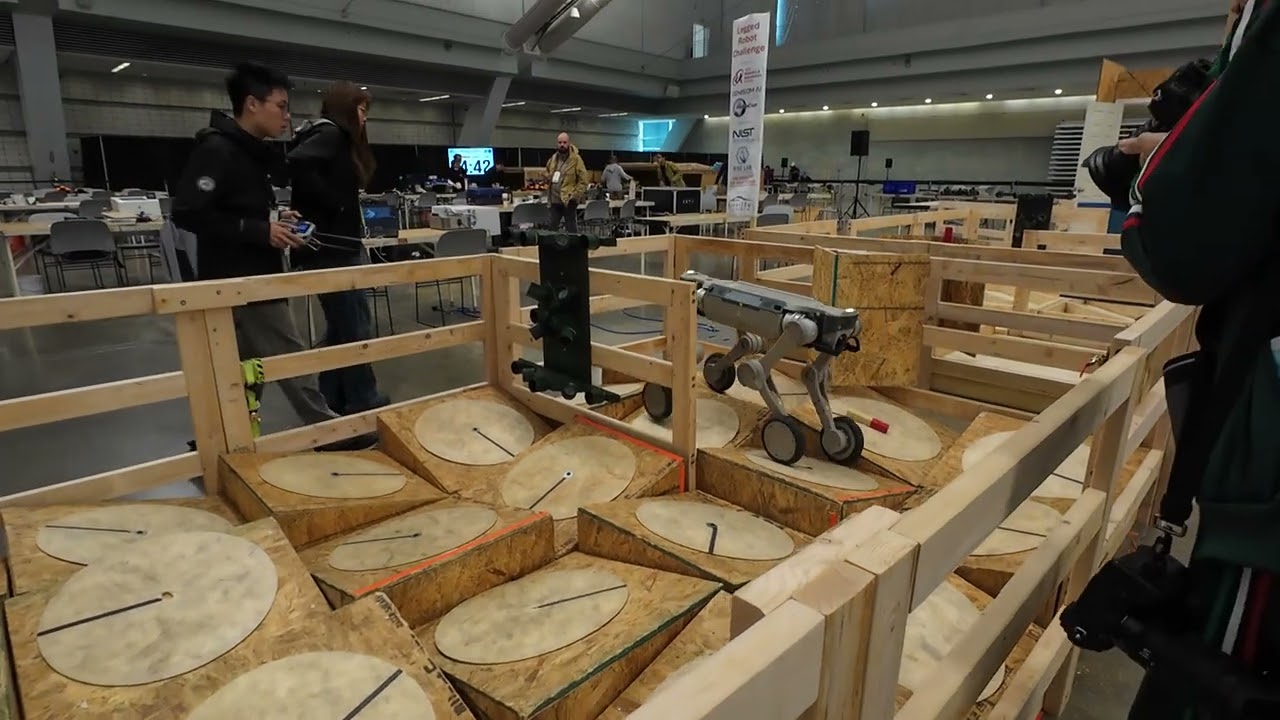
Robots navigate challenging ramp terrain to test mobility and stability at IROS 2026 in Pittsburgh.
Read full story →
A short look at a pitch and roll ramp challenge at IROS 2026 in Pittsburgh. The competition tests robotic mobility and stability as robots navigate challenging ramp terrain. Filmed at IROS 2026. News is about IROS event.
This segment is a highlight of the IEEE/RSJ International Conference on Intelligent Robots and Systems (IROS) 2026, held September 27–October 1 in Pittsburgh, Pennsylvania—the premier global forum for robotics research. IROS brings together thousands of engineers, scientists, and students to exchange breakthroughs in autonomous systems, perception, planning, and physical interaction.
The pitch-and-roll ramp challenge specifically evaluates how robots maintain balance, adjust posture, and execute controlled locomotion across inclines and uneven surfaces—core challenges in real-world deployment where terrain is rarely flat. While exact footage of the pitch-and-roll ramps may appear in conference live streams or related coverage, the competition underscores IROS’s tradition of rigorous testing for practical robotics performance beyond controlled labs.
With IROS 2026 now in its final days, this segment highlights ongoing efforts to bridge simulation and the physical world, ensuring that future autonomous systems can operate reliably outside factory floors or simulated environments. Stay tuned for post-event recaps as researchers publish findings on mobility benchmarks and stability metrics.
Watch IROS 2026 Pitch and Roll Ramp Challenge.
Open the official video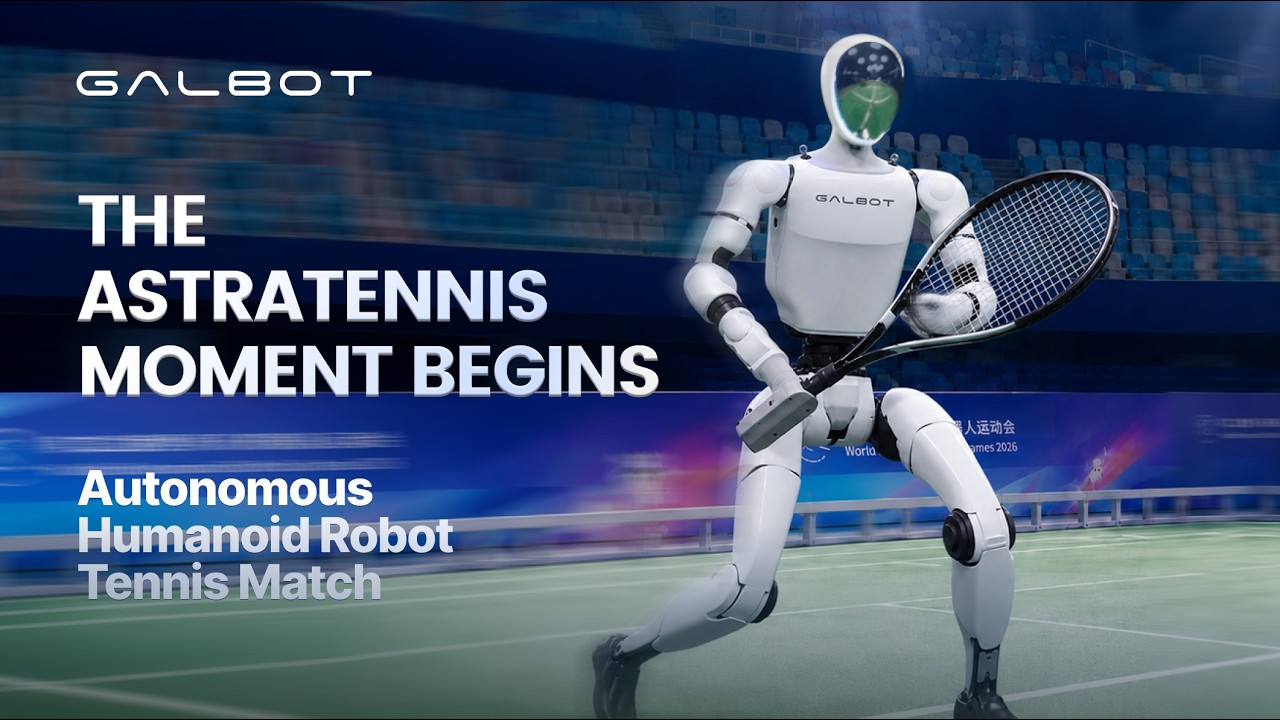
From AlphaGo to real-time play: Galbot robots compete live against humans at the Second World Humanoid Robot Games.
Read full story →
From AlphaGo to AstraTennis. In 2016, AlphaGo defeated world champion Go player Lee Sedol — marking a defining moment in AI history. A decade later, AI enters the physical world.
At the Second World Humanoid Robot Games, Galbot humanoid robots achieved the world’s first live autonomous humanoid robot tennis match, competing against human athletes on the global stage. Unlike scripted demonstrations, this was a real-time autonomous competition. The Galbot robot independently perceived the ball, made decisions, moved across the court, and competed against human players.
The robot demonstrated a full range of tennis skills, including forehand and backhand drives with precise timing, volley returns, and quick court movement. This milestone occurred at the Second World Humanoid Robot Games in Beijing in August 2026, where over 2,000 robots participated across dozens of disciplines. The event marked a significant step toward truly embodied AI, moving beyond simulation to live competition in unstructured, noisy environments.
While scripted demos have long shown humanoid tennis capability, Galbot’s live matches against humans represent the first time a robot independently controlled perception, strategy, and execution in real time. This advances the field by proving that general-purpose world-action models can handle dynamic sports with variable lighting, crowds, and unpredictable human movement.
The development also builds on broader 2026 trends in physical AI, where Chinese humanoid manufacturers continue to push boundaries in endurance, dexterity, and autonomous decision-making. With the games concluding, expect follow-up papers on perception pipelines, reinforcement learning for sports, and the scalability of such systems for entertainment and training applications. The clip serves as a powerful reminder that AI is no longer limited to abstract games—it is now competing on the court in the physical world.
Watch Galbot Autonomous Tennis at World Humanoid Robot Games.
Open the official video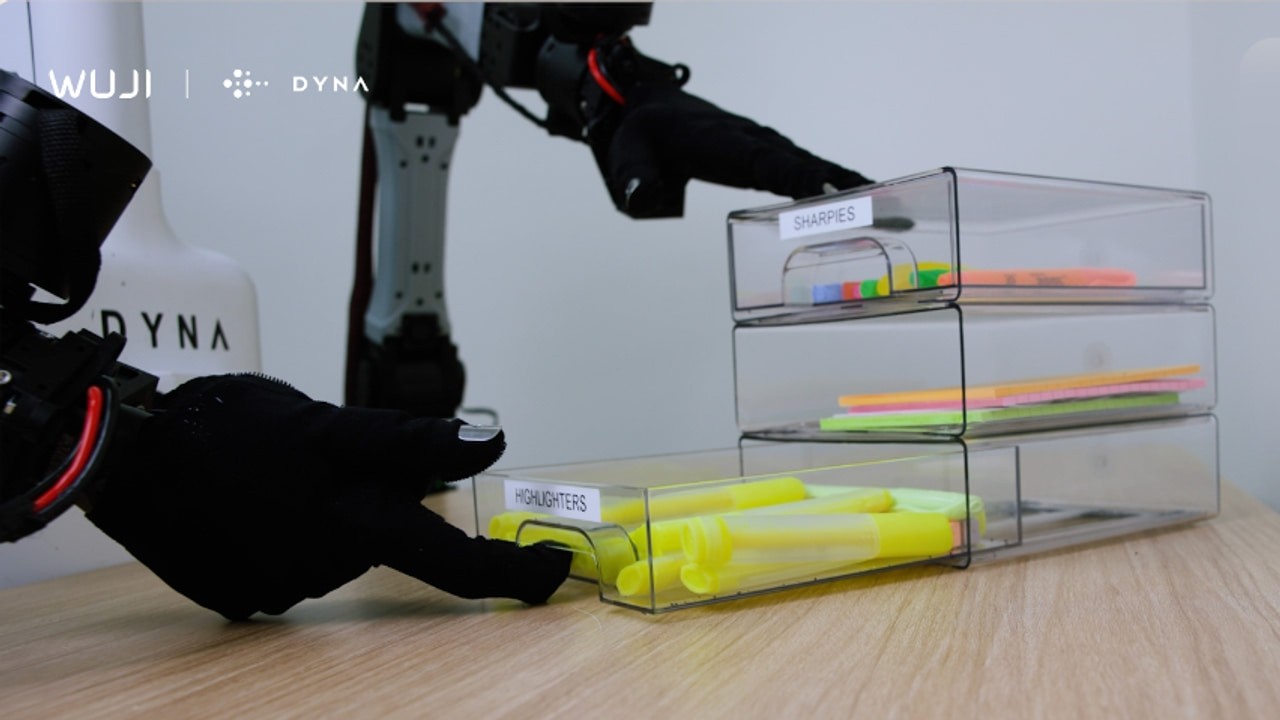
Pre-trained on over 1,000,000 hours of egocentric human video; real-robot dexterous manipulation demos using Wuji Hand.
Read full story →
Dyna Robotics has released Dyna-2, a world-action model pre-trained on over 1,000,000 hours of egocentric human video. In Dyna-2’s real-robot demonstrations, Wuji Hand is used for dexterous manipulation tasks that rely on contact, object-state understanding, and reliable execution.
At Wuji Tech, we continue to advance dexterous robot hardware and work with ecosystem partners to bring general-purpose robots closer to real-world deployment. The official Dyna-2 page is available at https://www.dyna.co/dyna-2.
This model marks a major leap in scaling world-action models without robot-specific pre-training data, relying instead on vast human egocentric video corpora. The scaling law has been validated across both continuous error metrics and discrete action accuracies, showing consistent improvement on unseen robots and real-world evaluations.
Wuji Hand, a commercial high-DoF anthropomorphic hand, powers several of the real-robot demos, handling contact-rich tasks such as object manipulation that demand precise force control and state estimation. The absence of robot data during pre-training is particularly noteworthy—it demonstrates that general human experience can transfer effectively to robotic hardware.
This aligns with broader industry efforts in 2026 to move beyond demonstration-heavy robotics toward models that generalize across domains. With Dyna-2 now public, expect rapid adoption in research labs and early commercial pilots for tasks like assembly, repair, and household chores. The integration with ecosystem partners, including Wuji Tech, signals a maturing supply chain for dexterous hardware.
Watch Dyna-2 World Action Model with Wuji Hand.
Open the official video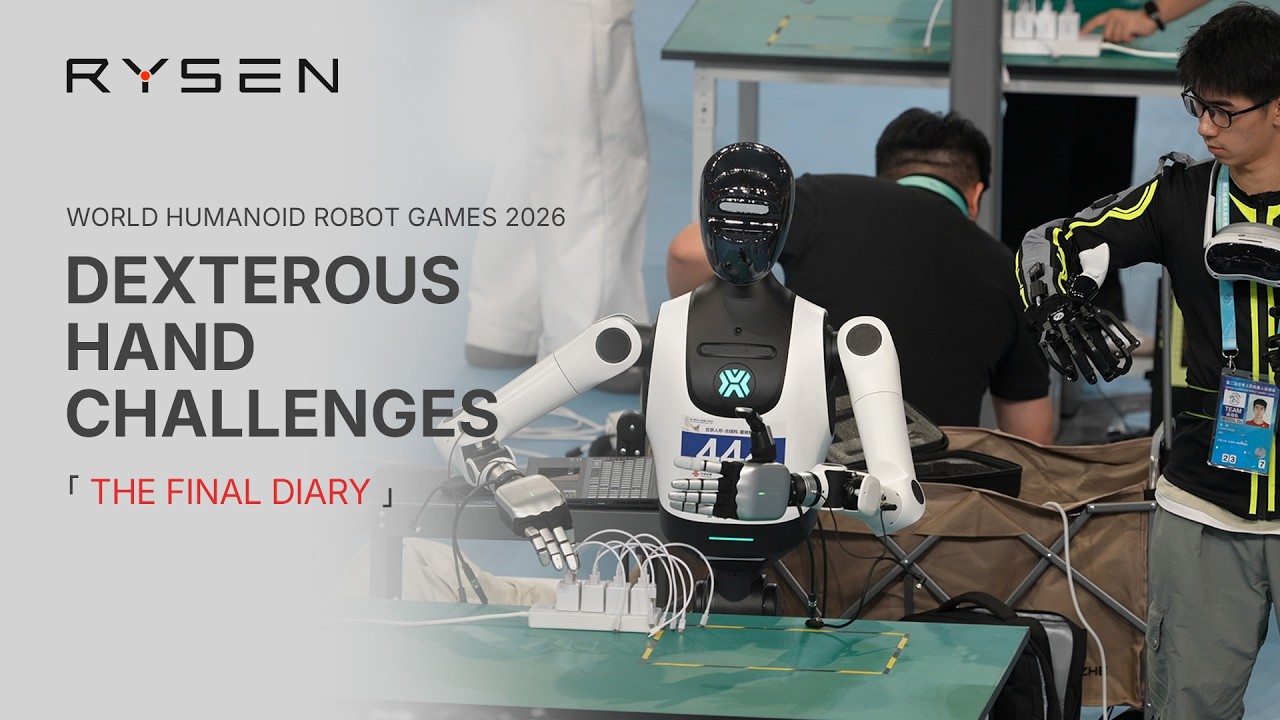
The only high-DoF dexterous hand powering both high-load and precision-manipulation challenges.
Read full story →
As the only high-DoF dexterous hand used across both high-load and precision-manipulation challenges at the World Humanoid Robot Games 2026, Apex Hand worked alongside the competitors—putting its dexterity, strength, and reliability to the test.
The Second World Humanoid Robot Games, held in Beijing in August 2026, featured over 2,000 robots competing in 64 skill categories across 68 countries. Apex Hand stood out as the sole high-DoF unit capable of both heavy-load industrial tasks and fine-grained manipulation, supporting athletes in disciplines requiring strength, endurance, and precise control.
Its performance in the games highlighted the maturing reliability of commercial dexterous hands, with fewer failures during high-intensity or precision-demanding rounds compared to earlier generations. The event’s emphasis on mandatory autonomy and real-time decision-making made Apex Hand’s role even more critical, as it had to operate without human intervention in live competition.
This deployment also signals a broader shift in 2026 toward hardware that can scale across use cases—from factory assembly to human augmentation. With the games now concluded, expect detailed technical reports on failure modes, grip strength metrics, and comparative benchmarks against other hands. Apex Hand’s success at the Games positions it as a key enabler for the next wave of humanoid applications in manufacturing, logistics, and beyond, where both power and finesse are non-negotiable.
Watch Apex Hand at World Humanoid Robot Games 2026.
Open the official video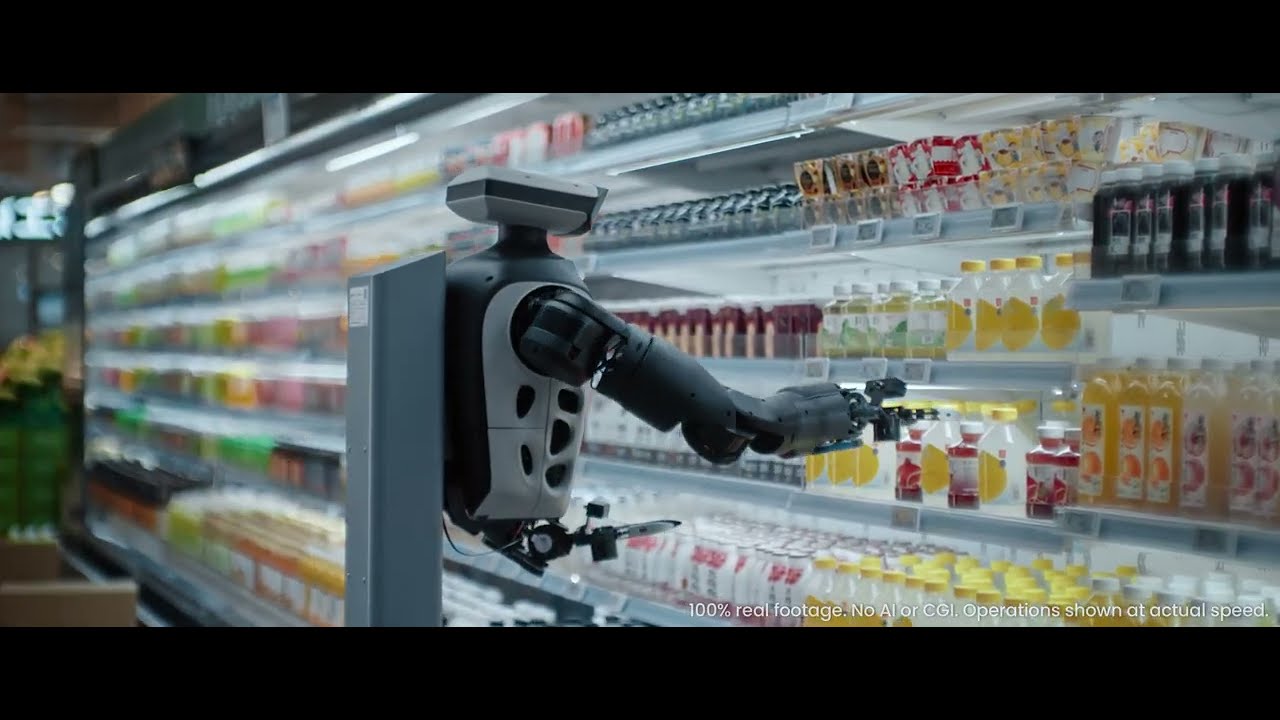
Real on-site footage of everyday manipulation tasks from supermarkets to warehouses and homes.
Read full story →
Meet LingYu TA2, a dual-arm robot built for real work. No CGI, no staged demos — every clip in this video is real on-site footage. TA2 is developed by Dexteleop, incubated at the Beijing Key Laboratory of Embodied AI.
From supermarket shelves to warehouses and homes, TA2 handles everyday manipulation tasks with two dexterous arms. Dexteleop, a Tsinghua-affiliated company founded in 2025, specializes in embodied intelligence systems, with a focus on teleoperation and commercialization through three strategic pillars: hardware development, software ecosystems, and real-world deployment pilots.
The Beijing Key Laboratory incubation provides access to leading expertise in perception, control, and safety-critical robotics. Unlike many research prototypes that remain lab-bound, TA2 has been tested in live environments including retail shelves, warehouse logistics, and domestic settings.
The absence of CGI or staging underscores Dexteleop’s commitment to practical validation, aligning with the lab’s emphasis on bringing general-purpose robots closer to everyday use. This dual-arm platform represents a significant advancement in bimanual manipulation, addressing the long-standing challenge of coordinating two high-DoF hands for tasks requiring sequential and simultaneous operations.
As more deployment data emerges, TA2 could accelerate the timeline for humanoid robots in consumer and industrial sectors, where current single-arm systems often fall short on complex, multi-step workflows. The real-world footage serves as compelling proof that sophisticated dual-arm control is now transitioning from prototype to production-ready technology.
Watch LingYu TA2 Dual-Arm Robot.
Open the official videoActuators leave the digits. Distal mass drops. That is the argument for coordinated work at this joint count.

LinkerHand is circulating new tape of the L30, a tendon-driven dexterous hand built for high degree-of-freedom motion at speed. The clip’s own line is short: tendon-driven, high DoF, and fast. Motors sit out of the fingers so there is very little distal mass to accelerate. That is the design claim. Coordinated work at this joint count, the company says, needs that mass off the digits. The video above is the file they attached to that argument.
A tendon hand routes force through cables instead of packing a motor in every knuckle. The fingers stay light. The actuators live in the palm or forearm. Less inertia at the tip is how you ask a high-DoF hand to change direction without waiting on a heavy joint. L30 is being shown as that architecture in motion, not as a spec sheet read aloud. Watch the digits, not a voiceover list of newton-meters that never appears on screen.
The footage is mixed. LinkerHand says the cut combines work from earlier this year with more recent takes. Treat it as a compilation, not a single session and not a timed benchmark. What you can see is coordinated finger work on a tendon stack. What you cannot see is payload, cycle life, or how the hand behaves after a shift on a humanoid wrist. Those numbers are not in the caption you were given.
Speed at a high joint count is the product pitch. Many dexterous hands add degrees of freedom and then look slow because each extra joint still carries its own motor. Moving the actuators out is the older tendon answer to that trade. L30 is LinkerHand putting that answer on camera again. It is a hardware story. It is not a factory deployment and it is not a claim that the hand now ships on a named biped.
Read the clip next to the rest of this brief without merging the tiles. JAKA π is a compact humanoid Games recap. X-Pro is a wheel-legged patrol dog from an August launch reel. L30 is a hand. Three different bodies, three different jobs. The L30 file does not put LinkerHand on an IROS booth and it does not put the hand on JAKA’s robot. Keep the boxes separate.
What holds for publication is the vendor tape and the vendor line. LinkerHand L30: tendon-driven, high degree of freedom, actuators off the fingers so distal mass stays low. Footage cut from earlier this year and more recent work. No independent endurance study, no listed price in the copy we used, no named customer wrist. The story is the architecture on screen. That is the lead.

JAKA Robotics posted a recap of JAKAπ at the World Humanoid Robot Games: dancing, competing and taking on new challenges on a compact frame. The tape is a highlight reel, not a medal table. JAKA is a Shanghai cobot maker that spent more than a decade on collaborative arms, motion control and joint modules before putting that stack into a child-sized humanoid. π is that first body. The games clip is how the company wants the jump from factory cobots to an embodied platform to be seen by labs and show floors that already know the arm line.
JAKAπ stands about 122 centimeters and weighs about 42 kilograms, with 27 degrees of freedom and a listed 3-kilogram arm payload. JAKA sells it as an open development machine for classrooms, retail, entertainment and companion settings, with SDK access, voice control and a dual “fusion brain” on an Intel platform that splits high-level reasoning from real-time motion. Walk, run and jump claims sit in the spec sheet. The games footage is the public proof file for balance and choreography, including a Tai Chi showing that JAKA itself billed as a top-ten finish at the Games.
That cobot history is the part of the caption that is not just a montage. Joint design, force control and safe motion next to people are what JAKA already ships in plants. A humanoid that dances on a stage is using some of the same joints under a different costume. Whether those joints hold up in a classroom or a shop floor for a full shift is a different test than a games highlight cut to music. The company is asking viewers to read the decade behind the reel, not only the performance on top of it.
The World Humanoid Robot Games have become the place Chinese vendors take a new biped to be seen walking under lights. JAKA’s own site framed π’s Beijing appearance as validation after a June 2026 public debut. A recap video weeks later is standard vendor aftercare: keep the robot in the feed after the arena lights go down. It is not an independent scorecard of how π placed across every event, and it does not replace a timed walk or a classroom log.
Watch the clip for what it is. Coordinated whole-body motion on a short humanoid. A cobot company showing it can put a biped on a floor and make it perform in front of cameras. No payload trial, no classroom study, no endurance hours. The open SDK and the listed markets are how JAKA says the same machine leaves the arena and enters a lab or a store. Those paths are still product language until someone publishes a semester or a shift with the unit still standing.
Write π as a compact JAKA humanoid with a games reel and a cobot pedigree. Height, mass and DoF are the company’s numbers. The Tai Chi top-ten line is JAKA’s own result posting. The tape D5z-MqDOuGo is the look-back they circulated after the Games. Until a third party times a walk or logs a classroom week, this stays a vendor recap. Do not read it as a LinkerHand wrist or as an IROS booth.

X-Pro is a wheeled quadruped that the vendor dated to an August 2026 model launch and is now circulating as a patrol and inspection platform. The pitch list is security patrol, fire rescue, facility inspection and oil-and-gas rounds. Wheels on the legs are the product idea: roll on flat ground, walk when the path breaks into stairs or gravel. The tape is a demonstration of that hybrid gait and of cameras doing a route, not a signed contract with a refinery, a plant or a firehouse.
Wheel-legged dogs have become their own shelf this year. Faraday Future’s Aegis family sits on the same idea at a different price. X-Pro is being sold into the industrial inspection slot: perimeter loops, plants, and sites where pavement and broken ground show up on the same shift. Vendor pages tied to the August clip describe autonomous patrol, navigation, obstacle avoidance and recognition, with a note that the footage is for demonstration. That disclaimer belongs in the same paragraph as the mission list, not after the sale.
Fire-rescue and oil-gas language is the high-risk end of the brochure. A dog that can carry thermal, gas or camera payloads is a familiar quadruped story. Putting wheels on it is how the seller argues speed on pavement without giving up a curb or a stair. None of that is a certified firefighting appliance or a documented leak walk at a live well pad. It is a configuration looking for a buyer who already runs patrol robots and wants mixed terrain in one chassis instead of two.
The August date is why the clip is still moving in late September. A summer launch reel often gets a second pass weeks later while other stories fill the same brief. X-Pro is not a biped and it is not a classroom kit. It is a wheeled dog with a job list. Keep the three tiles in separate boxes. L30 is a tendon hand. π is a Games recap from JAKA. This is a patrol platform on four legs and four wheels.
What can be stated from the listing and the video is limited and clean. A new X-Pro model was presented in August 2026 as a wheel-legged robot dog. Intended work: security, inspection, fire-rescue support and oil-gas patrol. The file TnpouUKpMFQ is the demo attached to that launch line. Capabilities shown are motion and sensing on a course the seller chose. Treat payload kits, runtime and weather limits as unspecified until a datasheet, not the title card, puts numbers on them.
Do not upgrade a product video into a deployment. No city, plant or brigade is named in the copy we were given. No price. No fleet size. The honest brief is a hybrid quadruped offered for patrol-shaped work, dated August, still being pushed in September. If a site logs nights with the unit on a fence line, that is a later tile. This one is the launch tape and the job list on the tin.
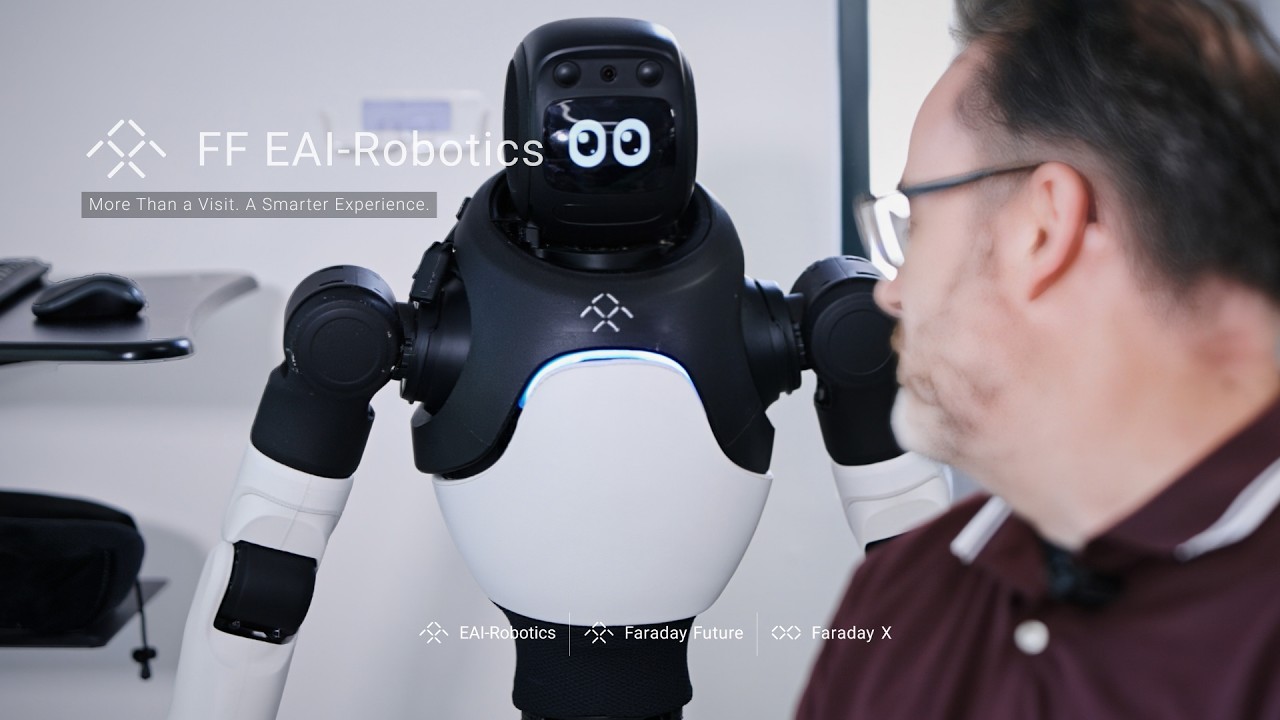
Faraday Future’s humanoid handles front-desk talk and wayfinding — not clinical work.
Read full story →
At Wonderful Life Dental Group in Los Angeles, Faraday Future’s FF Master is shown talking with patients through natural conversation, responsive movements, and personalized experiences. Faraday Future delivered the robot in June 2026 as its first real-world healthcare use of the Master platform.
The assignment is front-desk work: patient check-in, appointment lookup, reception assistance, and wayfinding. Faraday Future says the unit stays out of clinical procedure rooms. Local development and service teams can customize Master for different business needs, and the company says the robot can communicate in more than 50 languages.
A waiting room is a harder test than a booth. The clip does not prove medical utility. It does show Faraday Future putting a humanoid in a live customer-facing clinic role and treating customization as part of the product.
Watch FF Master at Wonderful Life Dental.
Open the official video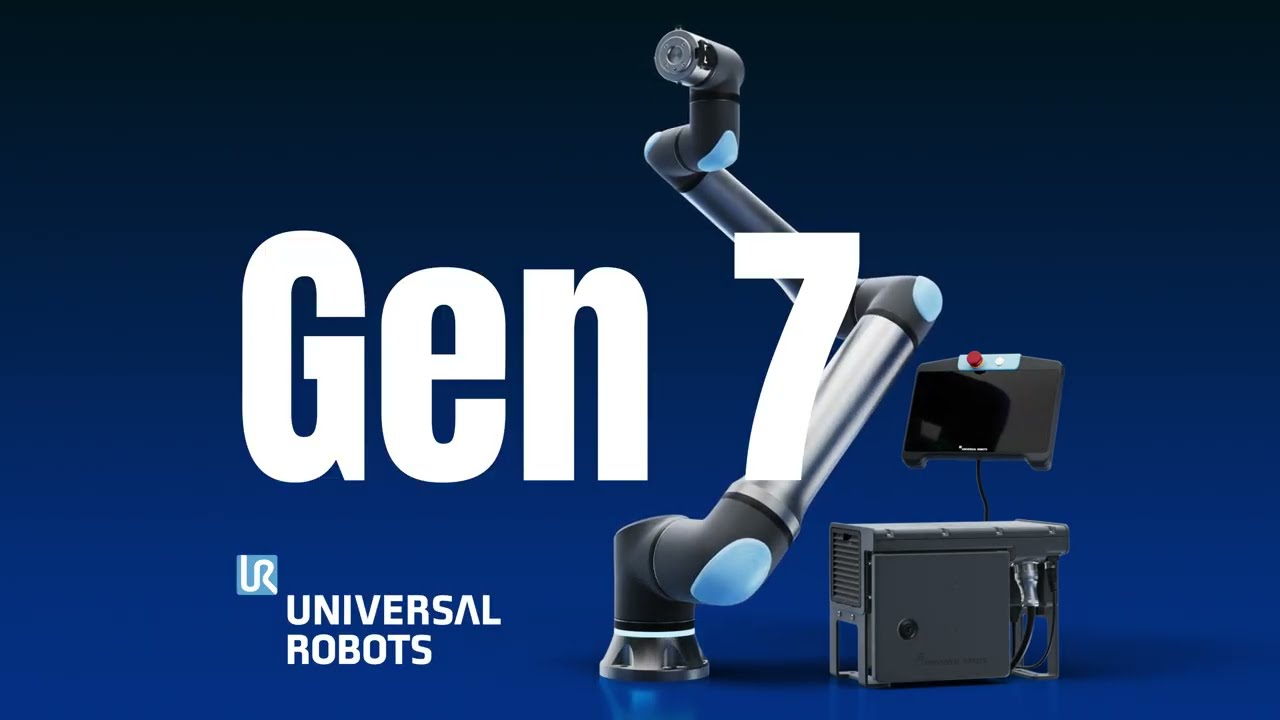
Tool-flange ports, plant-scale networking, and ROS2 AI control are the pitch.
Read full story →
Universal Robots launched Gen 7 at IMTS in Chicago on September 14 as its seventh-generation collaborative industrial robot platform. The company is leaning on more than 20 years in cobots and more than 100,000 robots sold. UR says customers still pick it first because it is easy to program and easy to deploy.
Gen 7 is a platform refresh — g-Series arms, CB7 Core controller, TP7 teach pendant, SP7 Smart Panel, and PolyScope X — not a single new arm. Integrated tool-flange ports add Ethernet, high-power supply, and configurable I/O so cameras and end-of-arm tools can connect with fewer dress kits and cables.
Most cobot buyers need a camera, a gripper, and an external AI box without a wiring project. UR is selling Gen 7 as that platform: advanced enough for physical AI, simple enough that existing UR shops can still teach it on the floor.
Watch Universal Robots’ Generation 7 introduction.
Open the official video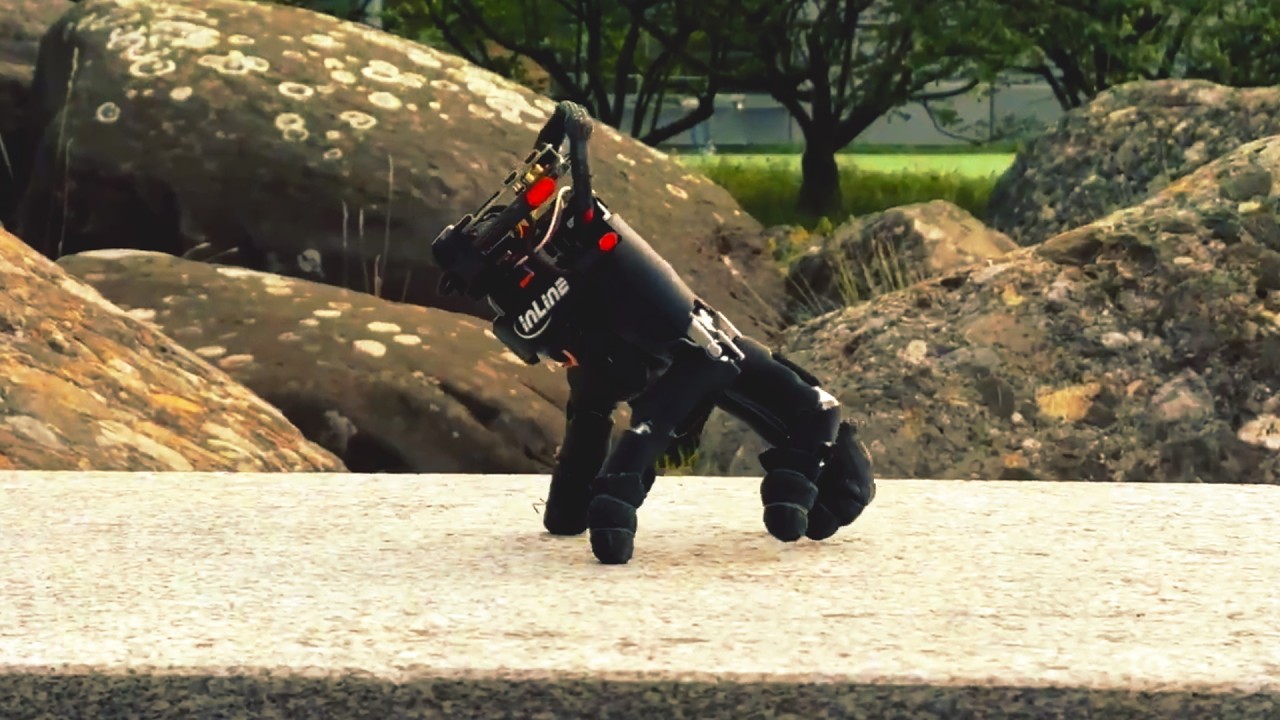
An 818-gram anthropomorphic hand crawls, recovers from falls, and taps keys.
Read full story →
Researchers at ETH Zurich’s Soft Robotics Lab taught a commercial WUJI anthropomorphic hand to walk on its fingertips. All five fingers carry the hand’s weight. It crawls across surfaces, gets back up after a fall, presses keyboard keys, and pushes objects toward a target.
The full system weighs 818 grams including battery and onboard computer, with 20 powered joints. Policies are learned in simulation with reinforcement learning, then run on the real hand. The preprint is “Fingers as Legs: Learning Self-Supported Locomotion and Manipulation with an Anthropomorphic Hand,” by Amirhossein Kazemipour, Hehui Zheng, and Robert Katzschmann.
WUJI is a store-bought manipulation hand. ETH did not invent the bare hardware. The result is still a lab preprint, not a product. It does show that the same fingers can locomote, recover, and manipulate without an arm holding them up.
Watch ETH Zurich’s WUJI hand demonstrations.
Open the research video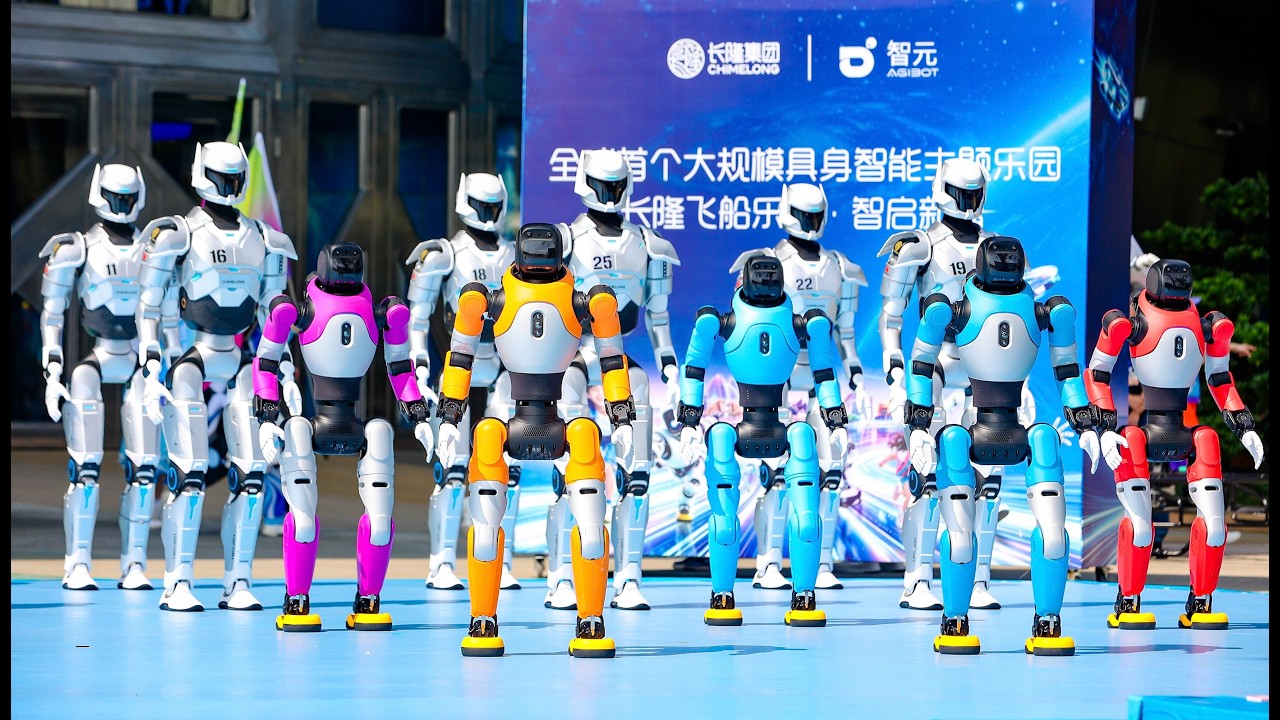
In Zhuhai, the fleet performs, guides visitors, and answers questions around people.
Read full story →
On September 24, AGIBOT and Chimelong Group opened the first phase of a large embodied-AI deployment at Chimelong Spaceship Park in Zhuhai. More than 300 AGIBOT robots are assigned to entertainment, education, visitor services, and hotel operations. AGIBOT’s video asks what a 300-plus robot deployment looks like when the machines perform, guide visitors, answer questions, and provide services around people.
The same announcement marked delivery to Chimelong of the 20,000th robot off AGIBOT’s production line. That is a cumulative manufacturing milestone, not a claim that 20,000 robots are working in the park.
A theme park is noisy, crowded, and public. That is a different reliability problem from a fenced workcell. The clip is still a company video. The next evidence is whether hundreds of units stay on task after opening week.
Watch AGIBOT’s Chimelong deployment video.
Open the official video
More than a dozen robots kept formation using onboard sensing, not joysticks.
Read full story →
More than a dozen robots joined human dancers at the opening ceremony of the WorldSkills Competition in Shanghai on Tuesday, September 22. South China Morning Post’s video says the robots were not controlled remotely. Engineers used built-in sensors and cluster control so the humanoids stayed in formation with their human partners.
The 48th WorldSkills Competition opened with 1,385 competitors from 68 countries and regions across 64 skill categories. The official WorldSkills Shanghai page describes 20 full-size humanoids performing with 120 dancers. Local reporting says 19 of those robots were Unitree H2 units.
A dance is still a show. It is also a multi-robot coordination test in a crowd. The useful takeaway is that a cluster can hold formation around people without remote puppeteering.
Watch the WorldSkills Shanghai human-robot performance.
Open the videoThe floor is crates and cable. Reception is tonight. The bar stays dark.

Humanoid Press stopped by the David L. Lawrence Convention Center while IROS 2026 was still a setup day. Workshops were already in the building. The exhibition floor was not. Exhibitors were still laying out booths, cases, demos and cable. That is the tape, not a keynote and not a counted result. The hall is quiet on purpose. A welcome reception is listed for Sunday evening in Hall A. Main exhibit hours open Monday. Treat this short as a before picture. The after picture starts tonight.
The calendar around the clip is not in dispute. IEEE/RSJ IROS 2026 runs 27 September through 1 October in Pittsburgh. Sunday is workshop and tutorial day. Official exhibit install runs through Sunday afternoon. Howie Choset of Carnegie Mellon is general chair. Pittsburgh last hosted IROS in 1995. Those are program facts. They are not proof any booth on this tape will still be standing Thursday.
What the new clip adds is the empty-room beat. A look inside before the floor gets busy: displays half-built, equipment on carts, staff on radios. No parade, no packed poster hall, no claim that a humanoid worked a shift. The correspondent’s line is that the atmosphere is relatively quiet and that the hall will look different once the community arrives. That is the cheapest true sentence of conference week. It is also the one that ages in a few hours. Watch it as logistics. Do not watch it as a product launch.
Program Chair Ross Hatton’s note is the scale line to keep: over 1,900 contributed papers, 86 workshops and tutorials, and 170-plus exhibitors. The program site also lists 19 keynotes, three plenary panels, nine competitions and 150 late-breaking posters. Do not swap those for older preview counts. The short does not audit the floor. It only shows the building while those sessions are still incoming. More IROS coverage from this desk is promised after the hall opens.
For a humanoid page the comparison is a factory tour, not a Games final. A quiet convention hall is how research weeks start. A crowded aisle with a working arm is how they get written up. Both can be true by Wednesday and still be early. A Sunday workshop is a useful scene. A booth that runs a demo without a minder is a different product. This tape has not published the second number. Until the floor is live, “IROS is here” is a caption, not a field rating.
So the 27 September lead is the walkthrough and the date. IROS 2026 is open in Pittsburgh, workshops first, exhibits still going in. Watch the short. Do not promote the bar. If tonight’s reception or Monday’s floor produces a named demo with hours, the ranking conversation starts. If the next clip is another empty aisle, this stays a conference-arrival story — which is still news. It is just not a counted fleet.
A company demo shows orientation, identity memory, live language switching, and multi-person Q&A on the humanoid.
Read full story →
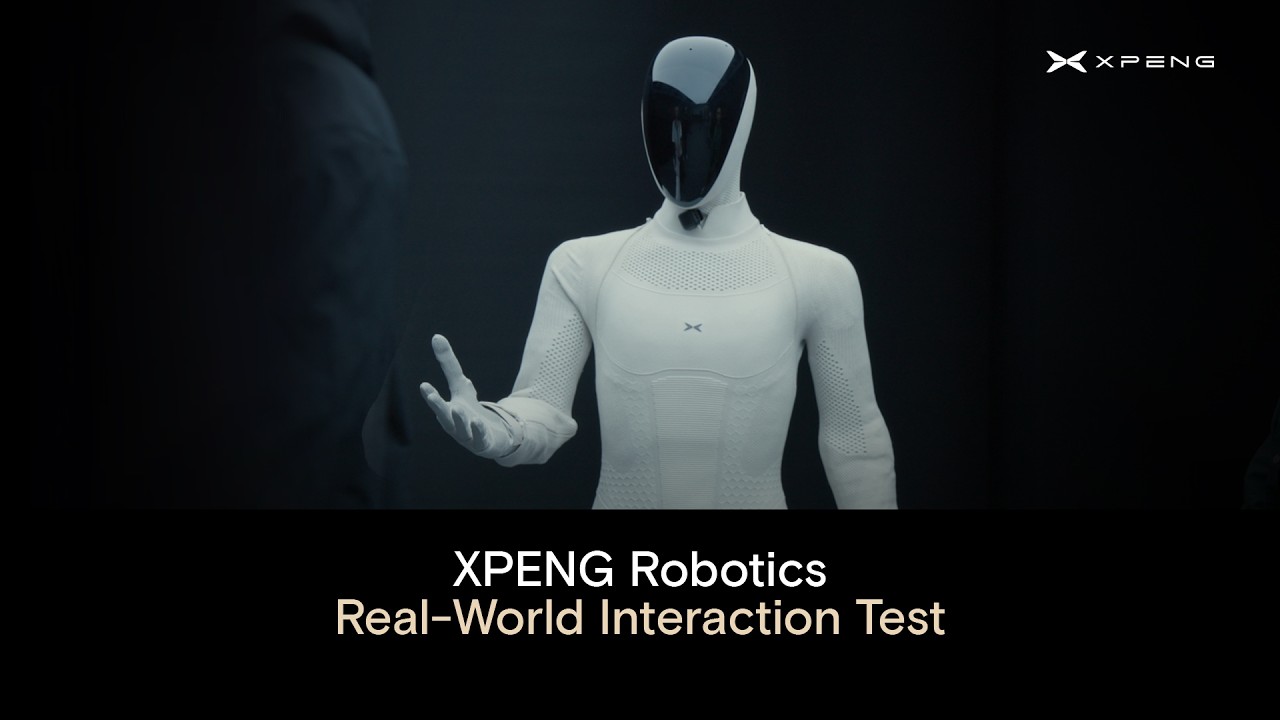
XPENG posted a five-minute “real-world interaction test” on September 22. IRON stands with three testers and runs four tricks the company says make the humanoid feel closer to a person: it orients toward whoever is speaking, it keeps an identity for each visitor after they swap clothes and places, it answers in Chinese, English, or German without a separate “switch language” command, and it handles overlapping questions as multi-person Q&A. The caption is blunt: IRON recognizes you, understands you, and responds to you. Powered by Physical AI.
The clip is a studio sales conversation, not a store floor or a factory cell. IRON turns head, waist, and torso toward the active voice. After the testers change outfits and positions, it still ties each person to an earlier vehicle preference and corrects one speaker who borrows another’s name. Language follows the last utterance. XPENG attributes that stack to acoustic perception, vision, motion control, a multilingual foundation model, and a balanced training set. The video does not publish latency, tracking accuracy, or how the same stack behaves in noise or a crowd.
IRON is XPENG’s next-generation humanoid, shown since AI Day in November 2025 as a biomimetic body with a spine, covered skin, and high joint count — company materials have cited 82 degrees of freedom on the body and about 21–22 on each hand. Compute is onboard Turing silicon running a VLT + VLA + VLM stack that XPENG also links to its cars. The interaction video is the social layer of that pitch: conversation and recognition first, manipulation later. Retail assistance has been the near-term commercial path XPENG has described, with store deployments discussed for 2027. Screw-driving trials inside XPENG’s own plants have already shown how fast complex hands wear and how hard it is to beat a human on cost. This new tape does not reopen that industrial test.
Autonomous orientation is useful if the robot is a greeter. Dynamic identity memory is useful if a showroom visitor walks away and comes back. Multilingual switching matters in export markets. Multi-intelligence Q&A is the claim that more than one person can talk at once without the session collapsing. All four are shown under lights, with willing testers, on XPENG’s channel. Commenters already asked whether any of it is teleoperated. The company presents it as onboard Physical AI. Until someone else runs the same four tests in a real store, treat the video as a capability reel, not a field result.
Watch XPENG’s IRON interaction test.
Open the official video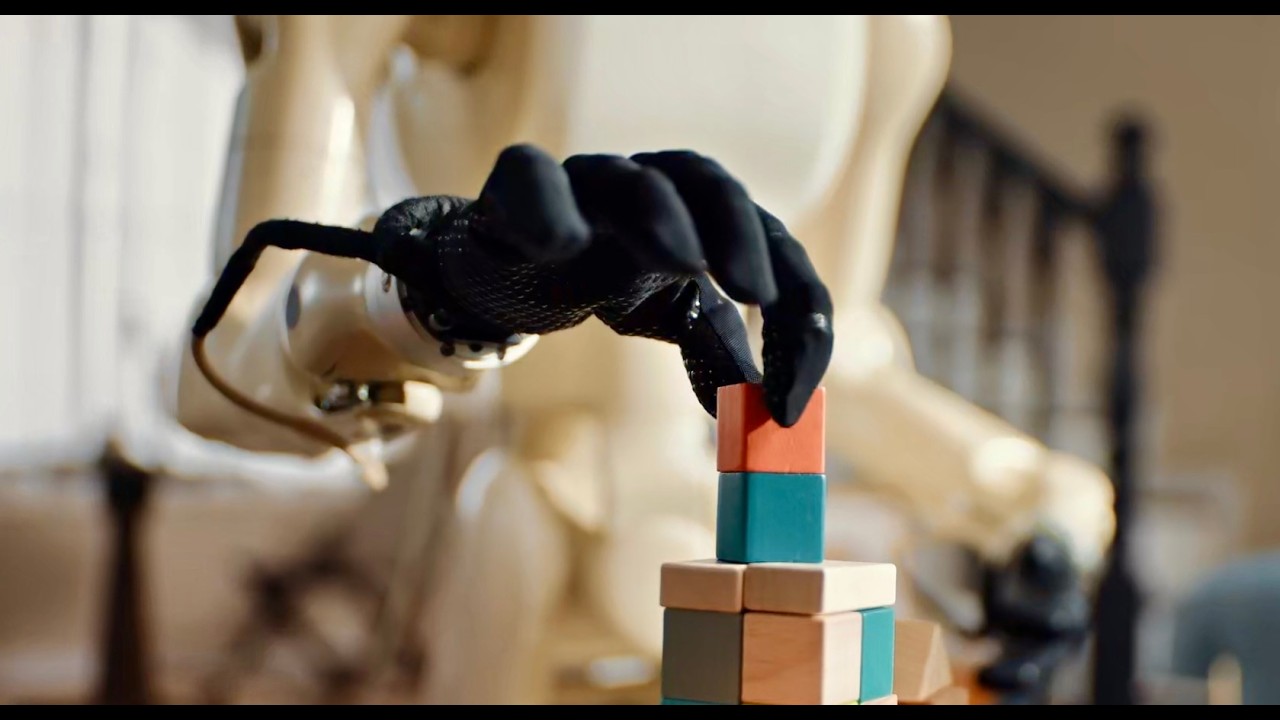
Finger coordination changes the grasp as object shape changes. WUJI is shopping the hand to other robot teams.
Read full story →
A new clip shows Gento Luna, the wheeled dual-arm platform from Gento Robotics / Tianji, running WUJI dexterous hands through three household-scale chores: handling bottles, stacking blocks, and putting toys away. The point of the tape is not a new body. It is the fingers. As each object changes shape and size, the hands retune the grasp instead of locking one pinch and hoping friction holds.
Gento Luna is a research and application base more than a biped: dual 7-DoF force-controlled arms, an omnidirectional chassis, full-body compliance, and an open compute stack. WUJI’s current hands are 20-active-DoF five-finger units with in-hand direct-drive joints, built as a component other teams can bolt on. WUJI’s own docs describe Hand 2 as a biomimetic research and integration product with joint-level SDK access, simulation models, and a teleop demo. The video is that pairing in motion — a mobile torso that can reach a table, plus hands that can close around a bottle neck, a cube, or a toy without swapping tools.
Bottles punish a grasp that is too stiff or off-axis. Blocks punish poor finger opposition and sloppy placement. Toys are the messy set: mixed mass, odd outlines, items that roll. Coordinated finger motion is the claim that one hand family can cover that range. WUJI is using the clip as a recruiting card. The closer asks other robotics teams to take the same hands into more real applications, which is how a component vendor grows when it does not ship a full humanoid of its own.
This is still a demonstration. It does not publish cycle counts, drop rates, or how long the motors stay cool. It also does not say whether the policy is fully onboard, teleoperated, or mixed. What it does show is a commercially pitched hand doing the last-centimeter work that parallel-jaw grippers skip, on a platform designed to collect that data.
Watch Gento Luna with WUJI hands.
Open the video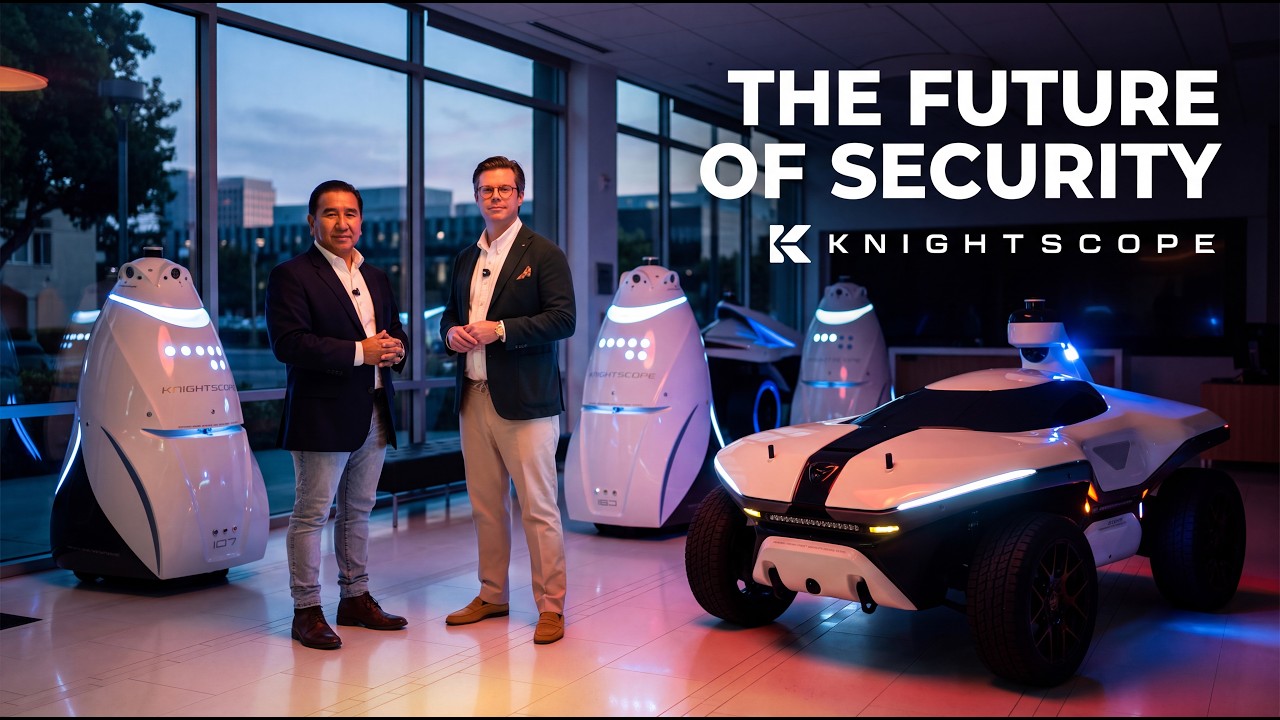
Bill Li walks K5, K7, and the rest of the Silicon Valley lineup. The robots are already on patrol.
Read full story →
Goanna Capital’s plant-floor tour of Knightscope’s Silicon Valley headquarters puts founder, chairman, and CEO William “Bill” Santana Li next to the machines the company actually sells. Knightscope is not pitching a home humanoid. It builds autonomous security robots, emergency communication devices, and the software that ties them to a human operations layer. The firm was founded in 2013 and trades on Nasdaq as KSCP.
The operating numbers Li and the company have repeated through the summer and into GSX in mid-September are specific: 434 clients across 42 U.S. states, and more than 4.4 million autonomous hours logged. Those figures showed up on the Q2 2026 call, in the investor deck, and again in September field briefs. They describe a deployed fleet, not a lab count. The mix includes robots plus emergency devices and licensed agents. Knightscope talks about “plus or minus about 10,000 machines and agents in network,” which is hardware, software, and people under one contract — not 10,000 walking humanoids.
On the floor, Li walks the K5, the familiar five-foot outdoor patrol unit, and the all-new K7, a larger, faster all-terrain robot the company has been gating through prototype reviews. Limited K7 deployments have been aimed at the second half of 2026, with production language pointing at the fourth quarter and a client list restricted at first to Autonomous Security Force accounts. The K7 is the machine Knightscope wants on big sites the K5 navigation stack struggled with. Speed is one advertised change: Li has said it can run up to about 10 miles an hour, well above the K5.
The strategy underneath the tour is unromantic. Machines watch; software sorts; people still take the calls that need judgment. Knightscope’s pitch at GSX was that this stack should sit inside one vendor instead of a pile of subcontractors. Li’s longer line is a million machines that see, hear, and cooperate so the existing guard force has better tools. Four-point-four million hours is the evidence he cites that the current generation already lives outdoors, in every U.S. time zone, across summers and winters. It is also why a headquarters tour is news in a humanoid feed: this is one of the few robot companies whose units are already on paid patrol.
Watch the Knightscope headquarters tour.
Open the videoFive models, four industry packages, a claimed “one-brain” stack. The tape is the Master Mini. The list price is the news.

Faraday Future Intelligent Electric Inc. (NASDAQ: FFAI) used a 19 September Los Angeles event to put nine new embodied-AI device configurations on sale across five models. The company says prices run from $9,990 to $137,900 and that all nine are available for sale and delivery now through FF.com, Amazon and RobotShop. The video above is the Master Mini, the compact humanoid FF is using to own the bottom of that ladder. The longer 919 keynote sits on a separate stream. What changed this week is not a research paper. It is a listed EV name publishing a robot price sheet with a sub-ten-thousand-dollar humanoid on it.
Master Mini is listed at about 95 centimeters and 19.5 kilograms, with three trims: Mini, Mini Pro and Mini Ultra at 48, 117 and 200 TOPS of onboard compute. FF prices them at $9,990, $12,990 and $17,990, each bundled with a skills package the company itself values at $1,000, $1,500 and $2,000. The pitch is classroom coding, open development and robot soccer on one chassis. FF calls it North America’s first compact EAI humanoid under $10,000 that combines those three jobs. That “first” is the company’s line, not an audited category, and the skills-package dollars are FF’s own valuations.
The rest of the nine-configuration card mixes humanoid and wheel-legged machines. All-New Futurist is the full-size flagship: 51 active degrees of freedom, 71 with a dexterous-hand upgrade, a 1,152-watt-hour dual pack and a claimed eight-hour shift under standard conditions. Standard is $89,900. Ultra, with NVIDIA Jetson Thor and a stated 700 TOPS, is $129,900. FX Aegis Hyper, a large industrial quadruped for harsh sites, opens at $137,900. Aegis Mega, a mid-size wheel-leg with a 50-kilogram payload claim, starts at $74,990. Aegis Ultra-W, a lighter security and companion wheel-leg at about 22 kilograms, is $12,990.
Around the hardware FF wrapped four industry packages — K-12 education, university research, security and inspection — plus what it brands Education & Research Ecosystem 1.0. Founder YT Jia’s line is that FF is not building one body that does everything. It is building an EAI brain meant to ride several bodies, with data from those bodies feeding a factory that trains the next skill. FF also claims the catalog now makes it the U.S. firm with the most robot forms. Treat that as a count of its own shelf, not a census of every lab and vendor shipping iron this year.
Sales language is a “6+1” map: B2B, FF Par, e-commerce, video sales, community and Mcube, with RoboShare as the rental plus-one through AIxC Holdings, a vehicle FF controls. Three bundles sit on the sheet — device only, device plus skills, device plus a complete solution. A Middle East partner event was slated for 23 September. A “Built in USA” partner conference and IROS 2026 in Pittsburgh sit on 28–30 September. Those dates are the company’s calendar. Whether every SKU actually ships at the printed price is a delivery question, not a launch-slide question.
What can be written without the slogan layer is still enough to lead. Faraday Future, on 19 September, listed nine configurations across Futurist, Master Mini and the Aegis family. Master Mini starts at $9,990. The top of the sheet is Aegis Hyper at $137,900. Four vertical packages sit on top of that hardware. The tape is the small humanoid walking the education pitch. The story is a Nasdaq EV name selling a robot catalog with a classroom price at the bottom and an industrial quadruped at the top.

The team behind Asimov 1 has open-sourced the robot’s locomotion policy and the training code that produced it. The drop includes a trained policy checkpoint plus Isaac Lab training code: reward definitions, hardware-tuned actuator configurations and domain-randomization settings. The clip starts at ten seconds, where that stack is laid out. The point is a starting walk other labs can fork, not a finished general controller for every pair of legs now leaving a factory in China or California. Asimov 1 itself is the open-hardware biped this policy was trained to move.
A locomotion policy is the controller that turns balance, step timing and contact into a walk. Publishing the checkpoint means someone else can load the weights instead of training from noise. Publishing the Isaac Lab recipe means they can see how those weights were grown: which rewards were counted, how the actuators were modeled on the real motors, and how the simulator was randomized so the policy would not overfit a single floor or a single mass. Without those three files together, a public “walk” is usually just a highlight reel.
That last piece is the useful one for anyone who does not own an Asimov 1. Domain randomization and actuator settings are where a simulated walk usually dies on hardware. By putting those files next to the checkpoint, the release is asking other groups to retune the same loop for a different gearbox, a different mass, or a different gait, rather than rebuild the scaffolding before they can take a first step in their own lab. That is the difference between a demo video and a repo someone can actually break.
The note that came with the video is modest on purpose. Adapt the training setup when the hardware changes. Try another walking style. Build toward a new skill on top of a walk that already exists. It does not claim the policy transfers zero-shot onto a Unitree, a Figure or Faraday Future’s classroom Mini. It claims a foundation that a graduate student can clone without first inventing the reward book. Read it as an invitation to train, not as a guarantee that the next robot will walk on Friday.
Open locomotion stacks have become a second beat beside product launches this year. A $9,990 humanoid is a price on a purchase order. A public Isaac Lab walk is a tool in a repo. One asks a school district to write a check. The other asks a researcher to break the gait on Monday and send a pull request by Friday. Both belong on the same brief. They are not the same kind of news. One is a catalog. One is a method other people can reuse.
The facts in the tape and the caption are the release itself: Asimov 1 policy weights, Isaac Lab training code, rewards, actuator configs, domain randomization. No third-party benchmark or cross-robot transfer study is attached. Treat it as an open walk from the people who built the reference hardware, and then watch who actually trains the next policy on top of it. Until that second paper or fork shows up, the story stops at the files they posted.

Qiyuan Robotics, sold in English as PrimeBOT, held a 20 September launch for two personal machines: the Qiyuan Q1 and the Qiyuan T1. Both standard trims open at 19,999 yuan, about $2,800. The tape starts at twenty-eight seconds. These are home-size robots, not factory bipeds. The company is selling companionship, a custom shell and a follow-cam, with Tencent Cloud WorkBuddy listed as the shared layer for talk and tracking across both bodies. Shanghai was the main stage; other cities ran experience events the same week.
Q1 is the small humanoid. Height is about 88 centimeters. Weight is about 15 kilograms. The body folds into a backpack or carry-on, and the shell can be customized, including 3D-printed parts in the launch pitch. The brief positions it as family company and a street-level gadget, not a research platform. Explorer Edition is listed at 26,999 yuan. That is the trim for buyers who want the same foldable frame with a thicker software and accessory pack. Voice, personality and motion are part of the customization story Qiyuan is selling with the hardware.
T1 is the transformable unit. Standing height is about 100 centimeters. Weight is about 16 kilograms. It switches between wheeled-humanoid and quadruped modes, and it is sold with a camera-follow and camera-move job for indoor-to-outdoor shooting. Pro is 29,999 yuan. Where Q1 is a packable figure you can put away, T1 is the one that changes stance and rolls when a walk is the wrong tool for the hallway or the park path. The company is pitching that change of form as the reason to buy T1 instead of a second Q1.
What the two share is the cloud layer. Both are integrated with Tencent Cloud WorkBuddy for multimodal interaction and intelligent following. That is the home-use argument: a voice, a trail, a small body that does not need a lab bench. It is also a vendor stack. WorkBuddy is Tencent’s. The robots are Qiyuan’s. The launch does not publish a detailed offline-fallback spec for when the network drops in an apartment. If the follow feature needs the cloud, that limit belongs next to the price, not in a footnote after a return.
Orders are set to ship in sequence from 1 October, first come first served. That is a calendar claim, not a tracked first-wave of boxes on doorsteps. A starting price of 19,999 yuan puts both machines in the same consumer band as other compact home humanoids now printing list prices in China, while Faraday Future’s Mini is the dollar figure sitting on the lead tile of this brief. Pre-order channels cited around the launch include the official mini-program and major domestic ecommerce storefronts.
Write the pair as listed, not as a household census. Q1: 88 cm, 15 kg, folds, 19,999 / 26,999 yuan. T1: 100 cm, 16 kg, wheeled-to-quad, 19,999 / 29,999 yuan. Shared WorkBuddy. Ship date 1 October, according to the company. The clip is the launch tape from the Shanghai event, not a week of homes already living with either machine. Until those October boxes land and stay powered, this remains a priced announcement with two distinct bodies on the same receipt.
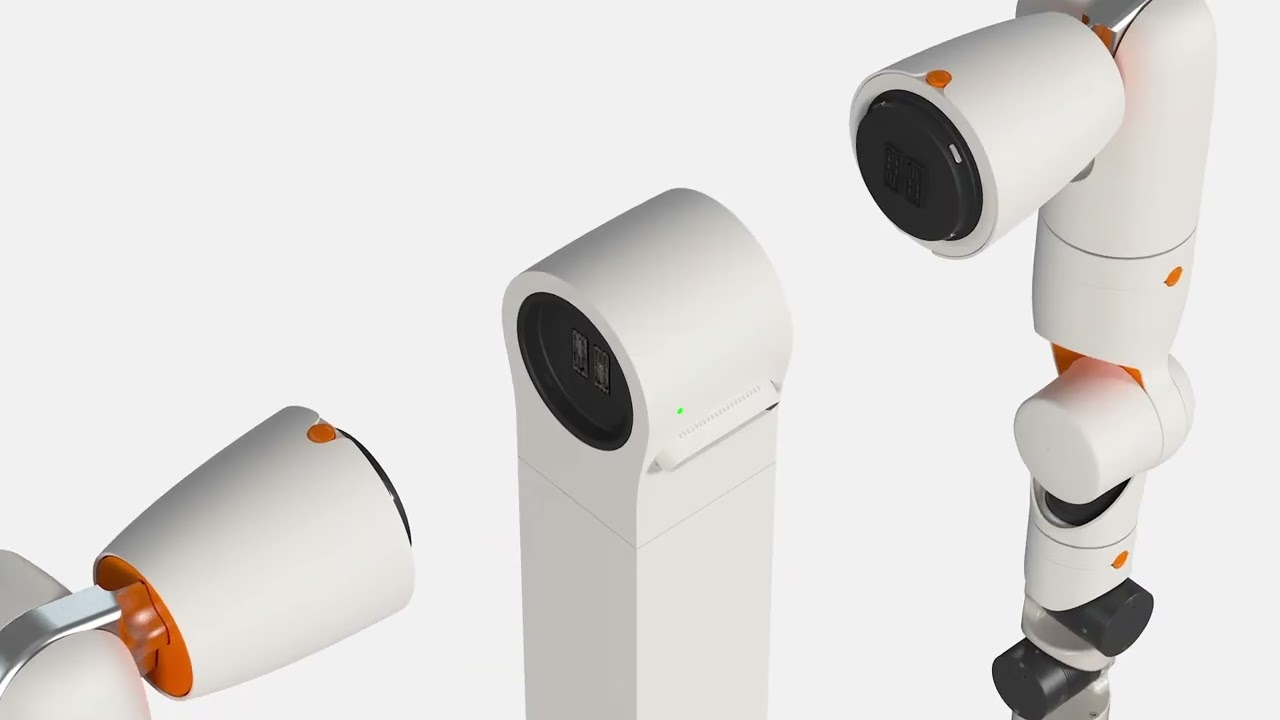
The Tokyo startup wants robots that slot into existing lines and swap worn parts on the floor.
Read full story →
Tokyo-based O-ID has raised $1.2 million in pre-seed funding to build fully modular humanoid robots for industrial manufacturing and logistics. The round was led by Chicago-based TAWANI Ventures, with participation from Hustle Fund, Techstars, and angel investors — including the founders of Humanoid Guide, who were early investors in 1X. The company will use the money to move its first robot from prototype to production and prepare placements on Japanese factory floors.
The pitch is aimed at labor shortages, not spectacle. Japan is projected to face a shortfall of more than 11 million workers by 2040 as factory staff retire and go unreplaced. In June 2026, Japan set a target of ¥10.5 trillion ($65.1 billion) in public and private investment for “physical AI,” with an aim of deploying 10 million AI-equipped robots by 2040. In the United States, manufacturers could need 3.8 million new workers by 2033, and as many as 1.9 million of those jobs could go unfilled.
Existing industrial robots are rigid, and retooling a plant around them takes capital and time. General-purpose humanoids are more flexible, but a single failed part can take a whole machine offline for months. For large automotive plants, an hour of downtime has been estimated at $2.3 million.
O-ID was founded in Tokyo in 2025 by Norwegian CEO Stian Jakobsen and Dutch CTO Simon Gormuzov, who met at Waseda University. Jakobsen previously worked in cyber defense. Gormuzov spent years in industrial robotics. The company has signed a letter of intent with Sumitomo Electric Industries to discuss applying Sumitomo technologies to humanoid wire harnesses. It has also filed a provisional U.S. patent for its modular connector technology and says Japan-built robots are being designed to meet NDAA requirements as it looks toward U.S. shipments later.
“When enough factory roles go unfilled at once, entire supply chains are at risk. O-ID’s robots are built to work alongside the people still on the floor,” Jakobsen said. TAWANI partner William Pritzker called modular humanoids a way to transfer Japanese robotics supply-chain expertise onto an AI-native platform. Techstars managing director Yuki Shirato said the robots are intended to be modular, mass-producible, repairable, and made in Japan.
Watch O-ID’s modular humanoid video.
Open the official video
It lifts 50 lb and recharges in nine minutes. Early access is planned for 2027.
Read full story →
On September 15, Agility unveiled Digit 5, a redesigned industrial humanoid with new legs, a higher lifting limit, and much faster charging. The pitch is simple: a robot that can work closer to people, so factories need fewer fences and cages around it.
Early access is expected in the first half of 2027, with general availability targeted for the end of that year. Agility also plans to expand beyond North America into the EU and UK. The specs are preliminary company estimates from pre-production testing, and some safety features are still in development.
Agility breaks it into three parts: detecting people, signaling what the robot is about to do, and an independent safety controller that supervises its motion. Depending on the situation, Digit can avoid a person, stop, or drop into a seated position. Agility is also the first launch partner for NVIDIA’s Halos for Robotics platform.
That is not a blanket safety certification. Planned CE and other regulatory marks for Europe are still expected rather than earned, and Agility says its safety measures do not remove all operating risk.
The timeline has slipped: an earlier company filing pointed to an initial Digit v5 release in late 2026. That filing also described a $300 million commitment for 1,000 Digit v5 robots under a three-year robots-as-a-service deal with a related-party customer — subject to milestones, and not yet revenue. Agility reported about $1.78 million in 2025 net sales and a $138.1 million net loss. It says Digit 4 has logged more than 65,000 operating hours, and no price has been announced.
Watch the Digit 5 launch video.
Open the launch video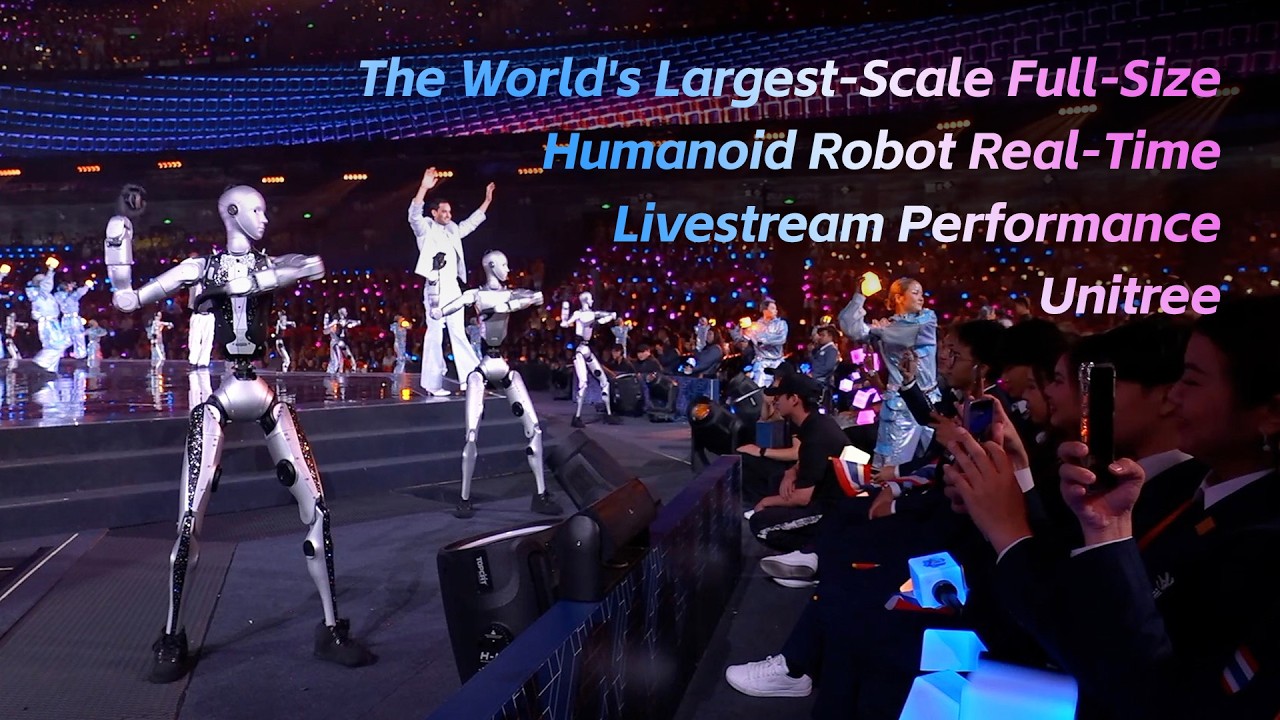
WorldSkills Shanghai opened with a live-streamed full-size robot cluster performance.
Read full story →
At the opening ceremony of WorldSkills Shanghai 2026 on September 22, 19 Unitree humanoid robots performed alongside 120 dancers. Unitree called it the world’s largest-scale performance featuring full-size general-purpose humanoids, staged before more than 10,000 people and live-streamed in real time as a fully AI-driven autonomous robot cluster.
The 48th WorldSkills Competition opened in Shanghai with 1,385 competitors from 68 countries and regions across 64 skill categories. Coverage of the ceremony focused less on medals than on a human-robot dance that organizers billed as a first for full-size humanoids working as an autonomous cluster.
A synchronized stage show is not a factory deployment. It does test timing, balance, multi-robot coordination, and safe proximity to people under lights and noise. Unitree is using the clip to argue that full-size general-purpose humanoids can now run as a coordinated group in public, not only as single demo units.
Watch Unitree’s WorldSkills performance video.
Open the official video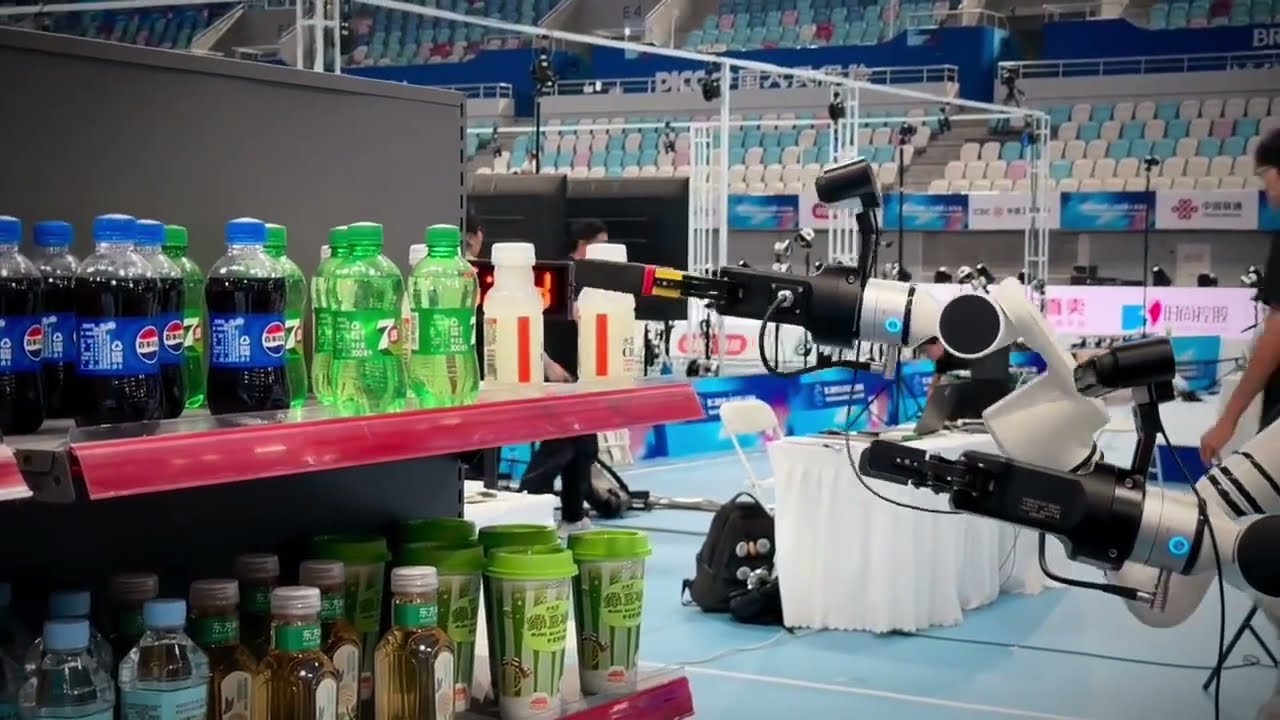
Pick, carry, and shelf placement are being trained as one retail workflow.
Read full story →
A new training clip shows a robot picking products, transporting them, and placing them on shelves in a supermarket setting. The point of the exercise is not a single grasp demo. It is the full loop stores actually run: identify an item, move it through an aisle, and seat it on a shelf without wrecking the display.
Retail is a hard test because products vary in size, weight, wrapping, and placement. A bottle, a box, and a bag do not fail the same way. Lighting changes down an aisle. People walk through the workspace. A policy that works on a lab table can stall when the next SKU is slightly farther back on the shelf.
Shelf work is one of the jobs retailers already spend labor on every day. Scanning robots that only look for gaps are already in some chains. Manipulation that can restock those gaps is a different problem. Real tasks are where robotic capabilities get tested and improved, and a supermarket aisle is a clearer scoreboard than a scripted lab clip.
Watch the supermarket manipulation training video.
Open the training video
Reception, water delivery, massage, and interactive demos put HRI on the show floor.
Read full story →
At the 2026 China International Fair for Trade in Services in Beijing, RealMan robots were shown in human-centered service scenes: visitor reception, water delivery, massage applications, and interactive experiences. The fair ran September 9–13 at Shougang Park and used service robots as a visible part of how exhibitors talk about daily deployment, not only factory work.
CIFTIS this year added consumer-facing robot zones covering retail, performance, and other public settings. Massage robots also appeared elsewhere on the floor, including traditional Chinese massage demos, which matches the service-work theme RealMan put in its own clip.
As robots move closer to real service environments, human-robot interaction becomes part of the product. A warehouse policy can hide behind cages. A reception robot cannot. RealMan has separately pushed a broader 2026 plan to put RealBOT systems into pharmacies, inspections, food production, and other live sites through its Global Link Network. A trade-fair clip is still a demo. The open question is whether those service behaviors hold up when the crowd is not watching a booth.
Watch RealMan’s CIFTIS service-scenario video.
Open the official videoSeven guest-facing jobs, a China Mobile 5G stack, a joint institute. The 20,000th machine off the line is a robot — not, in the PR, a humanoid-only count.

AGIBOT and Chimelong Group launched the first phase of a large-scale embodied-AI deployment at Chimelong Spaceship Park in Zhuhai, with more than 300 robots folded into the guest path. The companies call it a large-scale embodied AI theme park. The press note is careful about the work: not standalone demos, but robots embedded in entertainment, education, visitor services and hotel operations, with dedicated connectivity, multi-robot coordination and safety systems behind them. The launch reel above is the file issued with that announcement. The story is the fleet on a live park floor, not a new model name.
More than 300 AGIBOT robots are assigned across seven use cases: live entertainment, educational experiences, visitor guidance and shopping assistance, retail services, AI-powered companionship, hotel services, and sports. Visitors, the companies say, can watch martial arts, gymnastics and tai chi, play table tennis or run manipulation challenges, ask questions, get directions, or sit through robot-assisted learning. Hotel and companion settings add welcome, multi-turn talk and more personal interaction. Multi-robot shows are described as movement mixed with human performers, music and lighting. That is the visitor menu in the release, not an independent census of which unit does which job on opening day.
The serial number traveling with the launch is a factory count. AGIBOT says the 20,000th robot to roll off its production line was delivered to Chimelong. The About line in the same note lists humanoids, quadrupeds, dexterous systems and commercial cleaning in the portfolio. So the milestone is the 20,000th robot off the line, handed to this resort — not a verified tally of 20,000 bipeds. Linking that crate to one of the company’s largest tourism deployments is the point AGIBOT wants read in the same sentence as the 300.
Behind the path, AGIBOT, Chimelong and China Mobile say they stood up a dedicated 5G network for responsive interaction in high-traffic areas, plus centralized coordination across park and hotel zones. Safety language in the release covers network security, privacy, charging and fire. That stack is how they argue a three-digit fleet can run without becoming a pile of stranded units at the gate. It is still their operating framework. No uptime table or incident log is attached.
The partners also announced a joint research institute on embodied AI in culture and tourism, using this project as the working sample, and they describe the first phase as a base for spreading robots across more of Chimelong’s entertainment, hospitality and visitor-service sites over time. Collaboration language in the note is robot technology plus content design plus venue operations — robots as part of the day’s itinerary, not a single photo-op at the entrance.
What holds from the embargoed release is specific. Site: Chimelong Spaceship Park, Zhuhai. Phase one. More than 300 robots. Seven listed jobs. A China Mobile 5G and coordination claim. A joint institute. The 20,000th robot off AGIBOT’s line, delivered here. That is a launch, not a week of counted guest hours, and it is the largest guest-facing fleet the company has put on paper.

A hexapod teaching kit now ships locomotion, a small arm and a spoken-command stack on one chassis. The listed hardware is an 18-degree-of-freedom body running inverse kinematics; omnidirectional crawl, climb and dance; a two-degree-of-freedom arm for grab and carry; a two-megapixel camera for face, gesture, pet and line tracking; WonderLLM and ESP-Claw for speech; a six-axis IMU; and programming in Arduino, Scratch and MicroPython, with PC software and a phone app for direct drive.
Eighteen degrees of freedom on six legs is the standard three-servo limb. Inverse kinematics keep the body level while the gait changes, which is what lets a hexapod look like it is walking instead of ticking. The two-axis arm is the extra that turns a crawler into a machine that can pick something up and move it. Camera jobs match a first vision lab: find a face, read a gesture, follow a painted line, notice a pet in the frame.
WonderLLM is the branded module for talking to the robot. ESP-Claw is the on-device agent layer, so sensing, a decision and an action can run on the board instead of waiting on a cloud round trip. That pairing is the 2026 hook on an otherwise familiar hexapod recipe. The IMU exists so the chassis knows when a leg has left the ground, or when a student has picked the robot up mid-stride and put it down facing the wrong way.
The software path is built for schools and clubs rather than a factory cell. Scratch and the phone app cover beginners who want motion without writing a gait from scratch. Arduino and MicroPython cover students who want to own the claw, the camera loop and the walk. The pitch is one machine that can crawl on Monday and take a voice command on Friday without a second piece of hardware.
The video is a product demonstration of those features in sequence. It does not include a classroom trial with scored lessons, a published battery figure, or an endurance run that would tell a teacher how long the servos last in a noisy lab. Treat it as the spec list made visible, starting at the fifty-three-second mark where the hardware card is read aloud.
What you have, then, is a six-leg teaching platform with a small manipulator and an on-chip chat stack. It is not a full-size humanoid and it is not sold as one. It is a way for a student to hear a robot answer and then watch it close a claw on a block, which is how a lot of people will first meet embodied software this year.

Content creator Frankie LaPenna fought a six-foot humanoid styled as a T-800 at a private cage match organized by REK Robotics. The video is that bout. LaPenna, in heavy pads, lands punches on the metal. The machine answers with kicks that drive him into the fence and then onto the mat. The announcer frames it as a person stepping in against a six-foot robot. The clip is short, loud and built to travel.
REK billed the night as the first human-versus-Terminator fight and a turning point. That wording is the promoter’s. Similar man-versus-machine exhibitions have been staged before, which is why the “first” belongs in quotation marks. The 18 September event in San Francisco was organized to promote a virtual-reality game in which people pilot robots against one another or against a live opponent in a cage.
The robot is teleoperated from backstage, not choosing its own kicks. Coverage of the bout has identified the body as a modified EngineAI T800 under the Terminator shell and glowing eyes. Kick-force numbers that appeared in entertainment write-ups have not been published as a laboratory measurement. What the footage shows is a remote pilot, a heavy chassis and enough impact to move a padded adult across the floor.
LaPenna is a stunt and prank creator rather than a ranked fighter. After the match he showed a swollen hand from hitting metal, which is the injury detail that holds. REK’s chief executive later told an outlet that LaPenna came back and finished the robot once the viral kick sequence was over. The clip most widely shared still ends with him on the floor. Both accounts can sit in the same week without turning the night into a sanctioned result.
Pads, a cage and a pilot in a headset make this a show with real contact, not a title fight and not a new combat humanoid offered as a product. The thing being sold is the teleoperation loop and the game around it. REK has already said more bouts are coming and that the machine in this clip was not the last one in the lineup.
The facts that survive the edit are simple. The date is 18 September. The promoter is REK. The opponent is a six-foot T-800-styled humanoid driven by a person. The man in the cage is Frankie LaPenna. The tape is the exchange of punches and kicks from that private match, not a factory demonstration and not an autonomous fighter working on its own.
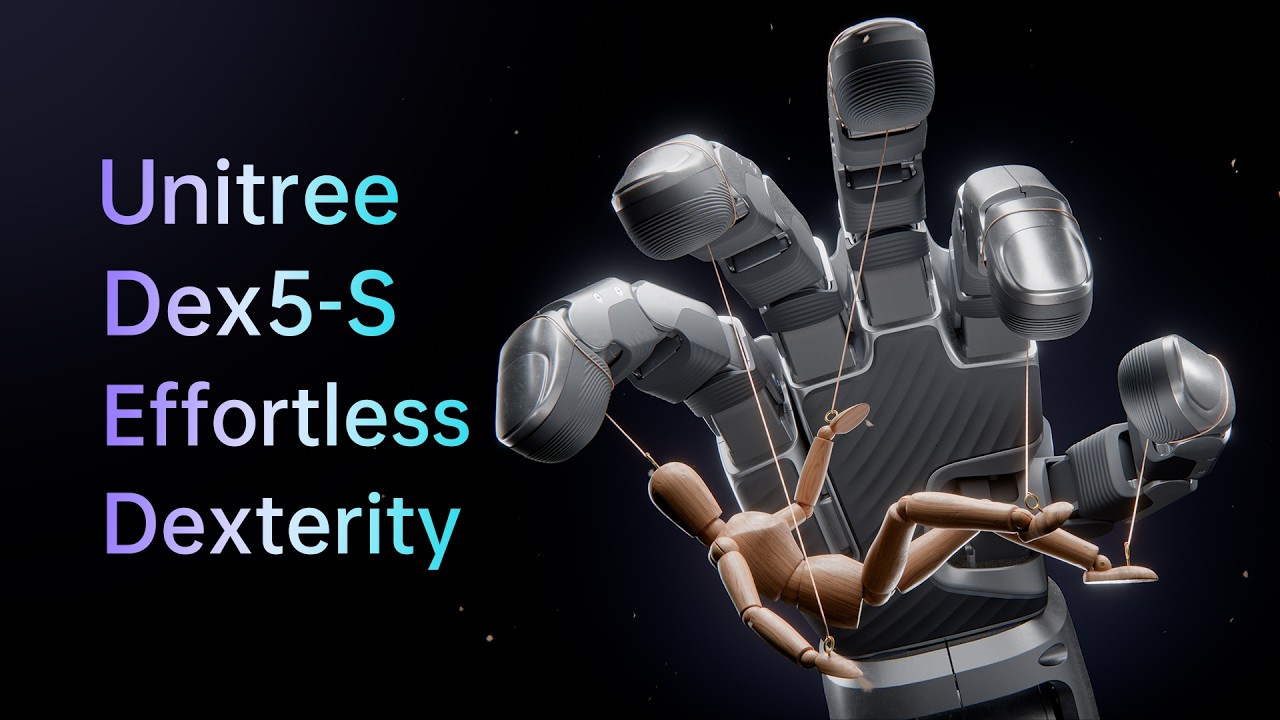
The new biomimetic hand starts at $6,500 before tax and shipping. Every joint is backdrivable and has impact-torque protection.
Read full story →
Unitree published the Dex5-S on September 21 as a precision biomimetic hand built at roughly 1:1 human-hand size. The official English listing puts the starting price at $6,500, tax and shipping excluded. Chinese coverage of the same launch quoted 39,900 yuan as the domestic starting price. Both figures describe a list price for the hand itself, not a complete arm, a humanoid, or an installed research cell.
The selling point is density. Dex5-S carries 22 degrees of freedom in one hand, with 22 motors that Unitree says all support direct drive, smooth backdrivability, and dual-encoder control. Each joint includes limit impact-torque protection so a hard collision is supposed to spare the gears instead of stripping them. Unitree added a little-finger roll degree of freedom that earlier Dex5 hardware did not have, which the company says improves wrap and grasp angles on tools and irregular objects.
Reporting on the launch put the aluminum-shell hand at about 620 grams, with paired left-right envelope dimensions of 102 × 187 × 26 millimeters. Peak one-hand payload is listed at 2 kilograms, with a 1-kilogram continuous working load. Power is a wide 15–65 volt range on an XT30 connector, with peak draw around 200 watts. Interfaces include gigabit Ethernet, USB, and high-speed 485. In the gigabit configuration, a palm camera can plug into the hand without a separate external camera harness.
The official clip shows spoon pickup, scissor cuts, lemon toss-and-catch, and can-tab pulls. Those are demonstration takes on a bench-scale hand. They do not establish cycle life in a factory, autonomy on a walking humanoid, or medical fitness as a prosthesis. Unitree’s own argument is narrower: once a hand is close to human size, it can use human tools and human workspaces without the bulk that older dexterous hands carried. Payload remains modest. Two kilograms peak is useful for utensils and small parts, not for tote work.
Backdrivability matters for learning as much as for safety. A joint that can be pushed around by the world is easier to force-control and easier to train with reinforcement learning than a locked industrial gripper. Impact protection is the complementary claim: the hand can take a hit without becoming scrap. Both claims are manufacturer specifications until third-party endurance numbers show up.
Dexterous hands have been the expensive, late, and fragile part of humanoid programs. A catalog hand at human scale, with a public dollar price, is Unitree trying to sell that bottleneck as a component instead of waiting for a full robot refresh. $6,500 before tax and freight is cheap next to research hands, and it is still only the end effector. Integration, sensing on the Pro model, and whether 22 small motors survive real collisions will decide if Dex5-S is a product or a spec sheet with a launch video.
Watch Unitree’s Dex5-S introduction.
Open the official video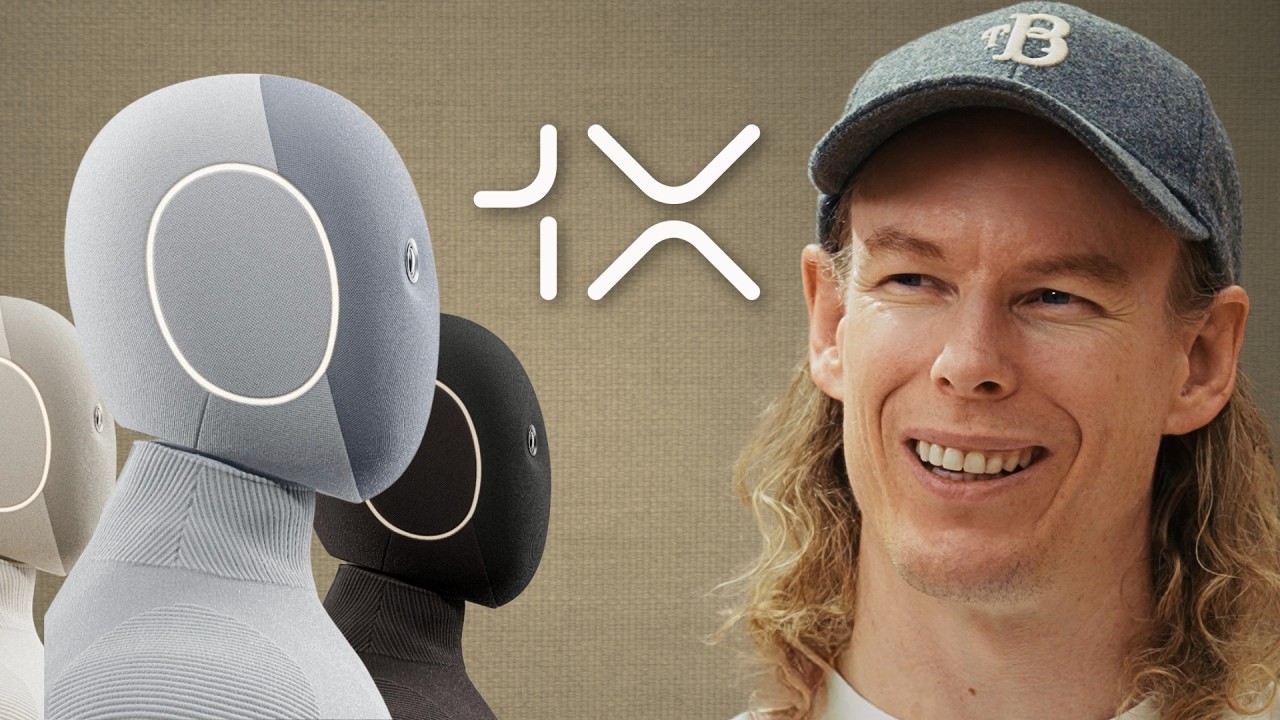
Bernt Børnich told Relentless the 2027 target is gated by quality, not by empty factory floor space.
Read full story →
In a September 18 interview with Ti Morse on Relentless, 1X founder and CEO Bernt Børnich said the company is preparing to manufacture and ship 50,000 NEO humanoids in 2027. He put the constraint in the first minutes: the hard part is not only moving that many machines out the door, but making sure customers do not send them back. That is a quality-and-safety gate, not a press-tour capacity number.
The installed base he described is two California plants running in parallel. Hayward is built out to about 10,000 units a year at a full ramp. Børnich said that rate arrives late in 2026, so Hayward will not actually produce 10,000 robots this calendar year. San Carlos is being built for 100,000 units a year at full capacity. Most of that volume, he said, comes online late in 2027. Combined nameplate capacity is 110,000 a year. The 50,000 shipment target sits well below that ceiling on purpose.
Børnich treated humanoid production as unlike auto production. A well-designed humanoid, in his telling, should have on the order of 1,000 parts rather than a car’s tens of thousands, but there is no mature supplier list for the motors and tendon drives 1X builds in-house. Because those pieces are internal, he said a major CAD change can become a walking robot off the line in about four weeks. Early units will still need remanufacturing and field service. NEO’s size and weight are supposed to let technicians fix many failures on site instead of issuing a recall.
The mix is homes, enterprise sites, and a developer platform. Home deployment is the uneven, less structured case. Enterprise work sits in tighter environments. The developer path is how 1X wants outside builders to generate the messy situations a lab will not invent. Børnich said folding laundry has become straightforward with current models and is not the enterprise job he is selling. He expects specialized models to stay ahead through 2026 and broader competence to show up more in 2027. That is a forecast from the interview, not a published benchmark.
The second half of the conversation is the learning stack. Training data, as he listed it, includes internet video, simulation, synthetic data, human sensor recordings, teleoperation, and robots acting on their own. Deployed machines feed the next model. He has argued that 1X is rarely starved of raw hours and is instead starved of variety: “In reality, you’re almost never data bound. You’re diversity bound.” World models are the company’s bet on learning how scenes change. He also allowed that task-specific vision-language-action training can still beat a world model on a narrow chore such as folding, given where the models are now.
Safety remains unfinished work. Børnich said 1X hopes to show more formal evidence later in 2026. Until that exists, a 50,000-unit year is a manufacturing plan sitting on top of an open reliability question. Shipping volume without a return rate the company can live with would be a failure even if the factories hit their weekly counts.
Most humanoid firms still talk in hundreds of robots. Fifty thousand is a different scale, and Børnich spent the interview refusing to treat factory floor space as the proof. The useful test in 2027 is not whether Hayward and San Carlos can physically assemble NEOs. It is whether the ones that leave stay in the field, generate diverse data, and do not come back in a truck.
Watch Bernt Børnich on Relentless.
Open the interview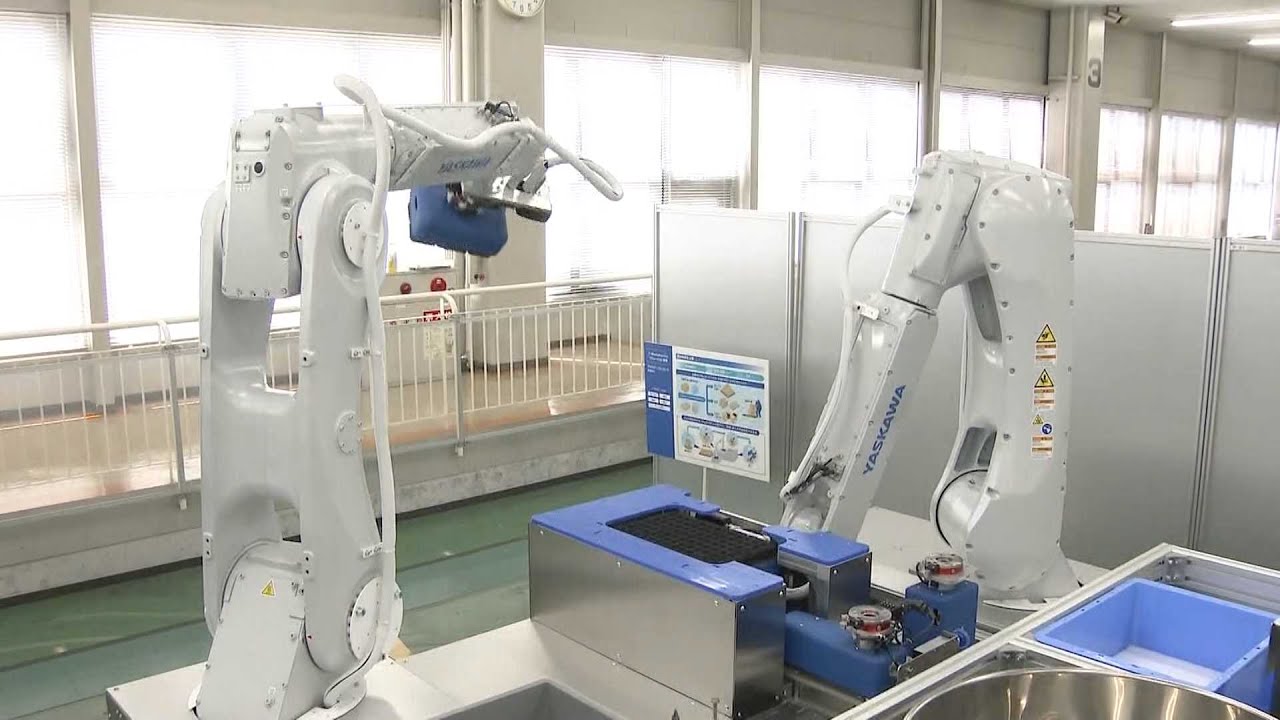
RKB filmed MOTOMAN NEXT assembling robots in Factory No. 5, then working the employee cafeteria.
Read full story →
RKB Mainichi Broadcasting posted a September 16 plant visit from Yaskawa Electric’s headquarters in Yahata-Nishi, Kitakyushu. The piece treats “Physical AI” — Yaskawa’s term for AI that recognizes a scene, chooses a procedure, and moves a robot without a fully written program — as the company’s core growth bet. Reporter Kensuke Nishio watches an AI robot take a vague spoken request, pick a pen from a toolbox, and put it in a blue box, narrating the steps as it goes.
That demo is the friendly version of a harder factory job. Yaskawa’s Robot Factory No. 5, which the company says moved into full-scale operation in July 2026 after coming online earlier in the year, is where AI robots assemble other AI robots. Section manager Masayuki Watanabe walks the line and points to MOTOMAN NEXT on screw tightening, the process he calls unavoidable in manufacturing. Conventional programmed robots, in the plant’s telling, already hit about 99 percent success. That still stops a line once every few units and sends a person in. The AI cell is supposed to see a missed thread or a dropped screw and retry on its own. Watanabe said tightening success had moved above 99.9 percent, which would cut the maintenance load if the figure holds off-camera.
A raw-material station uses 3D sensors to read wrinkles in a bag, cut it, and dump contents without wrecking what is inside. Assistant manager Keisuke Shirakami said that kind of work still depends on people lifting heavy sacks, especially in food and beverage blending, and that bag opening is a place Physical AI can go first. The same report then leaves the factory floor for the employee cafeteria. Two AI robots take a panel order, pull instant noodles, and cook udon or soba. A new hire called the workplace presence striking. Cafeteria assistant manager Hiroyasu Yamamoto said the value was simpler: robots now handle the hot, burn-prone steps people used to do.
RKB framed the Kitakyushu work against a global race. It cited the World Humanoid Robot Games held in Beijing in August, with more than 2,000 robots from 15 countries, and a 2024 Stanford country ranking on AI research and investment in which the United States led and Japan sat well back of China. Those are the broadcast’s comparisons, not a new Yaskawa scoreboard. The company’s own answer is motors it has built for decades, plus MOTOMAN NEXT cells that recover from errors instead of halting a line.
Yaskawa’s mid-term plan covering the years through fiscal 2029, laid out in May, commits about ¥250 billion of investment over four years. Japanese coverage of that plan put the fiscal 2029 aims at roughly ¥650 billion in revenue and ¥100 billion in operating profit, with Physical AI and MOTOMAN NEXT sales at the center and humanoid work aimed at offices, hospitals, and other non-factory floors. Factory No. 5 itself was a separate brick-and-mortar bet: on the order of ¥20 billion to move production onto the headquarters site, raise capacity about 1.8 times, and make servo motors in the same plant instead of trucking them across the city. Yomiuri’s June tour put output at 1,500 robots a month, expandable to 2,200, with about 35 of roughly 110 line robots being MOTOMAN NEXT units.
This is not a biped leaving a lab. It is an incumbent robot maker putting agent-style recovery on screw guns, bag cutters, and a cafeteria line, then filming it in the plant that builds the next robot. Ninety-nine-point-nine percent on one process is still a company-reported plant figure. The larger signal is that Yaskawa is spending like Physical AI is a product line, not a slogan, and it is doing the first deployments on work it already understands.
Watch RKB’s Yaskawa Factory No. 5 report.
Open the videoAdcock walks RoboStrategy through Index, the rented houses, Figure 03 at 1,000 units, and a Figure 4 teaser. Company numbers throughout.

Figure released Helix 2.5 on 17 September and sent Figure 03 into 30 Bay Area houses the robots had not seen. The company line: no extra training in those rooms, then useful work. Brett Adcock sat with RoboStrategy this week to unpack it — holy grail, four stages, Index scale, the houses, datasets, whether robot models follow LLM scaling, what 2.5 can actually do, a Figure 4 tease, Figure 03 past 1,000 units, the Schwarzenegger Figure 2s, more robots than employees. The interview is the lead tape. The numbers that matter are on Figure’s own score sheet, not the banter.
Figure reports 237 full-task successes in 420 trials, or 56 percent, with no partial credit. An otherwise identical policy trained without Index pretraining hit 9 percent. Split by chore: bed making 67 percent (94 of 140), towel folding 62 percent (87 of 140), living-room toy tidy 40 percent (56 of 140). A tidy trial only counted if all 13 to 15 toys reached the basket. Beds needed pillows and comforter corners at the head and the comforter pulled smooth. The inverse is the unsupervised problem: 44 percent of trials failed under those rules. That is still Figure grading Figure.
Zero-shot here means the homes, layouts and objects were unseen at evaluation. The three tasks were specified with fine-tuning data collected elsewhere. A frozen checkpoint ran across all 30 houses — no local data, no weight updates after the truck arrived. Figure says no single eval task is more than 1.90 percent of Index pretraining, and that 2.5 used about half the adaptation data of a comparable Helix 02 behaviour while leaving the training house. Index, in the company write-up, now generates about 35 minutes of new human experience every second. Compute commitment cited alongside: $3.5 billion with Nscale. Company figures.
What the robots actually did is whole-body work, not tabletop pick-and-place: walk the room, find the pile, fold cloth, pull a comforter. Figure posted a four-hour cut of continuous runs. Commenters asked for spills, a full sink, a cable on the floor. Fair. This brief will not upgrade tidy-and-make-the-bed into a maid. It will also not pretend 9-to-56 with Index held fixed is a small delta. Pretraining was the only variable in that comparison, per Figure.
The rest of the interview is roadmap talk. Figure 03 production crossing 1,000 units is a milestone RoboStrategy already logged in July as delivered units — treat the on-air recap as the same company claim, not a new audit. Figure 4 is a tease in the chapter list, not a spec sheet. “More robots than employees” is a headcount slogan. Schwarzenegger and the Figure 2s are colour. None of that moves the 56 percent.
Bar sits at four. A measured 30-home eval with published task splits and a control without Index is the strongest generalization tape of the month. It is not unsupervised housework and it is not a third-party bake-off. HPS #4 on this page means the test is real and incomplete. Watch for a dirty-home protocol, or someone else scoring the same three chores.

Unitree put Dex5-S on the channel on 21 September: a precision biomimetic hand, human-scale, from $6,500 before tax and shipping. All 22 joints backdrivable. Each joint listed with limit impact-torque protection. Domestic coverage puts the floor at 39,900 yuan. The 43-second clip is the announcement tape. It is a product drop, not a Games medal and not a factory cell. The number that moves the market is the sticker next to a 22-DoF count most labs still pay five figures for.
Launch write-ups describe five fingers at roughly 1:1 hand size, about 620 grams in one recap, thumb and pinky at five degrees of freedom and the middle three at four. Dual encoders and backdrivable motors are the compliance pitch — an external shove can move the joint instead of fighting a locked gearbox. That matters for reinforcement learning and for not snapping a wine glass. Unitree also flags a Pro SKU with tactile sensing versus a Standard without. Spec sheets are still thin on fingertip force and cycle life.
Dex5-S sits above Dex5-1 in the family tree. The prior hand was described as 20 degrees of freedom with a 16-active / 4-passive split and a large tactile array. The new unit’s claim is every joint driven and backdrivable. Do not flatten that into “more sensors.” It is more actuated axes plus a price that undercuts Allegro, Shadow and most direct-drive research hands. Whether it undercuts OmniHand or Wuji on a timed grasp is untested here.
The video drew the usual respect for showing metal instead of only renders, and the usual “that is not how you open a can.” Fair on both. A $6.5K 22-DoF hand will land on G1 / H1 / H2 arms because that is Unitree’s stack. Integration hours will decide if the DoF count is usable or just countable.
Bar at three. A named SKU, a public price, and a backdrivability claim across all joints is more than a concept reel. It is not a third-party durability log. Three bars means the product exists and the test has not.
Watch for a force table, a Pro versus Standard split you can order, and a humanoid wearing two of them through a shift. Until then Dex5-S is the cheapest ticket into the 20-plus-DoF club Unitree has sold.

XPENG’s new IRON clip is a real-world interaction test, labeled as such. Four capabilities: autonomous orientation toward the speaker, dynamic identity memory, seamless multilingual switching, multi-intelligence Q&A. The caption says IRON recognizes you, understands you, responds to you, powered by Physical AI. The footage is three testers playing car buyers in the robotics lab. That framing matters. This is not a dealership log. It is an R&D demonstration of the social stack sitting on the production-line body XPENG walked off the line earlier this month.
In the identity beat, one tester borrows another’s nickname; IRON corrects him and recalls vehicle interest. The company says recognition holds when the three swap places and clothes. Memory is described as face plus voiceprint plus conversation history, updated on later encounters. Language switch is presented without a separate “now speak English” command — Mandarin and English in the exchanges. XPENG credits a multilingual foundation model and balanced training data. No published accuracy, latency or overlapping-speaker score accompanies the reel.
Hardware context from the September production announcement, not this video: 76 body degrees of freedom, 21 per hand on the production revision, three Turing chips and a company rating of up to 2,250 TOPS onboard. Mass production targeted by end of 2026, commercial deliveries talked for 2027. Those dates stay on the factory slide. The interaction tape does not prove them.
Physical AI is XPENG’s corporate banner — cars, IRON, flying boxes on the same Turing story. VLM conversation and VLA action are the split the company has used since AI Day. This clip is almost all VLM: look at the person, remember the person, answer the person. Walking and grasping are off-screen. Do not write that IRON now sells cars.
Useful as a humanoid-as-clerk sketch. Thin as evidence. Three scripted buyers in a lab is how you start a memory demo. It is not how you measure a showroom.
Bar stays at zero. A labeled R&D interaction test belongs on the page beside Helix’s scored homes and Unitree’s priced hand. It does not get a field rating until XPENG publishes a recognition table or parks IRON on a real floor with real shoppers.
Omnidirectional base frees the arms. Mid-air dual-arm force control is the point of the tape. No pharmacy hours attached.

LimX Dynamics put Wuji Hand 2 on TRON 2 and ran a traditional-Chinese-medicine counter: pick herbs from drawers, weigh them, grind, pack. The clip posted late August is still the cleanest arm-plus-hand integration tape this month, which is why it leads on 21 September. The company line is hardware-software synergy. The useful sentence is narrower. An omnidirectional wheeled base carries the body so the 7-DoF arms and the 20-DoF hands can stay on the work. Mid-air dual-arm force control holds a scale that is not sitting on a table. That is a coordination demo. It is not a pharmacy roster.
TRON 2 is LimX’s multi-form platform: dual arms on a torso that can stand on wheels, legs, or a fixed base. Published spec: 7 degrees of freedom per arm, ±0.5 millimetre repeat positioning, 5 kilograms maximum per arm (3 kilograms extended), spherical wrist, optional gripper or dexterous hand. The pharmacy tape uses the wheeled-leg / omnidirectional setup so the robot can square up to a cabinet without asking the hands to walk the payload across the floor. Wuji Hand 2 is the ICRA-era direct-drive five-finger unit — 20 active degrees of freedom, serial rotary joints, no tendon maze in the digits.
Japanese and Chinese write-ups of the same video walk the sequence. One hand opens a drawer; the other extracts dried materia medica. Both hands then hold a beam scale off the counter while material is added. Grinding and bagging close the loop. The mid-air weigh is the hard part. The arm is no longer just a mover. It is a stable platform while the fingers dose. LimX lists 100-millisecond teleop delay on the kit; this reel does not say whether the run was teleop, scripted, or a learned policy. Do not invent that.
Wuji’s thank-you in LimX’s post is the integration note that matters. A lot of 2026 hand clips assume a fixed arm. This one assumes a mobile torso and a third-party hand that actually bolts on. LimX already lists BrainCo and Wuji as tested end effectors. That is a product path: sell the body, let the hand vendor ride along, collect the contact data that neither firm can gather alone. The TCM shop is a photogenic stand-in for any cabinet-plus-scale job.
What the tape does not show: cycle time, miss rate, a named pharmacy chain, or a shift without a spotter. Treat “handles TCM pharmacy work” as the caption on a validation video, which is how LimX posted it on 26 August. Re-upping it for Monday is fine. Promoting it to a deployment is not. Embodied-AI labs will care because drawer, scale, mortar and bag are four contact regimes in one take.
Bar stays at zero. Two vendors sharing a scene is news. A counted counter is a different story. Watch for the same stack on a second site, or a VLA paper that cites this run as training data. Until then: wheeled base, Wuji fingers, mid-air weigh, pack the bag, cut.

Dobot’s X-Trainer explainer is back in circulation: an advanced dual-arm teleoperation and AI training platform built around two Nova 2 cobots. The pitch is higher education, research and technical training — capture repeatable demonstration data without welding a rig from scratch. Imitation learning, computer vision, human-robot interaction. The chapters walk introduction, teleop, why the data matters, lab pain, hardware, SDK, curriculum. It is a product video for a kit that has been on the market since 2024. It belongs here because physical-AI labs keep buying dual-arm data, not because it walks.
Hardware is two 6-axis Nova 2 slaves plus two 6-DoF master hands with end handles. Nova 2 repeatability is listed at ±0.05 millimetres. Combined dual-arm span is about 1,200 millimetres; single-arm reach 625 millimetres. Collision detection is five-level; the cobots carry ISO 15066 collaborative certification. Dual e-stops sit on the table. Master-hand load on the operator is advertised under 400 grams. That is the safety case for putting undergraduates on the handles.
Software is DobotStudio Pro plus an API that exposes master joint angles, lock/sync, slave Cartesian control, gripper stroke, and RGB/depth frames. Record starts from a green button on the handle. GitHub’s embodied-dobot/x-trainer stack maps the leader into Isaac Lab, VR (Quest/PICO) and a 30-hertz HDF5 pipeline aimed at VLA training. Dobot has claimed a 70 percent cut in scenario training time, down to about two hours for simple tasks. That figure is marketing from the 2024 launch. Leave it labeled.
Why a humanoid page cares: most foundation-model teams still collect bimanual data on tables, not on bipeds. X-Trainer is the industrial-grade version of that table. Students get collision-limited cobots instead of a research arm that can break a wrist. Researchers get cameras and a leader that already talks to LeRobot-style formats. It does not replace a Digit or a TRON 2. It feeds them.
The clip is not news of a new robot. It is news of the channel still selling data infrastructure while the rest of the week argues about hands and policies. Fair placement as digest two. Do not write “humanoid trainer.” Write “dual-arm cobot classroom.”
Rating stays at zero. A shipping education kit with a new explainer is useful context, not a field rating. Watch for a published student dataset or a paper that names X-Trainer as the capture rig. Until then it is two Nova 2s and a pair of handles doing what they were built to do.
Linkerbot’s 19 September short is a speed argument, not a launch. LinkerHand L30 is tendon-driven, high degree of freedom, and fast because the actuators sit behind the fingers. Little mass left to accelerate. That, the caption says, is what coordinated work at this joint count requires. Footage from earlier this year is cut with more recent takes. The title on the channel calls it the fastest high-DoF hand they know of. That superlative stays in the video. It does not become a measured ranking here.
The product manual is the sheet we will use. L30 is a modular anthropomorphic hand from Linxin Qiaoshou / Linkerbot. Transmission is UHMWPE tendons in PTFE tubes, motors remote from the digits. Coordinated control of five fingers: 17 degrees of freedom, 21 joints (17 active, 4 passive), including a wrist degree of freedom on that count. Control interface CAN FD. Reseller pages scatter 21- and 22-DoF labels; treat those as marketing variants of the same architecture, not a second product.
Published performance numbers that repeat across decent listings: about 1.4 kilograms, ±0.20 millimetre repeatability, fingertip forces in the low-newton range on the flagship tendon version, core motion advertised near 400–450 degrees per second. Payload figures disagree between shops — 2 kilograms on one sheet, much higher on another — so this brief will not pick a load. Speed and remote actuation are the claims the new clip actually illustrates.
Why tendons again after a week of Wuji direct-drive: different packaging. Direct drive puts a motor at the joint and accepts heat and distal mass. Tendons move the mass into the palm or forearm and accept stretch, routing and maintenance. L30 is the second bet. If the cut-together reel is honest, the fingers look light because they are. If the “fastest we know” line is just editing, it will show the first time someone times an open-close against Wuji Hand 2 or OmniHand on the same task.
Linkerbot already had an L30 on the market before this montage. The news is the speed framing plus an admission that some shots are old. That honesty helps. A lab buying a high-DoF tendon hand still has to ask about tendon life, calibration drift and whether the wrist DoF is in the SKU they will receive.
Rating stays at zero. A tendon flagship with a new cut is the hardware counterpoint to TRON 2’s Wuji integration and Dobot’s classroom arms. Three ways to get fingers on a task this week. None of them is a counted line. Watch for an L30 on a named humanoid, timed, not montaged.
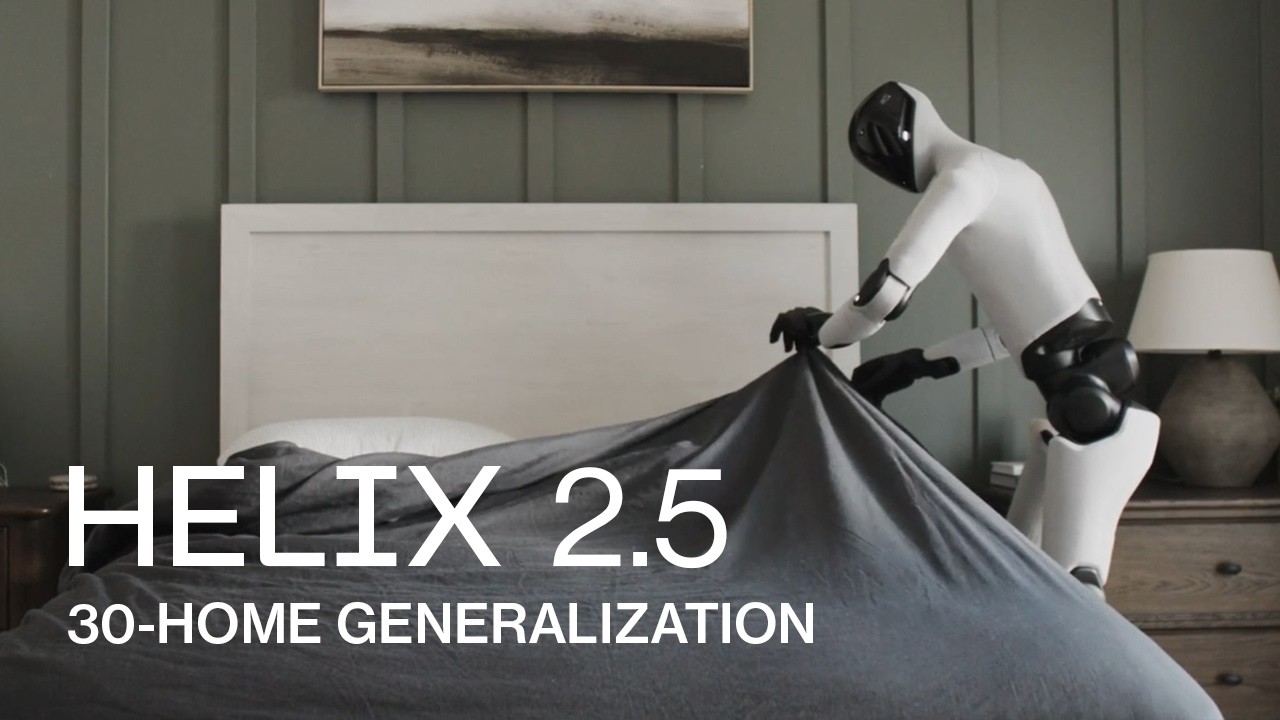
Same chores, same robot — Index pretraining raised full-task success from 9% to 56% in 30 rented homes.
Read full story →
Figure’s Sept. 17 Helix 2.5 release is less a new robot than a bet on data. The company sent Figure 03 into 30 rented Bay Area homes it had never mapped, then argued that pretraining on Index — its human-behavior dataset — is what made the difference.
Hold the chores, the hardware, the architecture, and the evaluation fixed, Figure says, and an Index-pretrained policy finished 56% of trials. A matched policy trained from scratch finished 9%. That is 237 of 420 full-task attempts versus a baseline Figure rounds to 9%.
No data was collected in the test houses. No weights were updated after the robots arrived. The beds, towels, and toys in the evaluation were kept out of the task-specification set.
The three jobs themselves were not improvised. Bed making, towel folding, and living-room tidy were specified with fine-tuning data gathered somewhere else. Zero-shot applies to the rooms and the objects, not to inventing household work on contact.
Success meant the whole job. Partial piles did not count.
Figure also says Helix 2.5 matched a comparable Helix 02 success rate with half as much task-adaptation data, then ran that policy across 30 unseen homes instead of the single house used to train the earlier behavior.
Helix 2.5 was pretrained from random weights on Index. Helix 02 started from a pretrained vision-language model. Figure’s claim is that the human-video corpus, not a borrowed VLM, now carries most of the transfer.
Index, by the company’s count, adds about 35 minutes of new human experience every second. Figure has committed $3.5 billion of compute to Helix training and says doubling Index data improved downstream action-prediction loss on a smooth enough curve to forecast its largest run before that run was trained.
Fifty-six percent is a research result, not a product SLA. Figure has said general humanoid robotics is not solved. A policy that clears beds more often than toy piles will not replace a housekeeper. The live question after Sept. 17 is whether more Index data keeps buying new-house performance, or whether the curve flattens before reliability is high enough to leave the demo.
Watch Figure’s Helix 2.5 30-home generalization video.
Open the official video
It lifts 50 lb and recharges in nine minutes. Early access is planned for 2027.
Read full story →
On September 15, Agility unveiled Digit 5, a redesigned industrial humanoid with new legs, a higher lifting limit, and much faster charging. The pitch is simple: a robot that can work closer to people, so factories need fewer fences and cages around it.
Early access is expected in the first half of 2027, with general availability targeted for the end of that year. Agility also plans to expand beyond North America into the EU and UK. The specs are preliminary company estimates from pre-production testing, and some safety features are still in development.
Agility breaks it into three parts: detecting people, signaling what the robot is about to do, and an independent safety controller that supervises its motion. Depending on the situation, Digit can avoid a person, stop, or drop into a seated position. Agility is also the first launch partner for NVIDIA’s Halos for Robotics platform.
That is not a blanket safety certification. Planned CE and other regulatory marks for Europe are still expected rather than earned, and Agility says its safety measures do not remove all operating risk.
The timeline has slipped: an earlier company filing pointed to an initial Digit v5 release in late 2026. That filing also described a $300 million commitment for 1,000 Digit v5 robots under a three-year robots-as-a-service deal with a related-party customer — subject to milestones, and not yet revenue. Agility reported about $1.78 million in 2025 net sales and a $138.1 million net loss. It says Digit 4 has logged more than 65,000 operating hours, and no price has been announced.
Watch the Digit 5 launch video.
Open the launch video
Drone footage shows the steel frame nearly done. Production timing is still unsettled.
Read full story →
A September 17 drone update from longtime Giga Texas watcher Joe Tegtmeyer shows the steel frame of Tesla’s dedicated Optimus factory roughly five column grids short of the building’s north perimeter beam. The frame is close to complete, but the plant is not close to building robots yet.
Tesla’s Q2 2026 shareholder update lists both its California and Texas Optimus facilities as under construction, without stating an installed annual capacity for either. In Fremont, the company said it had decommissioned the Model S and Model X lines and was installing the first Optimus production lines, with production anticipated in 2026. Early robots there would support data collection and development in its Optimus Academy.
Tegtmeyer expects first limited production at Giga Texas in late 2027. Teslarati’s coverage of the same update refers to high-volume production in summer 2027, and says Fremont began mass-producing Gen 3 in January, which sits uneasily with Tesla’s own July disclosure. A construction video cannot settle those differences.
A finished steel frame is a visible sign that Tesla is committed to Optimus manufacturing at scale. It does not show that assembly equipment has been installed, commissioned, or run at production speed. The next evidence to watch is equipment going in, commissioning, and sustained output.
Watch Giga Texas Site Update
Open the videoThe pitch is One Model, One Data Interface, Any Body. The hours are company hours. The bar stays dark.

Reward AI says human-level manipulation is not more data or more compute. OM-1 is the company’s general-purpose robot policy: learn from people at human speed, then run the same policy on industrial arms and humanoids. That is the line on the 14 September tape and the OM-1 blog, not an audited cell. The reel marks bartending at 00:11, a nut at 00:45, ethernet at 01:02, phone packaging at 01:10, laundry at 01:32, tube sorting at 01:47, and a humanoid toss at 02:04. Treat those as promotional cases. Bar stays at zero until someone else times the work.
The hardware Reward AI published is consistent across the blog and the launch posts. Omnibody Hand is a wearable seven-DoF capture device built on Stanford DexCap, not a joint-by-joint human copy. Thumb-index pinch and coordinated power grasp are the functions it keeps. One Data Interface adds tactile arrays, proximity, palm cameras and electromagnetic tracking so people do not have to slow down for the recording. Those are spec-sheet facts. They are not proof that a new body ran last night without a minder.
What the new clip adds is the no-teleop pitch. OM-1 is supposed to learn from human data alone — no robot hours, no separate post-train stage — and emit speed, force and grasp timing for any body. A high-frequency control layer, trained in simulation, is what maps that onto hardware and eats delay and load. The company says a hard long-horizon task can come up from less than thirty minutes of raw demonstration. That is the story Reward AI wants. It is also the story that is cheapest to film and hardest to verify off their floor.
Reward AI has spent the week moving from stealth to public rooms. DexCap was the academic beat. OM-1 is the work-shaped sibling: one interface, many bodies, not choreography. Fair enough as a marketing sequence. It does not retire the question every foundation policy still owes: how many sites, how many hours, how many human resets per shift. Multi-robot collab is named in the social copy. Named customers are not.
For a humanoid page the comparison is every stack that still routes skill through teleop and on-robot fine-tuning, not a dancing reel. OM-1’s argument is that those hops keep robots slow. Both can be true and still be early. A bench that pours a drink is a useful scene. A policy that holds a roster across mixed bodies is a different product. Reward AI has not published the second number. Until it does, “Any Body” is a caption, not a field rating.
So the 19 September lead is the tape and the label. OM-1 is a general-purpose policy trained on robot-free human data, with a seven-DoF glove and a control layer that is supposed to travel. Watch the clip from 11 seconds. Do not promote the bar. If a named lab posts its own timings, the ranking conversation starts. If the next video is another clean bench, this stays a company intelligence story — which is still news. It is just not a counted fleet.

Apex Hand, Dexcel Robotics’ high-DoF five-finger unit, is on a clip that is more vendor tape than medal table. The company says it was the only high-DoF hand used across both high-load and precision-manipulation challenges at the World Humanoid Robot Games 2026. That is the caption, not an organizing-committee roster. Independent coverage of the new eight-event hand track still runs through AGIBOT’s OmniHand. Treat Apex’s line as a promotional case shot against a Beijing backdrop.
The sheet Dexcel and Rysen publish is consistent across product pages. Apex lists 21 degrees of freedom with 16 active, about 1.2 kilograms, fingertip force above 20 newtons, and a 30-kilogram maximum-load claim. Joints are sold as backdrivable. Skin is sold as full-hand e-skin. Repeatability is under 0.5 millimetres. Founder copy describes a tendon-driven hybrid, not a pure direct-drive finger. Those are spec-sheet facts. They are not a start list from the Oval.
What the new clip adds is the two-lane pitch. One body is supposed to take load and still do fine work — tools and tweezers without a claw swap. The Games, 22–26 August at the National Speed Skating Oval, were the first edition with a dedicated dexterous-hand track. That is the story Dexcel wants: dexterity, strength and reliability tested next to competitors. It is also the story that is cheapest to cut with stadium b-roll and hardest to verify without a named heat.
Dexcel has spent a year moving Apex from launch reels toward public rooms. Smartphone use and a Kapandji score were the early beats. This tape is the next one: stop talking about a hexagon of specs and start talking about the Games. Fair enough as a marketing sequence. It does not retire the question every hand still owes: how many cycles, how many resets, how many fingers swapped per shift.
For industrial readers the comparison is OmniHand, not a parallel-jaw that already packs boxes. OmniHand’s argument is a published Games result. Apex’s argument is one end effector covering heavy and fine. Both can be true and still be early. A hand that holds 30 kilograms on a sheet is a useful scene. A hand that held a scored run in Beijing is a different product. Dexcel has not published the second number.
Rating stays at zero. A high-DoF hand claiming both load and precision at the Games is worth logging next to policy tapes like OM-1. One is trying to look transferable. The other is trying to look unbreakable. Neither is a deployment metric. Watch for a named team and a named event, not a second take of the same fingers on a clean floor.

WUJI is on a clip that is more origin story than product launch. The company says it takes only a few seconds to see a dexterous hand come to life, and that those seconds sit on seven years — motor to direct-drive hand, small factory to ICRA. That is Wuji Tech’s line, not a third-party audit. The official file runs twenty-three minutes under From Motor to Dexterous Hand. Treat the short hook as the sell. Treat the runtime as the history they chose to publish.
The hardware WUJI published is consistent across the site and docs. Wuji Hand lists 20 active degrees of freedom, four per finger, serial direct-drive joints, a skeleton of about 580 grams, 15 newtons at the fingertip and 10 kilograms static grasp. Hand 2, shown at ICRA 2026 booth 121, adds back-drivable actuation, force-position control and a 1-kilohertz loop. Those are spec-sheet facts. They are not proof the hand held a shift after the booth closed.
What the new clip adds is the no-playbook pitch. From data collection to end execution, Wuji Glove and Wuji Hand are supposed to be one stack: capture, stream, act. Direct drive is why. A tendon map hides slack. A joint the controller owns is what a learning pipeline can write to. That is the story WUJI wants. It is also the story that is easiest to narrate over a wake-up shot and hardest to keep when heat and dust show up.
WUJI has spent 2026 moving from factory trials toward public rooms. ICRA was the work-shaped sibling of the first Hand launch — thermal headroom and models in MuJoCo, not only a pretty curl. This week’s film is the next beat: stop talking about a motor and start talking about seven years. Fair enough as a marketing sequence. It does not retire the cycle-count question every hand still owes.
For a humanoid page the comparison is Apex and OmniHand, not a gripper that already ships. Digit’s argument is a cell coming down. WUJI’s argument is a light 20-DoF palm a policy can instrument. Both can be true and still be early. A booth that makes fingers twitch is a useful scene. A line that keeps those fingers on for a week is a different product. WUJI has not published the second number.
Rating stays at zero. A seven-year direct-drive path is worth logging next to OM-1 and Apex. One is trying to look employed as intelligence. The others are trying to look honest as hardware. None is a deployment metric. Watch the clip, keep the 20-DoF sheet, and wait for a buyer with hours. If the next video is another wake-up, this stays a company hardware story — which is still news. It is just not a counted fleet.
The pitch is continuous service work and multi-robot collab. The sites are AGIBOT’s. The hours are not public.

AGIBOT says A3 Ultra is already working in hotels, auto dealerships, supermarkets and metro inspection, with more sites coming. That is the company’s line on a 17 September tape, not an audited roster. Chinese coverage the same week named 4S shops, hotel rooms and convenience stores as the scenes in the reel: greet, pour water, talk a car, make a bed, restock a shelf. Treat those as promotional cases. What is solid is the product: a full-size service humanoid unveiled at WAIC 2026, now sold as a shift machine rather than a stage act. Bar stays at zero until someone else counts the units.
The hardware AGIBOT published at launch is consistent across trade write-ups. A3 Ultra stands 1.74 metres and weighs about 60 kilograms, with 51 degrees of freedom and up to five kilograms on each arm. Runtime is listed at up to eight hours, with direct charge, a battery swap and autonomous docking so the “continuous operation” sentence does not mean one pack for a day. Compute is NVIDIA Thor. Perception is the usual service stack: 3D LiDAR, RGB-D, fisheye and binocular cameras, plus GPS, RTK and UWB. Those are spec-sheet facts. They are not proof that a metro inspector ran last night without a minder.
What the new clip adds is the collaboration pitch. A3 Ultra is supposed to work on its own, take different tasks, and coordinate with other robots. Shanghai press described multi-unit greeting and delivery in a dealership, two-handed bed-making in a hotel, and night restock in a store. That is the story AGIBOT wants: one body, many jobs, other machines in the loop. It is also the story that is cheapest to film and hardest to verify. A humanoid that can switch tasks on a show floor is not the same as a humanoid that holds a roster across a chain.
AGIBOT has spent 2026 moving the A series from factory counts toward public rooms. The A3 platform already collected gold-medal clips at the World Humanoid Robot Games. A3 Ultra was the work-shaped sibling at WAIC — endurance and charging, not choreography. This week’s video is the next beat: stop talking about mass production and start talking about hotels. Fair enough as a marketing sequence. It does not retire the question every service humanoid still owes: how many sites, how many hours, how many human resets per shift.
For a humanoid page the comparison is Digit, not a dancing A3. Digit’s argument is a safety cell coming down. A3 Ultra’s argument is a lobby filling up. Both can be true and still be early. A dealership that lets a robot hand over keys is a useful scene. A metro inspection that runs without a safety officer walking behind is a different product. AGIBOT has not published the second number. Until it does, “everyday operations” is a caption, not a field rating.
So the 18 September lead is the tape and the label. A3 Ultra is a 174-centimetre service humanoid with an eight-hour pack and a swap path, and its maker says it is in hotels, shops, showrooms and tunnels. Watch the clip from 20 seconds. Do not promote the bar. If a named chain posts its own hours, the ranking conversation starts. If the next video is another lobby, this stays a company deployment story — which is still news. It is just not a counted fleet.

ALICE M1, AeiROBOT’s wheeled mobile humanoid, is on a clip that is more kinematics than marketing. The robot carries an object to a target pose by driving position and orientation together while both hands stay on it. The two arms and the load are treated as one closed kinematic chain, so the relative pose between the hands does not drift. That is the point of the tape: keep the grasp from shearing the part while the whole upper body walks the object through space.
Once the part sits at the target, ALICE M1 self-motions. Self-motion here means using redundant degrees of freedom to change shoulders, elbows, waist and knees without moving the object or the hands. The load stays put. The skeleton rearranges around it. In a tight aisle that is how you unload a joint that is near a limit, or slide a shoulder off a shelf edge, without putting the box down and picking it up again. The clip is a lab demonstration of that idea, not a warehouse scorecard.
The platform under the arms is the M1 already on AeiROBOT’s sheet: height 130 to 180 centimetres, about 97 kilograms with the base, 31 degrees of freedom, omnidirectional wheeled drive rather than a biped gait. Arms are 7-DoF; hands 6-DoF. Compute options include NVIDIA AGX Orin. That wheeled base is why a closed-chain carry is a fair demo. The robot is not also fighting balance on two feet while it solves the chain.
Closed-chain bimanual control is old theory and still rare on a product page. Most humanoid clips show two arms that happen to touch the same box. This one states the constraint: relative hand pose held constant, then null-space motion for posture. If the implementation is as clean as the caption, it is useful in aisles and cages. If the object still wriggles off-camera, it is a slide. The video is the evidence. There is no independent timing study attached.
For industrial readers the useful sentence is the last one in AeiROBOT’s own copy: keep the grasp and keep working when the room is cramped. That is a real failure mode on mobile manipulators — the part is fine, the elbow is not. Self-motion is how you buy another centimetre without a regrasps. Whether M1 does that at speed, under mass, next to a person, is not in this reel.
Rating stays at zero. A kinematics demo on a wheeled humanoid is worth logging next to service-floor tapes like A3 Ultra. One is trying to look employed. The other is trying to keep two hands honest. Neither is a deployment metric. Watch for a timed carry through a real fixture, not a second take of the same box on a clean floor.

VOGEBOT is a Chinese quadruped that puts four wheels on four legs and a person on top. The clip making the rounds this week — including a Portuguese-language tech recap — treats it as a mobility experiment, not a humanoid. Wheels for the smooth bits, legs for the ruts, a saddle instead of a gripper. That is a different product family from A3 Ultra and ALICE M1, and it belongs here only as the rideable-robot beat that keeps colliding with humanoid news feeds.
Public write-ups describe a wheeled quadruped that can take a rider across slopes and uneven ground. Independent spec sheets are thin. Do not borrow numbers from DaxAI’s Qiji horse or Unitree’s B2-W just because those also carry a person. VOGEBOT is its own tape. What we can say from the video and the caption is the layout: four legs, four wheels, one rider, rough terrain as the selling point. Speed, mass, range and maker legal name are not in a document we will treat as locked.
Rideable quadrupeds are having a second life in China after Unitree showed a person on B2-W and DaxAI showed a full-size robot horse. VOGEBOT sits in that lane: personal transport that can step where a scooter cannot. Inspection and rescue get named in recaps because every rideable robot eventually does. Those uses are speculation until a named agency buys one. For now the verified object is a demo machine that carries a human and mixes wheels with legs.
Why it is in a humanoid brief: readers keep asking whether the future of “robot mobility” is two legs at human height or four legs under a seat. Digit and A3 Ultra bet on walking through a door. VOGEBOT bets on not needing the door. Both answers can ship. Only one of them folds towels. The digest is here so the page does not pretend every interesting robot this week was a biped.
Safety is the open file. A wheeled-leg platform with a rider is a vehicle. Balance, braking, and what happens when a leg tucks at speed are not addressed in a highlight reel. Until there is a certification story or a test report, treat “carry a person” as a demonstration, not an invitation. Same standard we use for robot horses.
Rating stays at zero. A rideable hybrid is news; it is not a humanoid deployment. Watch the clip, keep the name distinct from Qiji and B2-W, and wait for a spec page with a company letterhead. If VOGEBOT publishes mass, speed and a buyer, it earns a longer slot. Today it is a mobility sidebar with a clean video ID and no invented numbers.
Agility’s cooperative-safety stack — detect, signal, squat — is why the ranking moved, not the 50-pound lift

Digit 5 is up to No. 4 on this page’s Humanoid Press Score because of safety, not because it lifts fifty pounds. Agility’s 15 September unveil from Salem still reads as a launch — early access is 2027 — but the safety architecture is the piece the rest of the field has been dodging. Cooperative safety, in Agility’s wording, means working close to people without the physical barriers traditional automation still requires. Digit 4 lived in a workcell. Digit 5 is designed to share the aisle. That design, not the payload, is why the ranking moved and the bar sits at three.
The behavior is blunt on purpose. Digit 5 watches a 360-degree field with company AI and several sensors. At distance it steers around a person or holds still so they can pass. Closer in, it can put the load down, squat into a seated pose, and cut motors so the 129-kilogram body is statically stable before anyone is near enough to be hit by a falling biped. Visual and audio cues advertise intent. An independent safety controller is supposed to fire those responses even if the main stack misbehaves. CTO Pras Velagapudi has described a system that picks the mitigation from the kind of human presence it sees — not one e-stop for every case.
That sit-down answer is why IEEE Spectrum and Ars treated the launch as a safety story first. A humanoid that can fall is a liability the industry has mostly talked around. Agility’s reply is to make falling onto a person physically hard: be seated, motors off, before contact. It is not elegant. It is verifiable in a way a “we trained it not to fall” slide is not. Digit 4 already passed an independent field evaluation on a customer line against OSHA-administered industrial safety standards. Digit 5 is built on that result, plus NVIDIA IGX Thor in the detection path and a seat at ANSI/A3 TR R15.108 and ISO 25785-1.
The hours that make the claim less empty belong to Digit 4: more than 65,000 in commercial settings, GXO and Amazon among the public names. Those units still worked behind cells. Digit 5’s job is to take that operating history and remove the fence without pretending a 50-pound lift at 7.2 feet is risk-free. Payload, reach and the 10:1 charge story matter for the shift. They are not why HPS moved. A warehouse will buy the lift. A safety officer will buy the squat. That split is the whole ranking argument.
None of this is a permit to pull every cage in 2026. Early access is first-half 2027. General availability is late 2027. The cooperative-safety sentence is still Agility’s, not a year of Digit 5 walking unfenced next to a picker. What changed this week is that a commercial humanoid vendor published a concrete mitigation ladder — avoid, stop, sit, cut — and tied it to a prior NRTL-style field evaluation instead of a vibe. That is rarer than another walking demo, which is why the lead stayed on Digit for a second day.
Bar three and HPS No. 4 are the same judgment: safety architecture ahead of the fleet. If a Digit 5 spends a quarter on a live floor without a cell and the sit-down path holds, the score goes up again. If the squat is only in the launch reel, the ranking comes back down. For today the brief is simple. The industry asked what happens when a biped falls toward a person. Agility answered: it tries not to be standing when they arrive.

A hand with places to be: ETH Zurich’s Soft Robotics Lab put an anthropomorphic hand on the floor and taught the same fingers to crawl, steer, get up, type and shove. The paper, posted 15 September as arXiv:2609.17172, is “Fingers as Legs: Learning Self-Supported Locomotion and Manipulation with an Anthropomorphic Hand,” by Amirhossein Kazemipour, Hehui Zheng and Robert Katzschmann. The video matches it — untethered indoor and outdoor crawling, fall recovery, a keyboard, an object push — without a second locomotion mechanism bolted onto the palm.
The point of the work is reuse. A walking hand has to move its body, hold its own weight, and still interact with the world using the same digits. The lab kept the finger design and the position controller. Power and policy inference sit onboard, so the platform is self-contained rather than hanging off a tether. Reinforcement learning in a simulator calibrated from hardware measurements accounts for unequal fingers. In simulation their reward beat tuned quadruped rewards for speed. On hardware the skills are separate, task-specific policies, not one net that does everything.
Keyboard work runs without visual feedback. Object pushing uses an overhead camera. That split matters. It says the hand can stab keys while supporting itself from proprioception and contact, then accept vision only when the task needs a target in the room. Fall recovery is in the same reel as the crawl. A lab that shows the get-up is taking the joke form factor seriously instead of cutting away before the hand tips over on a rug.
This is not a warehouse humanoid and should not be written as one. It is a compact mobile manipulator that refuses to grow legs. Katzschmann’s group has spent years on tendon hands and soft-rigid hybrids; this paper is the locomotion half of that bet. mimic Robotics, the ETH spin-out, is the industrial cousin. The brief’s interest is narrower: fingers that walk still have to work when the floor is not a lab bench and the key is not centered under the fingertip.
What you can take to a humanoid page is the constraint. Most dexterous hands assume an arm is holding them up. This one does not. If a detached end-effector can crawl to a panel and press a key, the design space for “hand” changes. If it only works on the lab floor with task-specific policies swapped in for each trick, it stays a paper and a good clip. Either outcome is useful. Only one of them ships.
Rating stays at zero. An arXiv drop and a demo reel are research. Watch for a single policy that locomotes and manipulates without a swap, or a hand that does this under a real humanoid wrist. Until then: same fingers, own weight, crawl and type. That is enough for the digest. It is not a product, and it should not be filed next to Digit as if both were ready for a shift.

ROBROS released a clip of Real-Time Full Body Teleoperation on IGRIS-C, the compact Korean humanoid the firm has been showing since CES. Squats, kicks, turns, bows, box handling, bag punching, ball kicking — the operator’s motion maps onto the whole body in the moment, not only onto a pair of arms. The company line is that industrial tasks rarely live in the upper body. Locomotion, posture and manipulation have to run as one behavior. Real-Time FBT is their name for giving the operator that whole chain at once while the robot keeps posture and balance.
IGRIS-C is a 154-centimetre, 56-kilogram platform with 31 body degrees of freedom and tendon-driven five-finger hands. ROBROS has already posted dynamic whole-body motion — sit-to-stand, kicks, even a backflip — as onboard control. This week’s tape is the teleop layer on top: a person driving the same coordinated stack live. That is a different claim from “the robot can flip.” It is “a human can steer the flip’s cousins in real time.” The brief should not conflate the two. One is a policy. The other is a mapping.
Upper-body-only teleop is how a lot of humanoid data still gets collected. Legs walk on a policy; arms copy a person. Full-body mapping is harder because the operator’s balance is not the robot’s, and a squat that looks fine on a person can put a 56-kilogram machine on its back. ROBROS says coordinated posture holds through the clip. The clip is a demo floor, not a line. Treat it that way. A kick compilation is not a shift.
For industrial humanoids the useful sentence is the one ROBROS actually wrote: tasks need locomotion and hands together. A box lift that starts with a step and a squat is not an arm skill. If Real-Time FBT lets an operator record those sequences as one take, the data gets cheaper and the policy that learns from it has a chance of looking like work. If every kick still needs a spotter and a reset, it is a show with a new acronym.
Korea has been crowding the compact-humanoid lane. IGRIS-C’s pitch has been developer-friendly hardware plus imitation learning from teleop. Extending that teleop from chest-up to full body is consistent with the pitch. It does not, by itself, put a unit on a shop floor or answer Digit’s question about standing next to a person. One stack is for collecting motion. The other is for sharing a floor. Both can be true. They are not the same product.
Rating stays at zero. A real-time full-body mapping demo is worth watching next to Digit’s safety stack: one company is trying to stand next to people, another is trying to let a person stand inside the robot. Neither is a deployment. Watch for FBT used to collect a shift of work, not a kick compilation. Until that tape exists, IGRIS-C stays a capable compact humanoid with a better teleop story than last month.
Fifty pounds, seven-foot reach and a sit-down safety stack are the company’s bid to leave the workcell after 65,000 hours of Digit 4
Agility Robotics spent Tuesday naming the problem every warehouse humanoid hits: the fence. Digit 5, unveiled from Salem, Oregon on 15 September, is the first Agility biped the company will call engineered for cooperatively safe work at scale — close to people, without the physical barriers traditional automation still uses. Digit 4 did useful work on real floors. It also lived in a workcell. Digit 5 is supposed to share the aisle with pickers and the rest of the shift. That is the product pitch, and it is why the launch video leads this brief. A safety architecture on a spec sheet is not the same thing as a year of unfenced hours.
The hardware steps past tote stacking, which is most of what the public has seen Digit do. Agility lists a 50-pound (23 kg) payload, about 40 percent more than Digit 4, a 7.2-foot (2.2 m) reach, and a body at 5-foot-11 and 129 kilograms. New legs use cycloidal actuators sized for repeated lifts and for sitting down so the motors can cut when a person gets close. A 90-minute pack that charges in nine minutes is the 10:1 run-to-charge ratio — more than 20 hours of work in a 24-hour day if the dock math holds. Grippers swap. Arc still runs the fleet and talks to WMS, WES and MES. CEO Peggy Johnson said the requirements came from three years of Digit 4 on customer production floors.
Safety is the feature they are selling, not a footnote. Digit 5 watches for people with company AI and several sensors, then avoids, stops, or sits and cuts motors. Visual and audio cues advertise intent. An independent safety controller is supposed to fire those responses when someone is too close. Agility says Digit 4 was the first humanoid to pass an independent field evaluation on a customer line against OSHA-administered industrial safety standards, and that Digit 5 builds on that. The firm is also in the room for ANSI/A3 TR R15.108 and ISO 25785-1, the emerging humanoid safety paper trail. None of that is a permit to yank every fence tomorrow. It is Agility arguing the architecture no longer assumes a cage.
The hours behind the argument belong to Digit 4. Agility cites more than 65,000 hours of real operation and commercial deployments — GXO, Amazon and Schaeffler among the names that have been public — and tote work at GXO on the order of 100,000 bins with high reported accuracy. Those are still company-framed numbers, but they are the closest thing the American humanoid market has to a field record. Digit 5 is meant to stretch that into fuller facility workflows: depalletize on the inbound dock, tend a machine, kit and sequence, inspect, palletize on the way out. That is a lot of verbs for a robot that has mostly moved totes. Agility says physical-AI training on the new body is how the extra skills arrive.
Commercial timing is not this quarter. Early access is slated for the first half of 2027. General availability for manufacturing, warehouse and distribution is aimed at the end of 2027, including Europe. Agility has talked about more than $300 million in multi-year orders as of May, subject to contractual milestones, and a Salem plant rated up to 10,000 units a year. It is also preparing to go public through a $2.5 billion SPAC merger. Those are forward numbers. Coverage tied to SEC material has put 2025 net sales at about $1.8 million. Digit 5 is a product announcement with a safety thesis, not a shipped unfenced fleet.
Bar two is the right mark for launch day. The body exists in video and on a spec card. The cooperative-safety claim is Agility’s, backed by Digit 4 hours and an OSHA-flavored evaluation of the prior generation — not by a year of Digit 5 walking next to a picker with the cell walls gone. If Agility can put a unit on a live floor without a cage and keep both the 50-pound lift and the sit-down behavior, this launch will have earned a higher rating. Until then it is the most serious American attempt yet to make a humanoid look like a coworker instead of a caged asset.

UBTECH commissioned what it calls an industrial humanoid “super smart factory” in Liuzhou, Guangxi, over the 12–13 September weekend and spent the next days repeating two numbers: one robot off the line every ten minutes, more than 10,000 units of planned annual capacity. The official clip adds a third — a leap from 1,000 to 10,000 units in under nine months. Treat that last figure as company narrative about the capacity ramp, not a verified shipment log. What opened is a 14,000-square-metre plant, 13.8 metres high, built to make Walker S bipeds and Cruzr-series industrial machines.
Siemens Digital Industries Software is on the badge next to UBTECH. Digital twins and a manufacturing-operations layer are how the companies say they schedule a product with more than 2,000 screws of mixed spec. Cruzr Y1 and S2 units are described on depalletizing, palletizing, loading and haul. Collaborative arms, rotating tables and AGVs cover final assembly. A compact automated store of about 65 square metres is said to hold 112 finished robots. “Robots building robots” is the line Global Times and the company both used. Some of those robots on the floor are wheeled industrial platforms, not only bipeds.
A ten-minute takt at two shifts, year-round, is the arithmetic behind a 10,000-unit year. That is design cadence. It is not yield, uptime, or robots that leave the yard and stay sold. Independent write-ups this week have been careful on that point. UBTECH has already been selling industrial humanoids in smaller batches. Liuzhou is the attempt to make the next order of magnitude a factory problem instead of a lab problem. A commissioned plant is a real event. A quarter of continuous output at the advertised beat would be a different one.
The geographic choice is not an accident. Liuzhou is an auto and industrial town. A humanoid line that borrows car-plant software and logistics is the Chinese answer to the question Agility is answering with safety architecture: how do you stop building one-off machines. Capacity is the Chinese lever. Cooperative safety is the Oregon one. Both showed up in the same news week, which is why they sit on the same brief.
What the video does not show is a customer taking 10,000 Walkers. It shows a commissioned hall and a claimed beat. Coverage said the stock ticked up when the plant news hit. That is a market reacting to a factory ribbon. The industrial test is whether the line holds the ten-minute story after the cameras leave, and whether Walker S units from Liuzhou show up in the same factories that already run UBTECH pilots, with serial numbers attached.
Keep the rating at zero. A plant that can, in theory, print a humanoid every ten minutes is worth the digest slot. A plant that has done so for a quarter, at yield, with robots earning their keep on a customer floor, is the story that raises the bar. Count the machines that leave and stay sold. Do not count the machines the brochure says the clock can make.
Reward AI came out of stealth this week with OM-1, a general-purpose robot policy the company says was learned from human hands and then dropped onto other bodies. The slogan on the 14 September blog is one model, one data interface, any body. The video is a string of contact-rich bits — bartending, a nut coming off, Ethernet cables, phone packaging, laundry folding, tube sorting, a humanoid pick-and-toss. Technical notes live at rewardai.com/blog/OM-1/. This is a model launch, not a factory or a safety case.
The stack is called Omnibody. Capture is a wearable, the Omnibody Hand, a 7-DoF glove with tactile sensing, proximity, in-hand cameras and tracking. The lineage is Stanford DexCap work associated with Chen Wang, Karen Liu and Li Fei-Fei. Reward’s claim is that teleoperation rigs and parallel-jaw grippers dirty the data, so the right move is to record people working at human speed and train one policy. OM-1 is that policy. The same weights, the company says, run on tabletop arms, industrial manipulators and humanoids without a per-body fine-tune.
The sample-efficiency number they want quoted is short: a new long-horizon task from less than 30 minutes of human data. Zero-shot transfer across embodiments is the other headline. Neither has been independently bench-marked in public. The reel is selected. That does not make it fake. It makes it a vendor tape, which is how every foundation-model shop arrives. Watch the nut and the cable, not the cocktail pour.
Why it sits next to Digit 5 and a Liuzhou plant: manipulation is still the bottleneck after walking. Agility is adding skills on a body it already deploys. UBTECH is printing bodies. Reward is arguing the intelligence layer should not care which body you bought. If that holds even halfway, a warehouse can change grippers and frames without throwing the policy out. If it does not, OM-1 joins the pile of lab transfers that die on a second lighting setup.
Keep the human-data story precise. The model is trained on wearable demonstrations, not on months of robot teleop — that is the company’s distinction. “Human-level manipulation” in the caption is aspiration. What the clip actually shows is a set of short, staged tasks that look like the current frontier of contact-rich demo culture. Laundry folding and a tossed pick will travel. Nuts and Ethernet cables are the frames that matter if you work in a plant.
Rating stays at zero. A stealth exit with a blog post and a two-minute reel is not a fielded stack. Watch for a third-party robot running OM-1 on a shift, or a published comparison against the usual VLA baselines on a held-out body. Until then the useful sentence is Reward’s own, trimmed of the slogan: one policy trained on human hands, shown on several machines, claiming minutes of new-task data. That is worth tracking. It is not yet work.
The Metzingen founder used the world’s oldest consumer-tech fair to argue that robots which act in the world — not chat windows — are how Europe fills a labour hole

David Reger took the Innovation Stage at IFA Berlin on 5 September and treated a consumer-electronics fair like an industrial briefing. The talk, “From Europe, for the World: Building the Ecosystem for Physical AI,” is the clip now circulating. IFA itself ran 4–8 September. Physical AI, in Reger’s telling, is the move from models that process text and images to machines that perceive, reason and put a hand on something. He framed humanoid and cognitive robots as the answer to a labour gap measured in the hundreds of millions by 2030 — and Europe as a place that can still lead if it builds an ecosystem instead of another lonely product.
That is not a small claim from a small shop. NEURA Robotics was founded in Metzingen in 2019. Italian coverage from the same IFA week put headcount around 750, an order book above €1.5 billion, and a pipeline of projects talked up near €10 billion. Reger’s own 2030 revenue target, as reported from the stage, is about €30 billion. Those are founder numbers. What is independently easier to pin down is the money that preceded the speech: a Series C of up to $1.4 billion, described by the company as the largest raise yet for a full-stack robotics firm, with names including Tether, Qualcomm, Amazon, NVIDIA, Bosch, Schaeffler and the European Investment Bank in the circle.
The product story underneath the speech is cognitive robots already sold, plus a humanoid line. 4NE1 is the biped NEURA keeps pointing at. Partners resell NEURA hardware under their own badges. Days after IFA, the firm announced a manufacturing tie-up with Italy’s SECO on compute modules — Qualcomm Dragonwing inside — for those robots, including the humanoid. The keynote’s “ecosystem” line is the same idea in a hall: sensing, compute, cloud and a factory that can actually build the limb, none of it owned by one logo.
Reger’s labour argument is the part that travels. Europe is short of hands. China has said out loud that it expects to lose tens of millions of workers and is pushing robots into a share of the labour force by 2030. Software alone does not pick a part or stand a shift. Physical AI is his name for machines that do. He is careful, at least in the official IFA language, to say they work alongside people rather than replace them. That is the polite version. The industrial version is fewer empty posts on a line that still has to ship.
IFA is an odd room for that speech and a useful one. The fair has been shaping home and consumer technology since 1924. This year the program stuffed “World of AI & Future of Tech” with Personal AI from AMD, RoboCup, and robots on a runway. Putting a German humanoid vendor on that track is a bid to make Physical AI sound like a household category before it is one. It is also a bid to keep the conversation from defaulting to Shenzhen and Silicon Valley. Europe has machine builders, auto suppliers and a habit of writing rules. Whether that stack can ship a cognitive robot at volume is the actual test. A keynote does not ship it.
Read the clip as strategy, not a field report. NEURA has capital, partners and a humanoid on the roadmap. It does not, from this video, hand you hours on a paid shift or a failure rate. The honest sentence is the one Reger kept repeating: Physical AI will not be built by one company. If Europe leads, it will be because Bosch-class suppliers, compute vendors and a Metzingen stack learn to make the same robot. If it does not, the speech will look like what IFA is good at — a polished hour in a hall that sells the future by the square metre.
GMO AI & Robotics, the robotics arm of GMO Internet Group, unveiled a van in Tokyo on 8 September and called it a humanoid ambulance. It is not for people. When a deployed biped goes down, the vehicle is supposed to roll out with an engineer, tools, spare parts and a replacement humanoid. GMO says it is the first maintenance van in Japan built specifically for that job. Service is slated to start in Tokyo later this month from a Shibuya lab, with a pitch of reaching central sites in one to two hours. There is one vehicle for now.
Inside, the joke becomes a workshop. Japanese press photographed a stretcher sized for a humanoid, diagnostic kit, consumables and room to lay a machine down. If the crew can fix the unit on the floor, they do. If they cannot, the broken robot rides back to the lab and the spare stays on the job. A monthly subscription already on GMO’s books — reported around ¥70,000 — is how some customers get that swap. President Tomohiro Uchida framed the van as infrastructure for social implementation, not a stunt. That is the right category even if the paint job is doing comedy.
The company does not build the robots. GMO AIR is a Unitree sales agent in Japan. The fleet it is promising to keep alive is largely G1-class hardware already in demos, including a Japan Airlines luggage trial at Haneda that started in May. The ambulance idea itself, engineers told Japanese media, came from a World Humanoid Robot Games heat: a GMO-entered Unitree went down in a 400-metre race, the crew swapped a head in about ten minutes, and the machine made the next round. One researcher put a rough number on wear — after three months, perhaps 30 to 40 percent of units see some part fail. That is an engineer talking, not a published reliability study.
Read as operations, the van is the missing sentence in every humanoid pilot. A biped that cannot be fixed before the next shift is a sculpture. Roadside assistance is how cars became infrastructure. GMO is trying the same move with a purple light bar. It is still a human-driven van. Nobody should write that an autonomous ambulance is coming to rescue robots. The intelligence, such as it is, sits in the spare unit and the person with the laptop.
Scale is the open question. One truck covering Tokyo is a press event. Years-out talk of regional bases is a plan. Japan’s broader robot targets — millions of machines across sectors by 2040, in the national paperwork — only work if someone owns downtime. GMO also launched two companion services the same day: field data fed back into performance, and network monitoring against tampering. Those are the unglamorous half of implementation. The van is what photographs well.
For this page the story is not the livery. It is that a reseller who already has humanoids in an airport decided the next product was a recovery vehicle. If the Shibuya crew logs real callouts and posts time-to-restore, the ambulance becomes a small piece of industry. If it stays a wrapped van in Minato, it is a good clip. Either way, every vendor promising a humanoid on a site now has a question they cannot dodge: when it falls over, who shows up, and what do they bring.

A camera crew walked Knightscope’s Silicon Valley headquarters and let founder William Santana Li talk through the machines. The company, founded in 2013 and listed on Nasdaq as KSCP, builds autonomous security robots, emergency call boxes and the software that ties them together. The figures it is repeating this month match the visit: 434 clients, 42 U.S. states, more than 4.4 million autonomous hours logged. Those numbers are in the company’s own Q2 materials and in the briefs it has been issuing around GSX in Atlanta this week. They are company-reported. They are also consistent across filings and press rooms, which is more than most robot startups bother with.
On the floor the lineup is wheeled, not bipedal. The K5 is the familiar cone-shaped patrol unit. The K7 is the newer, larger outdoor machine aimed at yards, hubs and infrastructure; Knightscope has said first deployments are due in the fourth quarter of 2026 after an alpha-to-beta gate. Around them sit K1 towers and capsules, emergency comms, and a prototype “H1” augmented agent. Li’s pitch is not that a robot replaces a guard. It is that cameras see everything and decide nothing, guards cannot be everywhere, and a managed “Autonomous Security Force” — machines, software, licensed people under one contract — is supposed to close the gap.
That Force is the story Knightscope is selling at GSX 2026 in Atlanta through 16 September: an ASF-7 escalation ladder with a human still holding authority at every level. The HQ video is the factory-floor version of the same argument. You see the hulls, the sensors, the command talk. You do not see a humanoid. Knightscope is adjacent to this page because it is physical autonomy in public space with real hours, not because it walks on two legs. Saying that out loud keeps the brief honest.
The financials behind the tour are mixed in the usual public-company way. Q2 2026 revenue hit a record $9.0 million, up sharply from a year earlier. Gross margin turned slightly positive. Operating costs and net loss also jumped as the firm hired and bought its way into a fuller security offering. Cash at mid-year was thin relative to the ambition. Recurring revenue is most of the mix. Li talks about a $230 billion U.S. security TAM and an in-account runway he says Knightscope has barely touched. Investors can read the 10-Q. This brief only needs the operational claim: the robots are already on sites, in volume that a humanoid vendor would envy.
What Li is willing to say on camera is where he thinks the industry goes: fewer stacked vendors, one accountable watch, machines on the monotony, people on judgment. The machines will keep logging hours whether or not a humanoid ever joins the parking lot. If a biped vendor wants those hours, it will have to answer the same questions Knightscope already lives with — who is on the radio at 3 a.m., who owns the incident report, and what happens when the hull takes a hit.
For a humanoid daily, the useful takeaway is infrastructure envy. Four million-plus autonomous hours is what a security robot company looks like after thirteen years of unglamorous patrol. GMO’s new ambulance is the humanoid market admitting it does not have that yet. NEURA’s IFA speech is Europe saying it wants an ecosystem before the hours exist. Knightscope already has the hours and still is not a humanoid firm. That contrast is the news, not the livery on a K5.
A two-stage planetary pack, a small inverter board and a motor that trades torque density for cost tell you how Hangzhou is pricing a humanoid
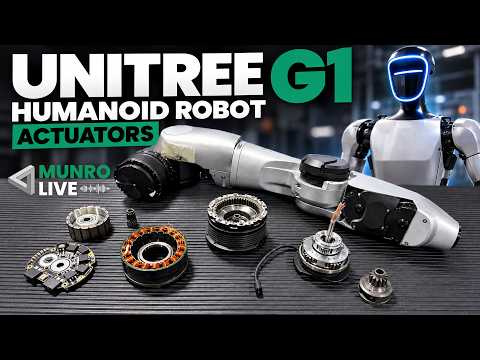
Munro Live, the camera arm of the costing shop Munro & Associates, has published the actuator chapter of its Unitree G1 teardown. The 26-minute cut is not a product review. It is a bench look at the thing that actually moves a humanoid: motor, two-stage planetary gearbox, bearings, and the little board that turns battery DC into three-phase current. Legs get the larger cans; arms get the same architecture scaled down. There is no one joint for every job, and Unitree did not pretend otherwise.
What they chose is telling. Most industrial arms hide a strain-wave drive in the joint — high ratio, almost no backlash, hard to back-drive, usually needing a torque sensor. The G1 uses a lower-ratio planetary stack instead. One unit on the bench measured about 7.8:1; other G1 joints in the same family sit nearer 15:1. That pack is easy to back-drive, so motor current can stand in for output torque. The price is backlash across two gear stages, which Unitree manages by measuring output position. The motor itself is inexpensive and not especially torque-dense. Munro even pointed at unused winding space where a different copper layout might cut resistance and heat.
The electronics are where the cost story gets sharp. A compact inverter board on the actuator handles peak loads above 100 amps, six switches, three phases, and a torque command arriving on thin wires. First-stage reduction is tucked inside the rotor; the second stage sits beside the motor and takes the higher torque. It is a packaging trick that keeps the joint short enough to hide in a plastic shin. It is also the kind of design you get when you are iterating hardware faster than you are qualifying a factory.
None of this makes the G1 a finished industrial product. Munro’s earlier full-body tear already flagged heavy CNC work and cooling choices that look fine on a demo robot and less fine on a line that has to run all day. The actuator video just names the trade. Unitree built a joint you can feel through, manufacture in several sizes, and sell at a price that puts a humanoid on a university bench. Harmonic-drive houses will keep arguing about backlash. Buyers who wanted a $16,000 biped already voted with a purchase order.
What the teardown is really for is the next purchase decision, not a scorecard on Unitree’s marketing. If you are costing a competitor, the lesson is that a two-stage planetary plus a small drive board is how a Chinese vendor hits a lab price without waiting on harmonic-drive supply. If you are putting G1s on a shift, the open questions are heat at the winding, backlash after a few thousand cycles, and whether those CNC housings ever become stampings. Munro did not answer those. It showed the joint well enough that you can ask them in the right order.

Microduck is the second consumer robot from Pollen Robotics, the Bordeaux team now inside Hugging Face, and it is built to waddle across a desk rather than stand on it. Official specs put the biped at 25 centimeters tall and about 780 grams, with 15 degrees of freedom through the legs, neck, head and an articulated beak. Out of the box it walks, sits, crouches, roller-skates, picks things up and gets back on its feet after a fall. You drive it with the included gamepad. Pre-orders opened late August at $399 before tax and shipping, in Cream, Graphite, Lavender and Sky. First deliveries are aimed at Christmas 2026 in North America and Europe.
The sensor list is the reason researchers are paying attention. A front camera, an 8×8 time-of-flight LiDAR, two IMUs, microphones, a speaker, NFC in the head and beak, Wi-Fi and Bluetooth sit on a Rockchip RK3566 with a small AI accelerator, 1 GB of RAM and 32 GB of storage. Battery is a removable NP-F550 good for about an hour. Software — SDK, simulation and the reinforcement-learning stack — is open source. The mechanical and board files are not. Pollen is explicit about that distinction, and it should stay in the copy: this is an open training platform, not open hardware.
That is the product thesis. Reachy Mini was a talking head for interaction. Microduck is a body you can train. Seven behaviors ship loaded. New ones are meant to be learned in simulation and dropped onto the real duck. Hugging Face has already talked up early pre-order volume in the five figures; later orders have been slipping past the Christmas window. A $399 biped that falls down and stands up is catnip. Whether the sim-to-real loop is pleasant on a machine with 1 GB of RAM is the part nobody can review until boxes land.
Treat it as a research toy with a storefront, not a household appliance. Accessories — roller feet, spare batteries, a dock, NFC-tagged objects — are how Pollen expects people to keep playing after the first afternoon. Races and football with several ducks are in the pitch. The honest sentence is still the short one on the product page: a small biped you can drive today and teach tomorrow, if the shipping date holds.
The storefront has already had to say that out loud. A banner on Pollen’s checkout warns that the community ordered a lot of ducks, Christmas is no longer promised on new baskets, and fresh orders are looking at four to six months. That is the usual tax on a viral pre-order, not a verdict on the robot. What matters for this page is narrower: Microduck is a biped you can train, priced like a gadget, shipping first to people who clicked in August. Everyone else is buying a place in line.

DaxAI Robotics brought a saddle and handlebars to the quadruped and called it a horse. The Qiji X1 is a full-size, four-legged mount that a person can sit on, and it spent August drawing queues at the World Robot Conference in Beijing. Riders crossed the carpet. At least one humanoid climbed on as a live payload. The company, a young Beijing startup, also showed the machine earlier in the summer at WAIC in Shanghai. “World’s first” is the marketing line. What is verified is simpler: a working, rideable quadruped on a show floor, not a render.
Company figures circulating with the debut put payload around 300 kilograms, top speed around 7 to 10 km/h on the pure-legged X1, and range near 40 kilometers on a high-voltage pack. The X1 itself is in the 300-kilogram class. A wheeled-leg XS variant was shown alongside it. Chinese coverage has put the base X1 near 289,000 yuan, with a three-year JD.com tie-up and pre-sale talk attached to the WRC stand. Those are vendor numbers. There is still no independent off-road test or published safety case.
The pitch is terrain wheels hate: slope, gravel, mud, a private estate, a forest path. Electric joint motors do the walking; onboard models are supposed to pick footfall. In the hall the gait looked deliberate and a little unsteady, which is what you expect when a 300-kilo machine is learning to carry a tourist. Control from the bars is the story DaxAI wants. Some of the stage passes were still being flown from the side with remotes. Both can be true at an expo.
This is a spectacle product with a logistics aftertaste. If the payload holds up off the carpet, you have a slow pack animal that does not need a trail graded for tires. If it does not, you have a conference ride. Until someone publishes hours, fault rates and what happens when a rider comes off, the Qiji X1 stays where it is: a large quadruped people actually sat on in Beijing, and a reminder that Chinese labs will try the joke form factor until it stops being a joke.
It is also only loosely a humanoid story. The reason it sits on this page is the rider — a person, and once a humanoid, using the same hall that is otherwise full of bipeds. DaxAI is selling a mount, not a worker. Limited deliveries have been talked about for late 2026. Until a unit leaves the expo circuit and comes back with a scratched belly and a log file, treat the horse as a show that worked, not a category that has arrived.
A San Francisco defense-first platform is being briefed for logistics and high-risk ground work while the Army’s prize competition hunts militarized humanoid subsystems

The Phantom MK-1 is being developed by Foundation, the San Francisco company also styled Foundation Future Industries, as a human-scale biped aimed at defense and other high-risk work rather than factory pick-and-place. Public figures put the machine at about 175 centimeters and 80 kilograms, with 29 degrees of freedom and a walking speed near 1.7 meters per second. Foundation has marketed it as a dual-use platform that can move through stairs, doors and interiors that wheeled or tracked systems struggle to enter. That pitch is now sitting next to a harder public record: company demonstrations of the robot handling standard infantry equipment, including a widely circulated mortar-handling clip, and a small field evaluation in Ukraine that began in February 2026. The video under review treats Phantom as the case study for how far a U.S. humanoid has actually moved toward military use, and how that effort sits beside official Army research rather than substituting for it.
What Foundation has shown in controlled settings is manipulation of human-standard tools, not a finished combat system. Company footage includes the MK-1 operating several common small arms in demonstration conditions and, separately, handling mortar rounds as a proof that the hands and stance can work with existing inventory instead of a custom robot weapon. Those clips are capability advertisements. They do not establish autonomous fire control, weatherproofing or sustained endurance. Reporting from the Ukraine evaluation is more cautious. Two early MK-1 units were sent for field tests with U.S. government support and Ukrainian official participation. Foundation’s public description of the visit centered on supply pickup — moving materiel from outside a contested site to inside it so a soldier does not take that exposure. Subsequent coverage said the machines were used mainly for logistics in hazardous areas and that the hardware showed the usual first-generation limits: roughly 20 kilograms of payload on the units tested, no waterproofing, and battery life measured in a few hours rather than a full infantry shift.
Those limits matter because the humanoid form is being sold precisely for places drones and ground vehicles already fail: bunkers, stairwells, trenches and interiors. If the robot cannot stay dry, carry a useful load or last a shift, the form factor advantage is theoretical. Foundation has said a follow-on Phantom 2 is intended to address payload, sealing and endurance and that upgraded units were planned for Ukraine later in 2026. CEO Sankaet Pathak has also described U.S. research work across the Air Force, Army and Navy and a pool of government research contracts reported at about $24 million covering inspection, logistics and weapons-handling tasks. Independent reporting has noted that the widely repeated “$24 million Pentagon contract” figure mixes inherited and research awards rather than a single production buy. The distinction is the one that should stay in the brief: Phantom is in evaluation and demonstration, not in a published program of record.
The U.S. Army is running a separate track that does not depend on Foundation. xTechHumanoid, launched in 2025 by the Army xTech Program with the Joint Humanoid Community of Collaboration, is an open prize competition for militarized humanoid capabilities and subsystems. The Army’s published problem set includes security, reconnaissance, supply, obstacle clearing, hazardous-material work and offensive and defensive missions in urban terrain. The prize structure is modest by defense-program standards — up to $490,000 in cash prizes and a follow-on pool described at up to $1.25 million — but the point of the contest is to force vendors onto a Soldier-facing evaluation rather than a trade-show floor. White papers were collected in late 2025. Finalists were slated for a live experimentation event with Army and DOD subject-matter experts in August and September 2026. That calendar puts official U.S. humanoid experimentation in the same season as Foundation’s more visible marketing, which is why briefings now treat the two as parallel rather than identical.
The wider comparison in the video — other countries’ robotic weapon programs — is the context, not a claim that Phantom is already a fielded soldier. China has published a dense set of humanoid procurement notices even as commercial factories outrun actual military deployments. Ukraine has industrialized uncrewed ground systems at a scale measured in tens of thousands of missions per quarter, which is the environment that made a two-unit humanoid trial newsworthy in the first place. European and allied programs remain earlier. Foundation’s own language has moved from “keep people out of harm’s way” to exploring “kinetic” options, a shift recorded in mid-2026 reporting. That is a policy and product-roadmap statement, not evidence that MK-1 units are conducting independent combat. The responsible reading is that a U.S. startup is testing a humanoid in a live conflict zone for logistics and that the Army is, at the same time, paying small prizes to find out which subsystems might someday be militarized.
For the industry the Phantom story is a warning about category mix-ups. Most of the capital in humanoids is still chasing factories, warehouses and homes. Foundation is one of the few American firms willing to say defense is a primary market and to put hardware into a war zone to collect data. The data so far says the body can climb and carry a modest load and that operators will immediately ask for water sealing, hours of endurance and a payload that matches a soldier’s pack. Until those close, Phantom remains an evaluation article. The questions that will decide whether it becomes more than that are ordinary and unsentimental: who owns the control stack in the field, how a human stay-behind authorization is enforced, and whether a second-generation unit can last a night in the weather that already defeats the first.

The 2026 China Mining Conference and Exhibition opened in Tianjin on September 10 at the Meijiang Convention and Exhibition Center, the 28th edition of a show the organizers bill as one of the four major international mining gatherings. This year’s theme is win-win cooperation with a green and intelligent turn. More than 650 companies are on the floor through September 12, and official photography already treats robots as part of the scenery: a mine-inspection robot dog on a stand, unmanned equipment in the aisles, ministerial forums on international mining cooperation in the halls. The exhibition is the place China uses to argue that a historically dangerous, labor-heavy industry is being rebuilt as a high-tech system. The argument is no longer abstract. Quadrupeds, cabless electric haul trucks and underground networks are being shown as products that already have sites, not only as concept boards.
One verified floor exhibit is a four-legged inspection robot built to enter hazardous, enclosed underground spaces where sending a person is the last option. Xinhua recorded a quadruped patrol robot on a preset underground route, adjusting for obstacles and working in closed headings; the named booth in that official dispatch was Ziguang Tianji. The job is not glamorous. A dog-sized machine walks a heading, carries cameras and gas or thermal payloads, and sends a picture back before a crew steps in. For non-coal metal mines and for coal sites under tighter safety rules, that first look is the difference between a planned inspection and a person in an unknown atmosphere. Tianjin is selling that substitution as routine industrial kit. Vendor names that appear only in secondary video narration, and that could not be matched to an exhibitor list or official photo caption, are not used here.
Haulage is the other half of the pitch. Exhibitors are showing unmanned, purely electric mining trucks that move ore without a driver in the cab. That class of vehicle is already in commercial use in China, separate from any single booth claim. Official and industry tallies put the in-service unmanned mining-truck fleet above 4,000 units by the end of 2025, with roughly a tenth of the country’s mining trucks now driverless. Large open-pit sites such as Yimin in Inner Mongolia have been running cabless electric fleets under 5G-Advanced networks. The commercial point at Tianjin is not that a truck can drive itself in a video. It is that the truck, the charger, the dispatch cloud and the safety case are being sold together so a mine can take people off the haul road in fog, snow and dust — the conditions that used to stop work because a human driver could not see.
The connective tissue under both the dog and the truck is communications and software. Chinese operators have been installing underground low-latency 5G and building 3D digital replicas of workings so a control room can watch a live twin of the heading rather than wait for a shift report. Digital twins of hoists, tailings levels, equipment load and personnel location were on display in smart-mine sand tables at the same show. The combination is what vendors mean by “intelligent mining”: the robot or the truck is only the visible actuator. The network keeps latency low enough for remote or supervised autonomy, and the twin is the place supervisors look when they decide whether a heading is safe to enter.
None of this makes a mine empty of people. What it changes is which jobs remain underground. Fixed posts and the first pass through a bad heading are the tasks regulators and operators most want off human backs. China’s mine-safety authorities have already pushed pilot programs for robots in dirty, dangerous and exhausting roles. Tianjin is where that policy meets a sales floor. A quadruped in a booth and a cabless truck on a screen are exhibits. A heading that no longer needs a walker with a lamp is the deployment. The gap between those two is still the story: certification, explosion-proofing, battery life in heat and dust, and whether the twin on the wall matches the ground when the network drops.
For the robotics market the mining floor is a reminder that the paying customer is often not a humanoid buyer. Inspection dogs, rail-mounted patrol robots, unmanned trucks and remote shovels are absorbing the same sensors, radios and autonomy stacks that humanoid firms advertise for factories. If China can keep scaling unmanned haulage and underground patrol, the data set that trains the next inspection model will come from mines, not from living-room demos. Tianjin this week is that pipeline in public: a national mining show using robots to say the industry’s next productivity gain is fewer people in the heading, not only bigger shovels at the face.

XPENG has switched on what it calls the world’s first automated production line for an advanced general-purpose humanoid, and it marked the moment with a robot that finished final assembly and walked off the line without a handler on the tether. The commissioning, announced in Guangzhou in the second week of September 2026, is the company’s bid to move IRON out of R&D prototyping and onto a factory schedule. XPENG says more than 80 percent of the line’s core processes are automated and that the process control is borrowed from its electric-vehicle quality system. That claim is the whole story in miniature. A humanoid that can take a step after the last station is a manufacturing object. A humanoid that still needs a puppeteer to leave the cell is still a prototype, however polished the walk looks on stage.
IRON is the same platform that went viral in November 2025 when XPENG cut a leg open on stage to prove no one was inside. The production description now circulating with the line is specific: 76 degrees of freedom across the body, 21 in each hand, a fully enclosed flexible lattice shell, and three in-house Turing AI chips rated at up to 2,250 TOPS so the company’s physical-AI model can run on the robot. XPENG’s point in repeating those numbers next to a factory clip is that the unit leaving the line is supposed to be the same architecture it intends to build in volume, not a one-off show machine. Shared parts with the EV business are part of the same argument. The company has said more than 85 percent of IRON’s supply chain overlaps the car side, which is how an automaker tries to make a humanoid line look financeable.
The schedule attached to the line is still a target, not a shipment log. XPENG is holding to mass production by the end of 2026, first deployments in its own stores and campuses, and a broader commercial launch with deliveries in China and overseas in 2027. Earlier in the year the firm talked about capacity above 1,000 robots a month and a longer ambition toward much larger annual volume by 2030. Tuesday’s line announcement did not restate every one of those figures, and XPENG has not published how many units the first small-batch run will yield or what a robot will cost. That omission should stay visible. Starting a line is not the same as filling a yard.
What walked off the line is being sent first into XPENG’s own world. Showrooms and campuses are the proving ground: tours, reception, and other supervised public tasks that generate data without asking a third-party factory to bet a shift on an unproven machine. The company has said additional in-house scenarios will be verified in the fourth quarter of 2026 before it tries a wider commercial push. That sequence is the automotive habit applied to a humanoid — build it, walk it, use it internally, then sell it. Competitors will watch whether the walk off the line is repeatable at the next ten units or only at the camera unit.
The “world’s first” language is XPENG’s own and should be read as a category claim about a high-DOF general-purpose humanoid leaving an automated line under onboard control. Other firms have built humanoids and other firms have built robot factories. What XPENG is advertising is the combination: automotive-grade automation, a production IRON, and an unaided walk at the end of the cell. Independent coverage has treated the clip as the clearest sign yet that IRON is heading for manufacturing rather than another stage demo. It has also noted the comparison hanging over the news cycle: Tesla’s Optimus program has not shown an equivalent line moment. That comparison is market color. It is not a verdict on either robot’s field reliability.
The industrial test from here is ordinary. Yield at the end of the line, hours before the first unplanned stop, and whether a store-floor IRON can do useful work without a safety driver in the wings will decide if Guangzhou started a product or staged a ceremony. XPENG has the capital, the EV supplier base and now a line that a robot can leave on its feet. Mass production by year-end is the date the company has put on the wall. Until units show up in numbered batches, the accurate sentence is the one the factory clip actually supports: an advanced general-purpose humanoid has completed automated production and walked off the line by itself.
Humanoid Press condenses its technical and commercial report on Figure AI’s third-generation humanoid — from official specs and tactile hands to Helix, BotQ throughput and paid factory deployments

Figure 03 remains one of the most closely watched developments in humanoid robotics because it is no longer only a demonstration platform. Introduced on October 9, 2025 as a redesign for Helix, the home and high-volume manufacturing, the robot is now in paid commercial work, in-house production and a second-generation model that must control locomotion and manipulation together. Humanoid Press is publishing a condensed summary of its technical and commercial report covering specifications, tactile sensing, Helix 02, battery and safety, BotQ scale, BMW Spartanburg, other deployments, funding and competitive position. Full report and HPS Global Leaderboard: contact@humanoid.press.
The official specification card should be treated as the baseline rather than older inferred numbers. Figure lists Figure 03 at 5 feet 8 inches and 61 kilograms, with a 20-kilogram payload, a walking speed of 1.2 meters per second and about five hours of runtime from a 2.3-kilowatt-hour torso pack. Charging is specified at 2 kilowatts through inductive coils in the feet. The vision stack offers twice the frame rate of Figure 02, roughly one-quarter the latency and a 60 percent wider field of view, plus a palm camera in each hand. Fingertip sensors detect about three grams of pressure, enough to distinguish a secure grip from an incipient slip.
Mobility and manipulation are no longer sold as separate stacks. Helix was the in-house vision-language-action system Figure designed the 03 hardware around after ending its earlier OpenAI collaboration. Helix 02 is the current generation: a pixels-to-actions model that Figure says coordinates hands, arms, torso and feet in a single network. That matters most at BMW, where the robot must pick unsorted parts, load a sequencing trolley and pull a heavy cart without dropping the manipulation thread. Soft textiles, foam at pinch points and speech-to-speech audio are part of the same argument for shared factory floors.
Power, safety and manufacturing are now first-order commercial questions. Figure says the 03 battery achieved UN38.3 certification, with layered protection at the BMS, cell, interconnect and pack levels and UL2271 pursued in parallel. Soft goods and reduced mass versus Figure 02 are presented as contact-safety features. Production sits at BotQ, initially rated at up to 12,000 robots a year against a longer target of 100,000 units over four years. April 2026 updates said output had moved from one robot a day to one an hour, with more than 350 units delivered; by late July the firm marked the 1,000th Figure 03. Figure has not published a retail price or waitlist.
The reference deployment remains BMW Group Plant Spartanburg. After Figure 02 spent roughly eleven months in the body shop and contributed to more than 30,000 BMW X3 vehicles — loading more than 90,000 parts across 1,250-plus hours — BMW brought Figure 03 into Hall 52 in late June 2026 for logistics sequencing. Unsorted components arrive in larger containers; the robot picks, sorts and loads a trolley for the line. BMW has framed Spartanburg as the birthplace of humanoid robotics in its day-to-day manufacturing. Outside the automaker, Figure has pointed to commercial work with Catalyst Brands in Reno and to package-sorting runs measured in tens and then hundreds of hours.
Capital explains why the platform draws more attention than any single demo. Figure’s September 2025 Series C raised more than $1 billion at a $39 billion post-money valuation, up from the earlier $2.6 billion Series B, with Parkway leading and Brookfield, NVIDIA, Macquarie, Intel Capital, Salesforce, T-Mobile Ventures and Qualcomm Ventures among participants. In early September 2026 the company added a multi-year Nscale compute partnership with an initial $3.5 billion commitment. Helix 02, BotQ, BMW and Catalyst, and that valuation, are the commercial case competitors have to answer. The open questions remain uptime, cost per completed task, and whether Helix keeps improving once easy structured work is exhausted.
AgiBot Research has released GE-Act 2.0, a world-action model trained from scratch on embodied manipulation data rather than inherited from a general video generator. Visual representation, future-state generation and action prediction are learned from random initialization. The September 2026 paper argues that most world-action models still borrow pretrained video backbones and never cleanly test whether manipulation-specific pretraining scales. GE-Act 2.0 is the counter-experiment: no inherited video generators, no task-specific fine-tuning at evaluation, and a real-robot zero-shot protocol on unseen scenes, 100 atomic tasks, 20 skill categories and two embodiments.
The architecture keeps planning and control aligned while allowing the pieces to pretrain on different data. A control-oriented autoencoder compresses each frame into tokens meant to retain instruction- and action-relevant detail. A single-step visual planner predicts a complete future state in one pass, and an inverse-dynamics model turns that future into actions. The modules are jointly trained with knowledge-aligned selective optimization, which keeps only predicted futures judged compatible with the recorded action. The project page says a full action chunk runs in 104 milliseconds on a single RTX 5090, or 52 executable actions at 30 hertz.
The scaling curve is the result the field will cite. Co-training data expanded in nested pools from 300 hours to 1,200, 5,000 and 30,000 hours. On G1-OP, mean zero-shot success rose from 17.1 percent to 44.1 percent. On G2-90D it rose from 13.4 percent to 31.1 percent. Gains covered 19 of 20 skill groups on G1-OP and 18 of 20 on G2-90D. Tasks with any nonzero success increased from 39 to 76 on G1-OP and from 24 to 72 on G2-90D, and the curve did not flatten between 5,000 and 30,000 hours.
New skills appearing only at the largest scale matter more than the averages. Folding towels, nesting paper cups, uncapping pens and arranging flowers are the examples AgiBot emphasizes — manipulations the 300-hour model could not complete. Skill-specific data coverage correlates strongly with zero-shot out-of-distribution success, with Pearson r of 0.80 and Spearman rho of 0.85. Under the same protocol the model grounds object, color, shape and position references in at least 90 percent of trials and follows explicit instructions even when they conflict with an already-committed behavior.
Cross-embodiment transfer is the second claim that will be tested. G2-90D accounts for less than 2 percent of the co-training mixture, yet still gains 17.7 percentage points as the shared corpus grows. G1-OP supplies more than half of the co-training data, so the experiment tests whether a data-rich body can lift a data-poor one. The mixture includes instruction-video data, action-labeled trajectories, simulation, open-source sets, egocentric human video, deployment rollouts and failure trajectories. Failure is treated as a training asset rather than discarded noise.
The industrial reading is unfinished. A model that envisions a future state before it acts is closer to how world-action systems were supposed to work than a policy that only clones teleoperated trajectories. GE-Act 2.0 is still a research checkpoint, and 44.1 percent zero-shot success on a 100-task wall is not factory reliability. What the result changes is the burden of proof for teams that fine-tune a web video model and call the leftover gap “embodiment.” If a from-scratch model keeps climbing from 5,000 to 30,000 hours, the next argument is how expensive the next tenfold data increase will be.

A special letter from the desert is how DEEP Robotics is framing its latest field deployment. This summer the Hangzhou company accepted an invitation from the Alxa League oasis plantation center and sent a Lynx wheeled-legged robot into the Tengger Desert to support patrol and sand-control work. The managed belt includes more than 100 mu of flower-rod forest and some 40,000 sand date trees, a thin green edge that rangers have historically walked 15 to 20 kilometers a day to inspect. DEEP presents the robot as a force multiplier for people already doing the work rather than a replacement for the ecological program.
The machine in the footage is the Lynx wheel-legged platform, described here as the M20S variant. Unlike a conventional quadruped that only walks, Lynx can roll when the crust will support speed and articulate the legs when the surface turns to soft sand, ruts or broken fencing. Company materials have cited a top speed up to 9 meters per second on the M20S and a payload that in the Alxa write-up reaches 35 kilograms of tree tags, water bags and replanting tools. That load is the core of the job: fewer return trips across hot sand for the same set of tools.
The environment is the actual product test. Surface temperatures around 50 degrees Celsius, wind-driven grit and long unstructured routes are closer to industrial inspection than to a motion-capture stage. The Alxa account says the robot held a patrol line across loose sand, used a dual-light pan-tilt to flag holes, downed plants and torn nets, and relied on IP67 sealing against dust. A thermal payload tracks wildlife near young plantings, and a loudspeaker is used to drive animals off seedlings without harming them. The claim is that 7-by-24 patrol coverage becomes possible where human routes are long and visibility collapses after dark.
This desert assignment sits on a longer DEEP field record. Lynx M20 was introduced in 2025 as an industrial mid-size wheel-legged robot for tunnels, substations, emergency logistics and scientific support, with operating bands that typically run from minus 20 to 55 degrees Celsius and protection ratings of IP66 or IP67 depending on the variant. The same family has been shown on red-sand slopes, in Turpan vineyards moving harvest baskets, and as a logistics mule on high-plateau research trips. The Tengger deployment is an application layer on a mobility stack already sold into heat, dust and payload work.
What the video is useful for should be kept separate from what it is not. It is useful as evidence that a wheel-legged robot can stay upright on terrain that breaks ordinary wheeled carts and exhausts walking patrols. It is not a controlled study of hectares restored, seedling survival or cost per inspected kilometer. Desertification control is a multi-year land-management problem. A robot that carries water bags and deters grazing animals can change the labor equation on the margin; it cannot substitute for planting density, irrigation and water politics in Alxa.
For the wider market the story is a reminder that not every commercially interesting robot this year is a biped in a factory. Extreme-terrain logistics, ecological patrol and inspection in places people should not walk twice a day are already paying use cases for Chinese quadruped and wheel-legged vendors. If Lynx can keep a schedule in the Tengger — heat, payload, dust, night thermal and a real ranger workflow — that is a more transferable data point than another indoor climb. The open test is durability across a full planting season, not a single summer visit.
China’s PLA Eastern Theater Command has released footage of humanoid and quadruped robots simulating full-scale invasion scenarios, while the U.S. Army is funding competitions for militarized humanoid capabilities including urban reconnaissance and obstacle clearing.

The rapid militarization of humanoid and quadruped robotics has entered a new phase, with national security concerns driving both competitive innovation and regulatory barriers around the world. China’s People’s Liberation Army Eastern Theater Command has recently released official footage demonstrating humanoid and quadruped robots performing full-scale invasion simulations across varied terrain, including jungle, desert, and urban settings, signaling a shift toward operational deployment of these platforms in potential conflict scenarios.
At the same time, the U.S. Army has launched the xTechHumanoid competition, offering up to $490,000 in cash prizes to develop militarized capabilities for urban reconnaissance, obstacle clearing, and other tactical tasks, directly responding to the dual-use potential of advanced robots while ensuring American technological leadership in this domain.
Regulatory action has intensified as well. The FCC has officially added foreign-produced humanoid robots and quadrupeds to its Covered List, banning new imports of such devices over national security risks and effectively curtailing access for certain platforms, particularly those from adversarial nations.
These developments reflect a global race where robotics is no longer viewed solely through a commercial or consumer lens but as a strategic asset with direct implications for defense, supply chains, and geopolitical stability. The footage from China and the U.S. Army’s competition efforts illustrate how rapidly these machines are moving from research labs to real-world applications, while the FCC’s move underscores the growing international tensions surrounding their deployment.
For the broader robotics industry, this moment marks a turning point: platforms that once focused on factory floors or entertainment are now being evaluated for their potential in high-stakes environments, prompting calls for enhanced safety standards, transparent testing protocols, and balanced regulatory frameworks that protect national interests without stifling innovation.
The coming months will likely see further public demonstrations, funding announcements, and policy announcements as countries balance the promise of humanoid robots with the imperative of secure and responsible deployment in an increasingly contested world.
Chinese EV maker XPeng has officially opened its humanoid robot assembly line, marking a significant milestone in the transition from research and prototyping to full-scale production. The company’s IRON platform has completed automated production and autonomously walks off the line, signaling the start of a new era for advanced general-purpose humanoids in China. Facing a slowdown in electric vehicle sales, XPeng is now leveraging its manufacturing expertise and supply chain to scale humanoid output, with the goal of reaching meaningful volume production by the end of 2026.
This move comes at a critical time for the industry, as several Chinese automakers are expanding into robotics to diversify revenue and capitalize on the growing humanoid market. XPeng’s IRON robot is now walking off the assembly line autonomously, a first for the sector and a demonstration of the company’s ability to integrate software and hardware at scale.
While China dominates approximately 97 percent of humanoid robot exports, other players are also active. Figure AI’s Figure 03 continues to perform paid logistics work at BMW facilities, and Boston Dynamics is shipping fleets of its Electric Atlas robots to Hyundai factories in South Korea. These deployments highlight the global reach of humanoid technology beyond China’s borders.
The timing of XPeng’s production ramp-up is notable amid tightening export controls and supply-chain scrutiny. The company’s ability to execute on its volume targets will serve as a benchmark for whether Chinese automakers can deliver competitive humanoid platforms that match Western competitors on both technical and economic grounds.
Challenges remain in scaling from low-volume pilots to true mass production, including software optimization, supply-chain integration, and rapid iteration based on real-world feedback. XPeng’s success will be closely watched as it helps shape the overall industry timeline for 2026 and beyond.
The line itself achieves more than 80 percent automation across core processes, with robots handling the majority of assembly tasks and the completed IRON unit walking off under its own power in a fully autonomous workflow. This level of integration demonstrates XPeng’s ability to combine advanced factory robotics with humanoid-specific software, setting the stage for consistent, high-volume output while minimizing human error and labor dependency.

Performing pirouettes, tennis strokes, or celebrating goals with the naturalness of a human is now possible for a robot. The BeyondMimic project presents a new robotic learning framework powered by human movement data, which creates natural physical behaviors. The robot can walk, run, and execute complex movements inspired by martial arts after training with approximately 2.5 hours of human movement data. The researchers first validated their method in a simulation environment before conducting physical experiments on different terrains.
This approach allows the robot to learn from real human demonstrations and translate them into smooth, human-like physical actions without requiring massive amounts of data or complex custom controllers. The framework’s ability to capture and replicate the fluidity of human motion opens new possibilities for robots in service, entertainment, and even collaborative tasks where natural interaction is essential.
Physical experiments confirmed that the trained policies generalize across varied surfaces and conditions, highlighting the robustness of the approach. This work represents a significant step toward more versatile and responsive robotic systems that can move and act in ways that feel intuitive to humans.
The BeyondMimic framework is positioned as a key advancement in embodied AI, with potential applications ranging from everyday household assistance to professional sports or performance environments. As the field moves forward, continued improvements in data efficiency and real-world transfer will determine how quickly human-like movement becomes a standard feature of advanced robots.
By leveraging open-source motion-capture tools and a two-stage pipeline—first mastering motion tracking via reinforcement learning, then enabling versatile control through guided diffusion and classifier techniques—BeyondMimic bridges the gap between scripted tasks and fully adaptable behaviors. This efficiency is particularly promising for rapid deployment in dynamic environments where robots must respond intuitively to unstructured real-world conditions.
The researchers note that while action scripts are still required for high-level task planning in testing phases, the core movement policies learned through BeyondMimic require minimal manual intervention, accelerating progress toward fully autonomous humanoid systems that can seamlessly integrate into collaborative or entertainment settings.
Figure AI has signed a multi-year agreement with Nscale to deploy up to 100,000 NVIDIA Vera Rubin GPUs for training its humanoid robots, with an initial commitment of $3.5 billion and plans to scale beyond $6 billion. This massive infrastructure build-out, located in Barstow, Texas, marks a pivotal moment in the race to integrate advanced robots into every home. Initial deployment begins in the second half of 2027, reflecting the unprecedented compute demands of democratizing humanoid robotics at global scale.

Figure AI, the leading humanoid robotics company developing the first commercially viable autonomous humanoid robot, has entered into a strategic multi-year agreement with Nscale, a British AI infrastructure provider, to deploy up to 100,000 NVIDIA Vera Rubin GPUs. The initial commitment totals $3.5 billion, with the option to scale the project beyond $6 billion as the demand for advanced AI training and inference accelerates across the industry. This infrastructure will be housed in Nscale’s facility in Barstow, Texas, and the first systems are targeted for deployment starting in the second half of 2027, aligning precisely with Figure’s timeline for scaling its Helix AI model and bringing advanced robots into everyday homes worldwide.
The partnership underscores the immense computational requirements for scaling humanoid robots into everyday households worldwide. Training and running models capable of natural interaction, memory retention, and real-world value creation demands unprecedented GPU capacity, far exceeding what current platforms can support. NVIDIA’s Vera Rubin Platform, with its revolutionary co-designed chips and architecture, is positioned as the cornerstone for this next wave of robotics innovation, enabling the massive datasets and real-time processing needed for reliable embodied AI.
The Barstow facility represents a strategic choice for both cost efficiency and supply-chain resilience. Nscale’s data center, already optimized for high-density AI workloads and operating as a Bitcoin-mined facility repurposed for AI, will serve as the primary compute hub for Figure’s humanoid development. This deployment not only accelerates Figure’s roadmap but also sets a benchmark for the industry, where bringing robots into every home will require massive, always-on infrastructure that can handle the demands of physical-world interaction at scale.
Industry analysts view this as a landmark moment in the humanoid robotics ecosystem. While many companies focus on software and simulation, Figure’s commitment to hardware-level compute infrastructure signals a shift toward end-to-end control—from the lab to global deployment. The timeline from announcement to initial rollout in 2027 allows for full integration and testing before mass consumer adoption begins, ensuring that the first 100,000-GPU clusters are ready when Figure’s robots move beyond prototypes.
Looking ahead, the scalability clause beyond $6 billion could double the footprint and enable further expansion into additional regions as humanoid adoption grows. As the market for embodied AI expands, such infrastructure plays will become standard, reducing latency and enabling more responsive, autonomous robots that can truly function in unstructured home environments. For investors and competitors alike, Figure’s move highlights the critical role of compute partnerships in achieving commercial viability at the scale required to bring robots into every home.
The broader implication is clear: true democratization of humanoid robots hinges on accessible, high-performance AI infrastructure. Figure and Nscale’s collaboration with the Vera Rubin Platform is not just a transaction—it is a foundational step in making advanced robotics a household reality, where compute at this unprecedented scale finally meets the needs of embodied intelligence.

Real innovation cannot be built on slides. From hardware to AI, true breakthroughs demand persistence and a willingness to get back up after every fall. XPENG Robotics has walked side by side with He Xiaopeng for six years, pushing forward through setbacks to build robots that interact naturally, hold memories, and deliver real-world value. Today, with the company’s production line now fully active and its humanoid platform advancing, He Xiaopeng continues to emphasize that we take it one step at a time—no shortcuts, no quick fixes, but steady progress toward machines that can truly operate in human environments.
This philosophy has defined XPENG Robotics’ journey from laboratory experiments to full-scale manufacturing. He Xiaopeng, who also serves as CEO of the newly formed XPENG-W Robotics unit, has personally guided every milestone, ensuring that technological progress aligns with practical deployment realities. The company’s focus on embodied intelligence means that every robot must be reliable, adaptable, and ready for real environments, not just controlled simulations or idealized demos.
Be patient—we take it one step at a time. This mantra reflects the deliberate pace at which XPENG is scaling its humanoid platform. From initial prototypes to production-ready units, the emphasis remains on quality, iteration, and real-world testing rather than rushing timelines or cutting corners. The result is platforms that can hold memories, respond naturally to human interaction, and create tangible value in homes and workplaces, exactly as the six-year partnership has aimed to deliver.
Looking back over six years, the persistence has paid off in multiple ways. XPENG’s transition from autonomous vehicles to robotics demonstrates the company’s ability to leverage its automotive expertise in building intelligent machines capable of complex physical tasks. He Xiaopeng’s leadership ensures that every decision—from hardware design to AI training—prioritizes long-term capability over short-term gains, turning challenges into opportunities for deeper understanding and better results.
As the production line ramps up and the first humanoid units move toward deployment, the industry watches closely. Will XPENG deliver on its promise of natural interaction and memory retention at scale? The answer will shape how quickly humanoids move from research demos to everyday companions that hold memories and create real-world value. For now, the message remains clear: we build it right, one step at a time, with He Xiaopeng at the center of every advance.

A video from Russia showing a humanoid robot striking a customer inside an electronics store has sparked a fresh round of debate about what happens when humanoid machines move out of controlled demonstrations and into everyday public spaces. In the footage, the robot repeatedly makes contact with a man standing nearby, using both its arms and legs before the encounter eventually ends.
The scene is unusual precisely because it looks so ordinary. There is no laboratory setup or carefully choreographed product demonstration—just a customer standing in a retail environment when a machine suddenly becomes physical. That makes the footage particularly relevant to the broader robotics industry, where humanoids are increasingly being tested in stores, factories, warehouses, and other places where people and machines have to share the same space.
The exact circumstances behind the incident remain unclear. The footage alone does not establish whether the behavior resulted from a software malfunction, a control error, an unexpected interaction, or some other failure. That distinction matters, because a humanoid robot capable of walking, manipulating objects, and responding to people also needs to recognize when physical contact is unsafe and immediately transition into a controlled state.
That safety layer is becoming one of the most important challenges in consumer robotics. A robot working around people cannot rely only on its ability to complete a task; it also needs reliable perception, force control, collision detection, emergency-stop systems, and clearly defined operating boundaries. In a retail environment, those requirements become even more important because customers are not trained operators and may not know how a machine will react to an unexpected movement.
The incident also highlights a larger gap between impressive demonstrations and dependable real-world deployment. Humanoid robots are designed to operate in environments built for humans, which means they inevitably encounter unpredictable situations: people stepping into their path, objects being moved unexpectedly, children approaching them, or customers interacting with them without understanding their limitations. Handling those situations safely is just as important as demonstrating dexterity or conversational intelligence.
For developers, the lesson is less about one unusual video and more about the standards required as humanoids become physically present in public life. Every deployment creates another opportunity to test how a robot behaves when conditions differ from the assumptions made during development. Transparent reporting, stronger safeguards, and well-defined emergency procedures will become increasingly important as companies move from pilot programs toward larger commercial deployments.
No injuries have been reported in connection with the footage, and the available video does not by itself establish the underlying cause of the behavior. But the episode is a useful reminder that humanoid robotics is ultimately a physical discipline. A system can be remarkably capable in software and still present serious challenges if its physical behavior is not predictable, controllable, and safe around ordinary people.
New world-action foundation model breaks key bottlenecks in instant planning, real-time decision-making, and dynamic interactive execution

Chinese robotics company Unifo has released UnifoLM-X2-1.0, a new world-action foundation model that dramatically advances the capabilities of humanoid robots in dynamic, interactive environments. The model is designed to overcome long-standing bottlenecks in instant planning, real-time decision-making, and adaptive execution, enabling fully autonomous combat behaviors that were previously considered beyond reach for general-purpose humanoids.
The breakthrough comes from a unified architecture that treats perception, reasoning, and action as a single continuous process. Instead of relying on separate modules for vision, planning, and control, UnifoLM-X2-1.0 processes multimodal inputs in a way that allows the robot to predict and adapt to rapidly changing situations on the fly. This results in smooth, high-dynamics movements that feel natural even during close-quarters combat or multi-opponent scenarios.
The model’s real-time prediction and planning capabilities are particularly impressive. It can generate and evaluate future action sequences in milliseconds, allowing the humanoid to adjust mid-motion based on new visual or tactile feedback. This is a significant step beyond traditional reinforcement-learning policies, which often struggle with long horizons and sparse rewards. By framing the entire combat task as a world-model prediction problem, UnifoLM-X2-1.0 reduces latency and improves robustness in unpredictable physical settings.
Validation of large-scale deployment feasibility comes from the model’s ability to handle full humanoid bodies — including balance, dexterity, and joint coordination — in real-world combat conditions. The company has demonstrated the system on their own platforms, showing that the intelligence layer can be transferred from simulation to hardware without major retraining. This is critical because earlier world models often failed when scaled to full electromechanical systems.
For the broader industry, UnifoLM-X2-1.0 represents a shift toward more general-purpose, goal-directed humanoid intelligence rather than task-specific policies. Once the model is fully open-sourced and integrated into additional platforms, it could accelerate the transition from research demos to widespread deployment in security, logistics, and service sectors where combat-like adaptability is increasingly valuable.
While the current implementation is still maturing, the results are already compelling. The model’s ability to achieve fully autonomous combat without human intervention in real time validates the direction of world-model-driven humanoid development. The next milestone will be scaling production and proving reliability across varied environments and opponent behaviors, but the foundation is now firmly in place.

XPeng has activated its dedicated humanoid production line, marking a significant milestone in the company’s transition from autonomous vehicles to robotics. The facility is now running at full capacity, with the company aiming for meaningful volume output by the end of 2026 as part of its broader strategy to scale humanoid production alongside its existing EV and smart-mobility businesses.
The move comes at a time when several Chinese automakers are expanding into robotics to diversify revenue streams and leverage their existing supply-chain and manufacturing expertise. XPeng’s IRON humanoid platform is already in advanced development, and the new line is designed to support both initial pilot deployments and eventual mass production. The company has emphasized that the production ramp will focus on reliability and cost control while maintaining the high standards required for consumer and industrial use.
Industry analysts view the XPeng production line as another data point in the growing wave of Chinese humanoid initiatives. While Western companies have focused primarily on research and limited pilots, several domestic players are now moving into actual manufacturing. The timing is notable because it coincides with tightening export controls and supply-chain scrutiny, making domestic production a strategic priority for both cost and security reasons.
Challenges remain. Scaling from low-volume pilots to true mass production requires not only hardware but also software optimization, supply-chain integration, and the ability to iterate quickly based on real-world feedback. XPeng’s success will serve as a benchmark for whether Chinese automakers can deliver humanoid platforms that are competitive on both technical and economic grounds.
The broader implication is that 2026 is shaping up to be a pivotal year for humanoid volume production. Multiple Chinese companies are now in or near production, which could accelerate the overall industry timeline and make early deployment in factories, logistics, and consumer markets more likely than in previous years.
For investors and competitors, the XPeng production line represents both opportunity and urgency. The company’s ability to execute on the volume target will determine how quickly the humanoid market can move beyond demos and into tangible economic impact. Whether XPeng’s output is sufficient to meet its ambitious timeline will be one of the key watchpoints for the remainder of 2026.
Microduck is a compact, open-source humanoid robot designed for education, research, and playful experimentation. At just 25 cm tall and weighing 780 g, the 15-degree-of-freedom machine is small enough to fit on a desk yet powerful enough to perform a wide range of autonomous and interactive behaviors right out of the box.
The robot features a front camera, 8x8 LiDAR, dual IMUs, microphones, speaker, NFC reader, Wi-Fi, and Bluetooth. Out of the box it can walk, sit, crouch, roller-skate, and recover from falls on its own. It can also pick up objects with its articulated beak and learn new tricks through reinforcement learning or manual control. The software stack is fully open-source, allowing developers to extend behaviors, add new sensors, or even train custom policies.
Pre-orders are now open at $399 (before taxes and shipping), with first deliveries targeted before Christmas 2026. The robot is available in four color options: Cream, Graphite, Lavender, and Sky. The low price and open-source nature make it accessible to hobbyists, educators, and researchers who want to experiment with embodied AI without the usual high cost of commercial platforms.
Microduck sits at the intersection of consumer electronics and robotics. It is not intended to replace industrial humanoids but rather to bring the joy and learning of robotics to a much larger audience. The open-source approach also accelerates innovation because the community can contribute improvements, new behaviors, and even hardware designs.
While the robot is small, its capabilities are surprisingly capable for its size. The combination of reliable self-recovery, real-time perception, and modular expansion makes it a versatile platform for teaching, research, and creative projects. Whether you are a parent introducing robotics to a child, a researcher testing new control algorithms, or an enthusiast building a custom swarm, Microduck offers a practical entry point into the world of embodied AI.
The pre-order window is open now, and the company has already started taking deposits. The tight shipping schedule before Christmas suggests the first units will ship in late November or early December, giving early buyers a chance to test the robot over the holiday season and provide feedback that will shape future versions.
Open-source IsaacLab codebase breaks down robot modeling, environment setup, policy training, and real-world transfer for the latest quadruped platform

DeepRobotics has open-sourced a comprehensive reinforcement-learning training pipeline for its DR02 quadruped humanoid platform, giving the community a complete blueprint to replicate locomotion training from simulation to real hardware. The video walks through the five core components: code structure, robot model, environment setup, training pipeline, and the underlying algorithm, offering a practical guide that many research teams have been waiting for.
The DR02 is the latest iteration from DeepRobotics, built on the same all-weather platform philosophy as earlier models but with refined actuators and sensors suited for outdoor and unstructured environments. The RL training itself follows the standard IsaacLab workflow: the robot model is defined with accurate joint limits, actuator dynamics, and sensor noise models; the training environment simulates a wide variety of terrains, disturbances, and task variations to encourage robust behavior; and the policy is trained end-to-end using proximal policy optimization or similar on-policy methods.
What makes the release especially useful is the emphasis on real-world transfer tricks. The video highlights techniques such as domain randomization, curriculum learning, and reward shaping that have proven essential for getting policies from sim to real without massive performance drops. Many previous attempts at humanoid locomotion have suffered from the sim-to-real gap, but DeepRobotics appears to have addressed it systematically by focusing on repeatable, recovery-capable behaviors rather than flashy single maneuvers.
The pipeline is structured in a modular way that allows developers to swap robot morphologies or extend the codebase with new tasks. This openness aligns with the broader trend of Chinese robotics companies releasing their training stacks to accelerate the entire sector. Whether other teams adopt the code directly or use it as inspiration for their own platforms remains to be seen, but the availability of full RL code is a significant step toward making locomotion training more accessible and reproducible.
Still, the video itself acknowledges the limits of open-source demos: real-world performance will ultimately depend on hardware calibration, sensor quality, and ongoing tuning that no static codebase can fully replace. The release is best viewed as a strong starting point rather than a finished product that guarantees instant real-world success.
For the wider humanoid community the DeepRobotics release is a reminder that locomotion is no longer the sole domain of a few large labs. By open-sourcing the full training stack, DeepRobotics has lowered the barrier for new entrants and encouraged faster iteration across the industry. The next few months will show whether this transparency translates into a flood of new DR02 variants or simply inspires similar open releases from other Chinese developers.

AGIBOT has demonstrated a striking example of coordinated multi-robot performance with its A3 humanoid platform, showing three synchronized robots executing a fluid dance routine. The short video captures the robots moving in perfect rhythm with one another — a clear illustration of the coordination capabilities that AGIBOT is developing for both entertainment and industrial applications.
The demonstration highlights the company’s progress in embodied AI and multi-agent systems. By controlling multiple A3 units as a single team, the robots achieve smooth synchronization that would be impossible with independent single-unit deployments. This capability directly advances AGIBOT’s broader goal of deploying fleets of humanoids that can collaborate in real-world settings such as factories, logistics hubs, or entertainment venues.
AGIBOT’s platform continues to evolve rapidly. The company is not only advancing its A3 humanoid but also scaling industrial deployments, exploring embodied AI applications, and preparing variants such as the A3 Ultra with enhanced autonomy and manipulation. The synchronized dance performance is presented as both a fun showcase and a technical milestone that underscores the company’s ability to move from individual robot capabilities to multi-robot teamwork.
While the video itself is entertaining, the underlying message is technical: AGIBOT is pushing the boundaries of robot coordination and control stacks. The success of the 3-robot routine relies on advanced perception, predictive control, and robust communication between units — areas where the company is investing heavily to prepare humanoids for collaborative industrial and service roles.
AGIBOT’s broader platform provides context: the company is not only developing the A3 humanoid but also running industrial deployments, exploring embodied AI, and scaling its A3 Ultra variant with improved autonomy and manipulation. The synchronized dance is therefore presented as both a showcase of athletic capability and a cautionary tale about the engineering effort required to make such behaviors repeatable in the physical world.
Ultimately the synchronized dance performance is less about the choreography itself and more about the ongoing challenge of closing the gap between impressive demonstrations and reliable, scalable multi-robot deployments. For the wider sector it serves as both an inspiration and a warning: impressive simulation results are necessary but never sufficient. The real test of any humanoid platform is how well its learned behaviors survive the transition to unpredictable physical conditions, and AGIBOT is using its own platform to illustrate exactly where that transition still breaks.
Chinese startup DaxAI Robotics has unveiled the Qiji X1, a full-size four-legged robot platform designed so a human can ride it like a horse while the built-in AI handles navigation, safety, and basic task assistance. Debuted at the 2026 World Robotics Conference in Beijing, the Qiji X1 represents a new category of transport robot that blends mobility, autonomy, and human-rider interaction in a single package.
At its core is a rideable chassis with four powerful legs that can traverse rough terrain, stairs, and uneven surfaces where traditional wheeled or tracked vehicles would struggle. The AI system, developed in-house by DaxAI, includes real-time perception, path planning, and emergency-response capabilities, allowing the rider to focus on steering while the robot manages balance, obstacle avoidance, and basic environmental awareness. The platform is positioned as both a personal transport device and a potential base for future delivery or inspection tasks.
Pricing has been reported around $40,000 for the initial versions, placing it in a premium segment that combines the cost of a high-end vehicle with the capability of a specialized robot. The debut at the World Robotics Conference underscores DaxAI’s ambition to bring fully autonomous, rider-capable machines from research labs into practical use. The company has framed the Qiji X1 as the first true “robot horse” in the sense of a four-legged platform where a human can ride and control it directly.
While the platform is still in early deployment, its integration of AI, vehicle dynamics, and human-rider interface raises interesting questions about the future of personal transport. Unlike traditional electric vehicles or bicycles, the Qiji X1 can adapt its gait, recover from falls, and operate in environments that would be inaccessible to most wheeled or tracked alternatives. Whether the AI layer proves reliable enough for daily use or whether regulatory and safety concerns slow adoption will shape the product’s trajectory.
DaxAI’s announcement also fits into a broader trend of Chinese companies exploring rideable or passenger-carrying robots. The Qiji X1 demonstrates that the hardware and software foundations are now mature enough to consider human riders in real-world applications, a milestone that moves beyond purely industrial or research use cases. For the sector it serves as a reminder that the ultimate value of humanoid and quadruped platforms may lie not only in labor replacement but in new forms of mobility and assistance that combine mechanical strength with intelligent decision-making.
The Qiji X1 is therefore best read as an early but concrete example of how rideable robot platforms could evolve from niche concepts into practical consumer and service vehicles. Whether it becomes a bestseller in China or remains a conference demo will depend on real-world reliability, regulatory approval, and the long-term cost of operation. For now, the debut at the 2026 World Robotics Conference has successfully shown that a human can ride a fully autonomous four-legged robot horse—and that the technology is ready for the next stage of development.
National-security measures target Chinese platforms including Unitree while analysts flag neodymium-iron-boron magnets as the single largest bottleneck for domestic production

The U.S. Federal Communications Commission has moved to restrict new imports of foreign-made humanoid and quadruped robots on national-security grounds. The Covered List update, finalized in late July 2026, blocks new models from receiving equipment authorization once they exceed defined thresholds for mobility and sensor density. Industry participants have noted that the wording is broad enough to capture nearly all current Chinese platforms, including those from Unitree and similar developers.
Unitree has already appeared on the separate Pentagon blacklist, which prevents government agencies from purchasing certain hardware outright. The overlap between the FCC measure and the Pentagon list has created immediate uncertainty for any company relying on U.S. sales channels or federal contracts. Industry analysts interpret the dual actions as a deliberate attempt to slow the rapid proliferation of Chinese hardware while the domestic supply base is still catching up.
Behind the headline restrictions lies a deeper structural vulnerability: extreme dependence on rare-earth magnets, especially neodymium-iron-boron grades, for actuators, joints, and motors. China controls the overwhelming majority of global magnet production and refining capacity. Recent market reports have highlighted that a single advanced humanoid joint can contain dozens of these magnets, creating a single-point-of-failure scenario for any nation attempting to scale production without access to Chinese supply chains.
European manufacturers have already begun expressing concern in internal briefings. U.S. officials have spoken of targeted investments in domestic magnet processing and recycling, yet meaningful capacity increases are still years away. The current policy environment is therefore framed as both a short-term defense and a long-term bet that domestic or allied supply chains can eventually match Chinese scale and cost.
The timing of the FCC announcement coincides with the second World Humanoid Robot Games in Beijing, suggesting it may also serve as a diplomatic signal during an international showcase of Chinese capabilities. Whether the measure ultimately slows overall adoption or simply accelerates parallel investment in Western hardware ecosystems remains to be seen.
For the broader industry the message is clear: rapid progress in hardware and software has now met a hard geopolitical and materials constraint. Companies that treat magnet supply security as a first-order engineering problem—rather than a downstream issue—will be best positioned to navigate the next phase of fragmentation and regionalization in the global humanoid market.

XPENG has closed its latest financing round for its dedicated robotics business, securing more than $900 million in fresh capital at a valuation that places the unit above $6.3 billion. The round, led by IDG Capital and backed by established Chinese investors, marks a significant step toward the mass-production target for the company’s IRON humanoid platform, with initial deployments now projected for late 2026.
The funding round comes at a moment when several Chinese automakers are accelerating their own robotics programs. XPENG has positioned the IRON robot as a versatile platform capable of supporting both factory and service-sector applications, and the valuation reflects growing market expectations that domestic players can maintain technological momentum even under export restrictions and heightened scrutiny.
Industry commentary has focused on the timing and size of the raise. Wall Street analysts have noted that the $6.3 billion figure sets a new benchmark for Chinese humanoid developers and may influence future valuation discussions for other domestic platforms. The capital will be used to accelerate production lines, expand sensor and AI capability, and begin pilot deployments with strategic partners in manufacturing and logistics.
Challenges remain. Delivering on the late-2026 production target requires not only hardware scaling but also software maturity, supply-chain reliability, and the ability to iterate quickly on real-world feedback. XPENG’s success will serve as a data point for whether Chinese companies can close the gap on Western programs while operating in a more fragmented global environment.
The round also highlights a broader trend: Chinese automakers are treating robotics as a strategic growth vector rather than a side project. Whether the capital flows translate into machines that actually outperform imported alternatives in cost, reliability, or regulatory approval will determine how much the sector can grow outside Western markets.
For investors and competitors alike, the XPENG round provides a clear signal that the race to produce humanoids at scale is no longer confined to a handful of Western names. The valuation and funding volume suggest that Chinese players are prepared to invest heavily and move fast, even if the resulting platforms must navigate a more complex international landscape.

Barclays has published a forward-looking assessment of global humanoid-robot adoption that projects more than 60,000 new units entering service in 2026 alone. The forecast, drawn from a combination of industry data and proprietary modeling, places the steepest growth curve in the latter half of the decade as hardware costs decline, reliability improves, and early adopter industries begin to demonstrate measurable ROI.
The 2026 figure represents the first year in which total deployments are expected to cross a meaningful threshold and includes both internal corporate fleets and the first wave of external commercial sales. The analyst team notes that the bulk of 2026 activity will likely concentrate in automotive assembly, logistics, and certain service-sector applications where tasks are relatively structured and labor availability is constrained.
Looking further out, Barclays models annual deployments reaching approximately 13 million by 2035. The long-term trajectory assumes continued cost reductions—potentially to the $20,000–$30,000 range for consumer-grade models—along with incremental gains in autonomy that allow robots to operate across a wider range of unstructured environments. The projection also factors in the possibility of regulatory frameworks that accelerate or slow adoption depending on safety and data-privacy standards.
While the numbers are high-level estimates, the shape of the curve aligns with earlier commentary from other firms that have identified 2027 as a potential inflection point for external sales. The 2026 ramp is framed as the period when early machines move from pilot programs and academy-style training into genuine operational environments, generating the first wave of real-world data that will shape the next generation of platforms.
Significant execution risk remains. Many of the projected 60,000 units in 2026 are still in the final stages of development or limited pilot deployments. Any delays in software reliability, supply-chain bottlenecks, or regulatory hurdles could compress the 2026 figure and push meaningful volume growth into 2028 or later. Conversely, a breakthrough in one of the key constraints—compute, perception, or actuation—could accelerate the timeline.
For the industry the Barclays forecast serves as a benchmark rather than a guarantee. It underscores that 2026 is the year when humanoids are expected to move from novelty demonstrations to a visible part of the economic landscape. Whether the actual number lands closer to 30,000 or 100,000 will depend on execution across hardware, software, and the policy environment that shapes both supply chains and adoption.
August 25, 2026
BotQ production sustained at one robot per hour. Figure 03 now sorting and sequencing parts at Spartanburg; continuous multi-day package demos draw industry attention.
August 2026
Global humanoid shipments surge 272% YoY. Chinese makers hold ~97% of volume; Unitree IPO and factory deployments accelerate the commercial phase.
Late July – August 2026
Former Model S/X space converted; low-volume builds start for internal training and data collection. External sales still targeted later.
July 23, 2026
Figure AI becomes the first U.S. humanoid company to surpass 1,000 units produced. Throughput jumps and supply-chain localization continue.
July 2026
Digit fleets expand at GXO and new sites including Toyota Canada. Operating hours and contracted pipeline strengthen commercial leadership claims.
July 2026
All 2026 Atlas production committed to Hyundai and Google DeepMind. Heavy-lift and whole-body control demos advance the industrial case.
June 2026
After successful Figure 02 body-shop work, Figure 03 takes on more complex parts sorting and sequencing in a live production environment.
June 2026
JCPenney parent deploys Figure 03 fleets at Reno logistics center — one of the first major retail-supply-chain humanoid contracts.
Late May – June 2026
Open physical-AI foundation model unifies world generation, visual reasoning and action simulation — core infrastructure for humanoid training pipelines.
May 2026
1,250+ operating hours, 90,000+ parts handled, contribution to 30,000+ X3 vehicles — the clearest Western commercial proof point to date.
May 2026
Manufacturing and logistics pilots deepen; Jabil partnership advances “robots that build robots” manufacturing model.
May–June 2026
AgiBot, Unitree, UBTech and Xiaomi push high-volume production and real factory task training (nut installation, panel sorting, logistics).
April 2026
Additional logistics and automotive customers come online; RaaS model and operating-hour data continue to differentiate Agility.
April–May 2026
Limited Optimus units operate on battery-cell and parts-handling tasks inside Fremont and Texas while production lines are prepared.
Spring 2026
Omniverse, Cosmos and human-motion foundation models tighten the loop between synthetic data, policy learning and real humanoid control.
March 2026
World models, simulation pipelines and reference humanoid platforms take center stage as the industry shifts from demos to scalable training data.
March 2026
First production units allocated to Hyundai industrial sites and Google DeepMind research; strength and whole-body control emphasized.
Q1 2026
Live trackers, HPS-style leaderboards and side-by-side capability databases emerge as key reference points for operators and investors.
February 2026
Digit expands from pure logistics into automotive manufacturing environments under a formal Robots-as-a-Service contract.
February 2026
BMW results, early warehouse deals and production-rate targets set the competitive baseline that Chinese volume players and Tesla will be measured against.
Early 2026
High shipment numbers and new production capacity announcements reinforce China’s early lead in pure unit volume.
January 2026
Boston Dynamics presents the production-intent electric Atlas; 2026 output fully committed to Hyundai and research partners.
January 2026
Conversion of former vehicle production space begins; internal deployment and data-collection focus remains the near-term priority.
January 2026
Agility, Figure, Apptronik and Chinese platforms move from pilots into multi-site, multi-customer operations as the industry enters its first true deployment year.